


This is a somewhat heavy philosophy of science article I wrote to help those interested understand the arguments around simulation theory.
There are two distinct ideas that often get conflated with each other when discussions on simulation theory are attempted. They are:
(1) the universe itself is computable and/or is itself like a big computer, or is a computation;
(2) the universe is the result of a computer outside of our universe.
They sound similar, and they do share some critical overlap, but they are absolutely different in fundamental ways.
The first can be described as pancomputationalism and is more-or-less non-controversial in science and philosophy with some exceptions. Simply put, “According to pancomputationalism, everything is a computing system.”1 Nature itself can be computed: it can be expressed in math (the science of quantity).
Again, this is not controversial because we can back-engineer the laws of physics via observation, and turn those observations into math. Math that works at accurately prediects future observations. Nature can be represented by computation.
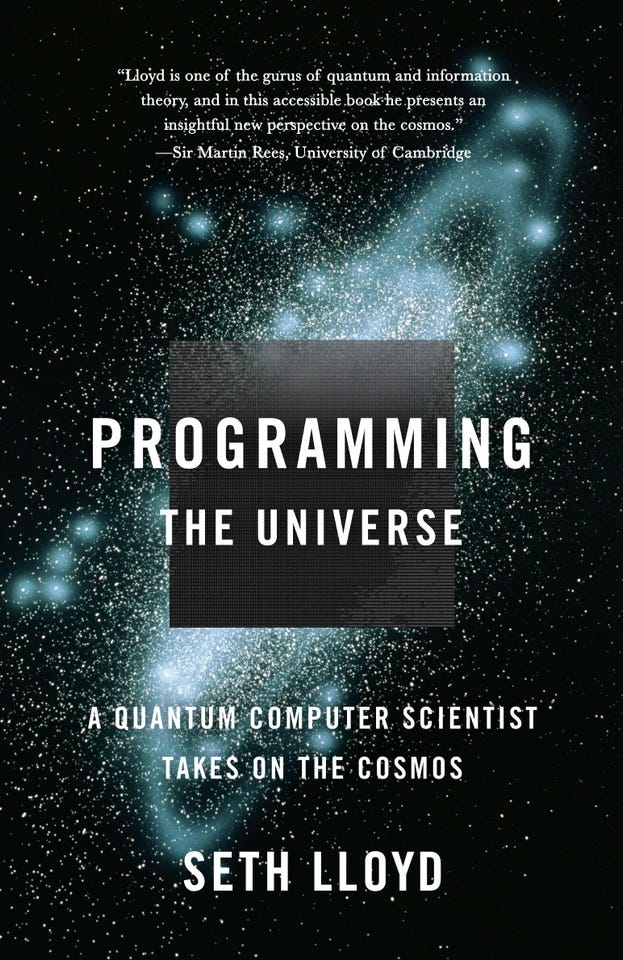
If you want to push the idea far enough you reach positions like those of Seth Lloyd who states that the universe itself is one gigantic quantum computer: “The history of the universe is, in effect, a huge and ongoing quantum computation. The universe is a quantum computer [...] What does the universe compute? It computes itself.”2 This might sound like a strange bridge too far to a reader unfamiliar with the state of science today. However, Sabine Hossenfelder, a physicist and popular YouTuber known for her critical takes, stated in the Institute for Arts and Ideas debate ‘Lost in the Matrix’:
“Does the universe in some way calculate the laws of nature? I think, and I guess most physicists would agree with me, the answer is yes. Because all of our fundamental theories are mathematical in nature. And that’s really the only thing that this statement says.”3
Nature is computable and can be thought of as some kind of gigantic computer itself. Philosophies built on appreciating the computability of nature are at least as old as Pythagoras, some 2,500 years ago. The universe is computable; is itself a computation. And that presents itself as a deep truth because it means we can expect some kind of regularity and prediction. The world can be accounted for, at least in part, by formulae.
The second can be described as simulism and is, broadly speaking, far more controversial. Simulism is the idea that the universe is the result of a computer—not itself a computer.4
There are many key differences between simulism and pancomputationalism. One of note is that simulism always carries with it the notion that there is another higher reality that is responsible for this one. “[O]ur universe runs on some Great Computer, which was built by some engineers in some larger universe.”5,6 That is because simulation theory can argue “a VR cannot compute itself—its source must lie in an underlying reality frame outside the VR.”7 This is not itself a requirement of pancomputationalism. However, Edward Fredkin’s work in pancomputationalism is an exception to the rule worth mentioning.
Edward Fredkin, one of digital philosophy’s own founders, held that our universe runs on discrete, finite processes at bottom. This is a long quote, but thankfully, an interesting one:
As to where the Ultimate Computer is, we can give an equally precise answer, it is not in the Universe - it is in an other place. If space and time and matter and energy are all a consequence of the informational process running on the Ultimate Computer then everything in our universe is represented by that informational process. The place where the computer is, the engine that runs that process, we choose to call “Other”.
Where did Other come from? This question is actually quite easy to fence with. The nature of systems of laws that can support computation is very much broader than the nature of systems that are limited to the physics of our universe. In other words, many of the properties of our world that are necessary for our world to take the form it has are not necessary for other kinds of worlds that can support universal computation. Universal computation, the kind that can simulate other general purpose computers, is even a property of all ordinary commercial computers.
[In Other] There is no need for a space with three dimensions; computation can do just fine in spaces of any number of dimensions! The space does not have to be locally connected like our world is. Computation does not require conservation laws or symmetries. A world that supports computation does not have to have time as we know it, there is no need for beginnings and endings. Computation is compatible with worlds where something can come from nothing, where resources are finite, infinite or variable. It is clear that computation can exist in almost every kind of world that we can imagine, except for worlds that are sterile or static at every level. Universal computation is essentially synonymous with the idea that something interesting is going on. Worlds where nothing interesting will ever happen are the only kinds of places that cannot support universal computation.8
Fredkin was an outlier in assuming a computer outside of our reality in his field. Seth Lloyd, working from the same pancomputationalist starting point, denies any such thing is needed: “The computational universe is not an alternative to the physical universe... The two descriptions, computational and physical, are complementary ways of capturing the same phenomena.” For Lloyd, the universe simply computes itself. Fredkin and Lloyd are both card-carrying pancomputationalists, but only one of them conjures with an Other realityframe.
These two ideas, pancomputationalism and simulism, are so regularly confused that it is important to make sure that their differences are clear. If we wanted to reduce both these positions into a single sentence we could use two working definitions:
Pancomputationalism is the position that views nature as essentially computable and/or that the universe itself is a gigantic computer that is computing itself.
Simulism is the position that views the universe as a simulation that is generated by some kind of computer that exists “outside” of our physical universe.
Once again, in pancomputationalism, the universe itself is the computer and/or the computation, and is not such a controversial idea. In simulism, the computer is “outside” our universe and is creating our simulated world for some reason, and is controversial.
There are different forms, flavors, and subgroups of both pancomputationalism and simulism. Some subgroups have overlapping commitments like nature being digital.
Pancomputationalism, in its classical/digital-physics form (Zuse, Fredkin, Wolfram), sees the universe as an enormous computer—one that is exactly the size of the universe, down to the Planck length. Its quantum-computational form (Lloyd, Deutsch) makes a narrower demand: state amplitudes stay continuous even where the underlying basis states are discrete. It does not matter if you quite understand the difference between these two positions entirely—the important point is that both treat matter as exhaustively, continuously computed. In simulism, however no such commitment is necessary as rendering-on-demand can be invoked—you do not need to compute the whole universe. Once a computer is generating a representation (i.e. something virtual that need not exist continuously) for an observer-participant rather than computing a whole universe, the vision of what the computer is computing (and what the deep nature of reality might be) changes dramatically.
In pancopmutationalism, it’s pan- that is, everything; -computationalism. In simulism, reality is virtual and as needed.
In Bostrom’s canonical text he points out that a simulation only needs to generate a convincing enough experience that is intersubjectively coherent amongst agents.9
This is a far smaller compute that needs to be fulfilled that crunching the whole universe. Even if it means computing the subjective experience of all the lifeforms on the earth! That’s obviously a smaller number than computing all the Planck volumes in the known universe. That number gets even smaller indeed once one begins accounting for natural experiences that unfold with aging like memory loss, or Markus Meister and Jieyu Zheng’s text The Unbearable Slowness of Being: Why do we live at 10 bits/s?10 They state, “Every moment, we are extracting just 10 bits from the trillion that our senses are taking in and using those ten to perceive the world around us and make decisions.” And, “The information throughput of a human being is about 10 bits/s.” Creating subjective experience might not be as expensive as we would assume.
Simulism always carries with it a challenge to object permanence simply due to the reality of computational economy. It questions matter through the lens of virtualism that things truly might merely be representational and dependent upon a more fundamental organizational system. Objects are non-continuous. In essence, simulism carries with it unique challenges to physics that pancomputationalism does not have to commit to. We normally don’t assume the universe does not exist when we aren’t looking.
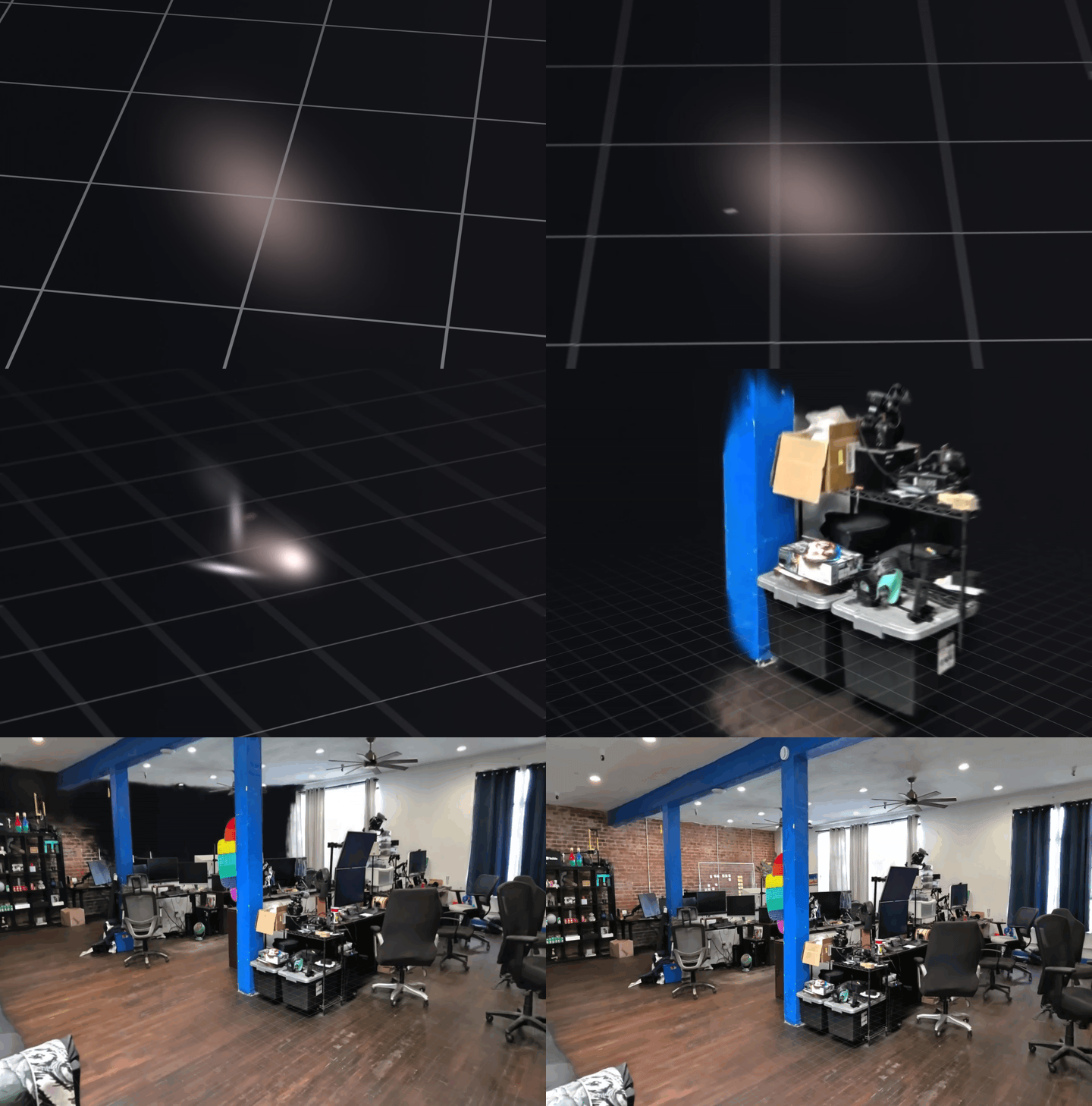
Rendering-on-demand might sound like quackery, but ask a theoretical physicist for an account of the outer edges of the field and you’ll bump into ideas in quantum mechanics that already do a version of what simulism proposes.
Both pancomputationalism and simulism are comfortable with interpreting reality as information. The information-ontology position goes back to Wheeler: “it from bit,” the idea that every “it”—every particle, every field, every physical quantity—ultimately derives its function, its meaning, its very existence from the answers to yes-or-no questions, from bits.11 Take his notion seriously and information stops describing the physical world and starts becoming an account of what the “physical world” is actually made of—information. Information as a concept is more central than matter as a concept in physics. It should come to no surprise that both pancomputationalism and simulism share philosophical provenience in Wheeler.
Wheeler didn’t stop at the metaphysics of ‘it from bit’; in the same paper he ties it straight to the observer. “All things physical are information-theoretic in origin,” he writes, “and this is a participatory universe.” Answering a yes-or-no question (running an experiment) is not taking a reading of an external world waiting for someone to come along and look at it. Measurement is an act, performed by what Wheeler calls an observer-participants rather than a spectator, and on his account physical law itself gets built up out of “billions upon billions of acts of observer-participancy.” An heir of Bohr, Wheeler made clear that we must adopt this understanding: that we do not passively observe the world. Rather making a measurement is like throwing a brick through a glass window. You have collapsed the system. An observer-participant in a participatory universe is exactly the same configuration as a player in a video game. There is no collapsed universe without a participant; there is no game without a player.
QBism is an attempt to extend more of the formal work on Wheeler’s intuitions. Like Wheeler, in Fuchs, Mermin, and Schack’s formulation, quantum mechanics does not describe an observer-independent world at all. Quantum mechanics is just a tool an agent uses to organize her own expectations about her own future experience: “A measurement does not, as the term unfortunately suggests, reveal a pre-existing state of affairs. It is an action on the world by an agent that results in the creation of an outcome—a new experience for that agent.”12 [emphasis in original] Two agents aren’t guaranteed to agree on what they’re seeing—agreement is something they develop empirically, measurement by measurement. Now, QBism is not simulism per se, but it is an information-theoretic universe model built from intersubjectively negotiated experience, and simulism finds obvious sympathy with these issues.
Simulation theory critics often mischaracterize a purely subjective realityframe in simulation theory as support for solipsism. However, that charge overlooks that intersubjective coherence is already in Bostrom’s original text as well. Agents can have agreement without an external independent world. The easiest example is low latency massive multiplayer games. Here, servers feed each user-client a subjective experience which coheres across agents’ personal feeds without issue. I hit you, and everyone can see it. But there was no world, and I had no real hand to hit you with nor you a real body, but information was exchanged through the servers and the clients. In principle, this is notion of interactivity without a shared, continuous external independent world is not foreign to us in the slightest.
Simulism isn’t even alone in putting the ontological weight on the measurement problem. Physics has spent a century unable to agree on what “measurement” means or why anything happens when it occurs—Copenhagen collapse, Many-Worlds branching, pilot waves, objective collapse, relational states: pick your poison. That reality seems to hinge on the act of observation, rather than sitting settled, waiting, and complete in the observer’s absence, is not a fringe simulist theory. It is the single most argued-over feature of twentieth- and twenty-first-century physics.
Brian Whitworth considered simulism independently, and in far more systematic form, in his 2007 paper “The Physical World as a Virtual Reality.”
A virtual reality is here considered to be a reality created by information processing, and so by definition it cannot exist independently in and of itself, as it depends upon processing to exist. If the processing stops then the virtual reality must also cease to exist. In contrast an objective reality simply is, and does not need anything else to sustain it. This suggests two hypotheses about our reality:
1. The objective reality (OR) hypothesis: That our physical reality is an objective reality that exists in and of itself, and being self-contained needs nothing outside of itself to explain it.
2. The virtual reality (VR) hypothesis: That our physical reality is a virtual reality that depends upon information processing to exist, which processing must occur outside of itself.13
Whitworth’s most useful move, for our purposes, is refusing to treat rendering-on-demand and the measurement problem as two separate curios. He ties them together directly: “if our reality is in effect a processing interface, an observer viewing an object could indeed create it... If what we call reality is a multi-dimensional space-time interface, it would likewise be expected to be calculated only on demand... Our reality could indeed be only calculated when we ‘measure’ it.”
Applied to Heisenberg, Whitworth stops sounding like merely a vogue computation-based metaphor entirely: complementary properties that can’t both be known at once sounds exactly like a screen that only renders what’s currently being looked at/engaged with, one variable at a time.
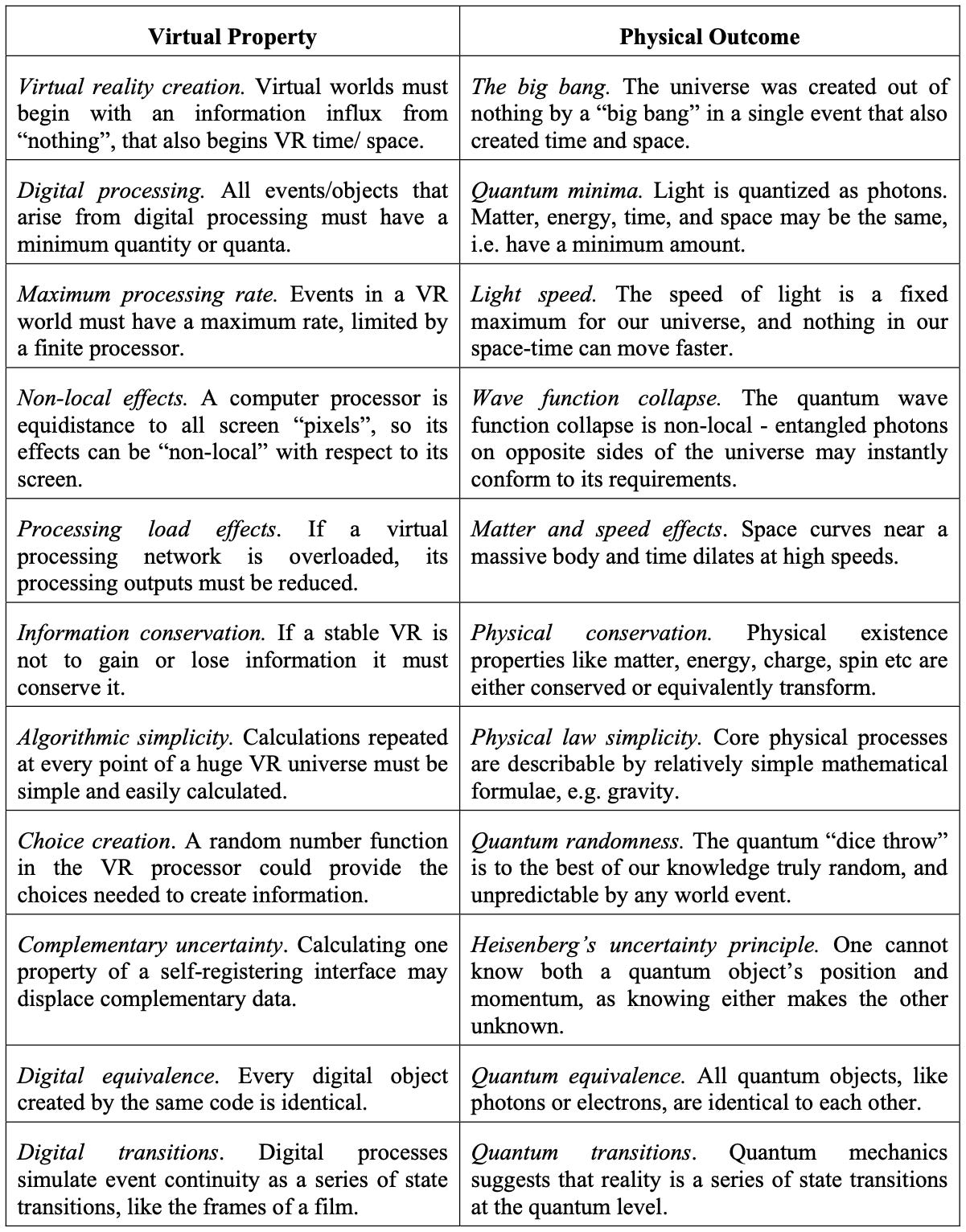
Whitworth catalogs eleven of these examples side by side, in a somewhat famous table among simulists—nonlocal wave-function collapse reads as a processor equidistant to every pixel on its screen, quantum equivalence reads as identical objects instantiated from identical code, the big bang reads as a boot-up sequence, and so on.
And the broader claim—that the seeming universe (spacetime) is not, at bottom, fundamental—is not controversial in physics either; if anything, it’s the default assumption.
Nonlocality and entanglement already violate the naive picture of separate objects with separate, local properties. The quantum Zeno effect already shows that how, and how often, you look at a system changes what that system does—physics already has observer-dependent evolution as part of its corpus. Special relativity already tells us there is no privileged, fundamental reference frame from which the “real” state of the universe could be read off. Cosmological observation affirms the universe has no center, no distinguished location, nothing like the fixed stage a “real” physical object would need.
In essence, Simulism is not asking physics to accept anything it hasn’t already accepted in one way or another. Indeed, Simulists are actually asking physics to take its own observations more seriously.
Which returns us to the key split: the hypothetical existence of a supersystem, a Big Computer, Fredkin’s Other, that supports the phenomena we experience as the World. It is important to note that posthumans, that is to say, overlords that programmed the computer, are not necessary to simulism. Bostrom uses them as a rhetorical device to get simulism on the table without deviating from physical monism—an impressive accomplishment. However, Fredkin’s Other, a formally computational dimension, does not necessarily need to be engineered externally by some higher-level computer scientists. He writes, “Other is that place that has such structure and laws as to not raise the question of its origins, as origins are a concept peculiar to our world.”
So here’s the throughline. Pancomputationalism, simulism, and the physics in between are all pointing at the same thing, just from different stances. Pancomputationalism says nature computes. Simulism says nature is computed—by something Other. And the physics in between—Wheeler, QBism, the measurement problem, Whitworth’s table of conversions, and a universe with no privileged reference frame and no center—keeps trying to develop ontologies that always seem to be Newtonifying a reality that has been attempting slough off such premeses for a century.
But what simulism, pancomputationalism, and physics all agree on: none of them treat matter as a fundamental concept anymore. Information does more work; it is a more powerful and accurate interpretive metaphor than that of massy objects occupying space. Granting that, the questions come down to: what is information; what is processing that information; and what does that say for our bigger picture understanding of reality?

Like what our original research and programming? SUPPORT US!
ALSO!? HAVE YOU SEEN OUR HILARIOUS NEW SHOW?
Piccinini, Gualtiero, ‘Pancomputationalism’, Physical Computation: A Mechanistic Account (Oxford, 2015; online edn, Oxford Academic, 20 Aug. 2015), https://doi.org/10.1093/acprof:oso/9780199658855.003.0005. Ch. 4: Pancomputationalism, pp. 51–73.
Lloyd, Seth, Programming the Universe: A Quantum Computer Scientist Takes on the Cosmos (New York: Alfred A. Knopf, 2006), p. 3.
The Institute of Art and Ideas, ‘Does reality exist? | Anil Seth, Sabine Hossenfelder, Massimo Pigliucci & Anders Sandberg’, YouTube, 1 Nov. 2021, 4:50–5:10.
Computation is possible inside of a simulated world, as in the case of virtual machines on computers. But in simulism, there is always a fundamental supersystem that supports and realizes the computation generated inside the virtual reality. Nothing about the simulation needs to be ontologically robust for computers to work “there”—the computation is real, but it is not fundamental. It is derivative all the way down to the supersystem.
Steinhart, Eric, ‘Naturalistic Theories of Life after Death’, Philosophy Compass, 10 (2015; online edn, Wiley Online Library, 28 Jan. 2015), https://doi.org/10.1111/phc3.12193, pp. 145–158.
Not every form of simulism requires posthumans, higher form engineers, etc.
Campbell, Tom, ‘Virtual Reality (VR)’, My Big TOE Glossary (online edn, my-big-toe.com, last modified 2 Aug. 2023), https://www.my-big-toe.com/theory/glossary/virtual-reality/.
Fredkin, Edward, ‘A New Cosmogony’, in PhysComp ‘92: Proceedings of the Workshop on Physics and Computation (Dallas, TX: IEEE Computer Society Press, 1992/1993), pp. 116–121, doi:10.1109/PHYCMP.1992.615507.
Bostrom, Nick, ‘Are You Living in a Computer Simulation?’, Philosophical Quarterly 53, no. 211 (2003).
Zheng, Jieyu, and Markus Meister, ‘The Unbearable Slowness of Being: Why Do We Live at 10 Bits/s?’, Neuron 113 (published online 3 Dec. 2024; print issue 22 Jan. 2025): 192–204, https://doi.org/10.1016/j.neuron.2024.11.008.
Wheeler, John Archibald, ‘Information, Physics, Quantum: The Search for Links’, in Proceedings III International Symposium on Foundations of Quantum Mechanics (Tokyo, 1989), pp. 354–368.
Fuchs, Christopher A., N. David Mermin, and Rüdiger Schack, ‘An Introduction to QBism with an Application to the Locality of Quantum Mechanics’, American Journal of Physics 82, no. 8 (2014): 749–754.
Whitworth, Brian, ‘The Physical World as a Virtual Reality: A Prima Facie Case’, Research Letters in the Information and Mathematical Sciences 11 (2007): 44–60; also released as CDMTCS Research Report 316 (Dec. 2007) and arXiv:0801.0337.