

Physicists Keep Refuting the Wrong Simulation Hypothesis
Franco Vazza's 2025 paper is technically impressive, but it does not address the basic premise of Bostrom's Simulation Hypothesis. We just published a response in Frontiers in Physics.


Franco Vazza pulled off something genuinely difficult. In his new paper, Astrophysical constraints on the simulation hypothesis for this Universe: why it is (nearly) impossible that we live in a simulation, published in Frontiers in Physics, the astrophysicist deploys the holographic principle, information-energy equivalence, and ultra-high-energy neutrino physics to demonstrate that a universe like our own cannot simulate a similar universe. It is physically impossible—the computation simply cannot be performed.
Working from the foundational principle that information is physical—meaning computation is bounded by energy and thermodynamic limits—Vazza calculates the minimum resources required to simulate the world at three different large scales. Simulating the whole universe to the Planck length, simulating only the earth down to the Planck length, and simulating the earth down to neutrino interactions.
Simulating the entire visible universe down to the Planck length (theoretically the smallest scale possible) is ruled out instantly; there simply isn’t enough energy in the observable universe to store the data required to even begin. Simulating only the Earth at full resolution (again, down to the Planck scale) requires converting an entire galactic globular cluster into pure workable energy just to get the operation off the ground. Then the same cost would be owed at every subsequent timestep. This means you exhaust all the energy in the Milky Way and then repeat every fraction of a second or so. Very heavy computing indeed if it were even feasible—but it isn’t. This cannot be done.
Those two scales are knocked out entirely before a possible computer is even considered to do the job.
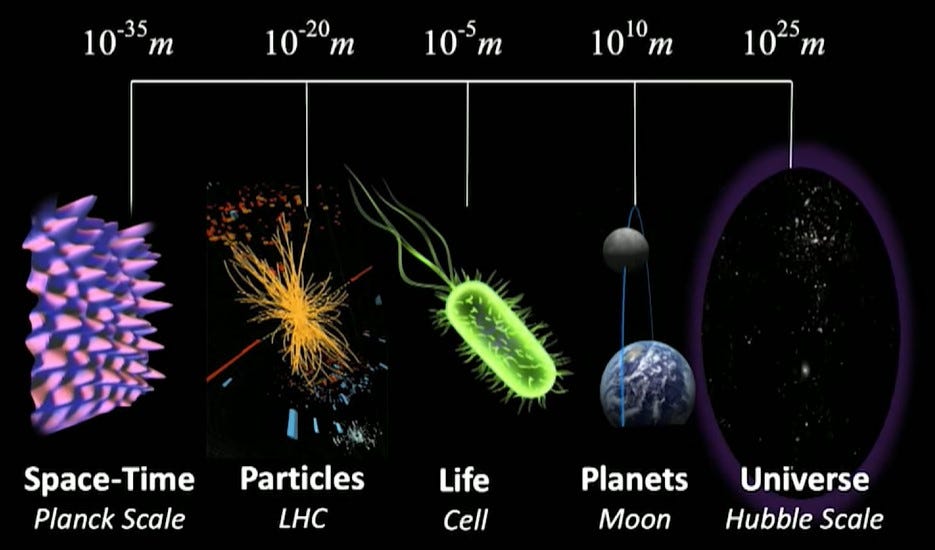
But in the most generous scenario, a low-resolution version of Earth, the results remain absurd. Simulating a single second of Earth’s history would take geological epochs of wall-clock time on the most powerful computer physically conceivable: a black hole. To reach this calculation, Vazza uses ultra-high-energy neutrinos detected by the IceCube observatory (which pass through the entire planet on their way to the detector) to set the minimum resolution scale any simulation would need to render. Even at that far lower—but still detailed—resolution, the computation required remains gargantuan.
To get an idea of just how impossible it is, Vazza offers illustrations of simulation theory’s infeasibility that approach the sublime:
[…] the initialization of a complete simulation of “just” a planet like Earth requires either converting the entire stellar mass of a typical globular cluster into energy or using the equivalent energy necessary to unbind all stars and matter components in the Milky Way.
And then elsewhere:
[...] Concentrating so much mass and energy in such a limited volume will inevitably produce high levels of energy emission and heating, as in standard black holes and their related accretion disks.
Vazza’s three conclusions are likely correct, clearly derived, and probably useful. All in all it’s a fine technical work. In fact, it very well might be the final nail in the coffin for something—but it is not the coup de grâce for the simulation hypothesis that it repeatedly claims to be. Rather, what Vazza's efforts demonstrate is that a form of pancomputationalism—the idea that the whole universe is reducible to physical information—cannot be crunched by a computer that operates using the same physics that we know and measure every day. This is what he really achieves, not the death of the simulation hypothesis. Far from it. In fact Vazza’s whole attempt carries with it conclusions about the simulation hypothesis that Bostrom never put on the table and that no simulation theorist would ever take seriously—like crunching the whole universe down to the Planck length.
The Same Argument Keeps Getting Made
Before we get to Bostrom’s actual framing, it is worth pointing out that the frustrating thing about Vazza’s paper is that this is not a new mistake—it is the mistake. Those who work on simulation theory have been watching this same argument being made over and over again for twenty years now.
Michio Kaku made a similar argument to Vazza’s using more humble scales in a 2023 Big Think video, confidently announcing: “You’re talking about 10 to the 25 just to model the atoms inside a goldfish bowl... We do not live in a computer simulation. Sorry about that.”
Before Kaku, Sabine Hossenfelder declared the simulation hypothesis “pseudoscience” using climate models as her example, noting that we can’t even resolve the weather at distances below 10 kilometers computationally. There is simply too much information to crunch at just that scale. Tim Lou argued that no conceivable improvement in computing power could close the gap, after calling the hypothesis “lousy”. Further, MIT’s Seth Lloyd argued that an exact simulation of the universe would have to be the size of the universe. Jonathan Bartlett noted that any perfect simulation requires more substrate than what it’s simulating (29:40 in the link). Ringel and Kovrizhin proved that simulating a few hundred electrons would demand more memory atoms than exist in the observable universe.
We’ve heard these arguments before. While it is something of an improvement that physicists have moved on from claiming the simulation hypothesis is unfalsifiable to claiming to have falsified it completely, it would be better if they would try to falsify the version of simulation hypothesis that is actually on the table.
Point of fact: every single one of these critiques is a bottom-up physicalist argument. Every single one of them refutes a strawman. And every single one of them has been published or broadcast in the spirit that the debate is settled. These conclusions are pushed as assurances to the public that there is nothing to simulation theory, it’s basically stupid to even consider it, and you can all put the menace out of your minds.
What these critiques reveal is twofold. One is a basic, ingrained disciplinary habit—physicists are naturally trained to think from the ground (the substrate) up. This is how we all became cosmological physical-materialists in high school: particles build into atoms, atoms build into molecules, which build into chemistry, which builds into life, planets, stars, galaxies, and the universe. That’s bottom-up. When physicists look at the simulation hypothesis they see a claim about physics—a claim that they instantly assume must mean that the whole universe is computed somewhere, by something, in full physical detail all the way down and all of the time. But that is not the same simulation hypothesis that Bostrom laid out—and yet it is the very one they all cite and claim to have refuted.
The second thing these critiques reveal is that they haven’t really read the literature that they’re so loudly critiquing, otherwise they wouldn’t dare make these kinds of arguments at all.
What Bostrom Actually Argued
In the 2003 paper that concretized the discourse and launched a million late-night debates, Are You Living in a Computer Simulation?, Nick Bostrom explicitly and preemptively addressed the computational resource problem that Vazza and company base their critiques on. In fact, Bostrom structured his entire argument around it, stating “Simulating the entire universe down to the quantum level is obviously infeasible, unless radically new physics is discovered.” His exact words:
But in order to get a realistic simulation of human experience, much less is needed – only whatever is required to ensure that the simulated humans, interacting in normal human ways with their simulated environment, don’t notice any irregularities. The microscopic structure of the inside of the Earth can be safely omitted. Distant astronomical objects can have highly compressed representations: verisimilitude need extend to the narrow band of properties that we can observe from our planet or solar system spacecraft. On the surface of Earth, macroscopic objects in inhabited areas may need to be continuously simulated, but microscopic phenomena could likely be filled in ad hoc. What you see through an electron microscope needs to look unsuspicious, but you usually have no way of confirming its coherence with unobserved parts of the microscopic world. Exceptions arise when we deliberately design systems to harness unobserved microscopic phenomena that operate in accordance with known principles to get results that we are able to independently verify. [emphasis added]
What Bostrom’s simulation hypothesis does require is far more modest than simulating the whole universe: simulate only what’s needed to sustain convincing and lawful inter-subjective experiences for the agents. That’s it.
So the target of the simulation, under this framing, is not physical reality—it is experience. In this way, it is akin to thinking about immersive virtual reality as opposed to computing a whole universe down to a maddening level of granular detail everywhere and all the time. That means you never have to render a whole universe entirely, because there doesn’t need to be a whole universe to begin with! Only your first person subjective experience needs to be rendered in a convincing way—even if your job is to run quantum experiments all day long. Those experiments only need to comport with the ruleset, and match up (more or less) with what other agents report too.
That means the question is not whether you can run a physics engine on the whole cosmos down to the microphysical level. The question is whether you can maintain coherent, anomaly-free subjective experience for a finite number of conscious agents. Those are not the same questions. They don’t even share the same assumptions!
An easy way to think of it is that a video game does not simulate the molecular structure of the walls. It only has to render what the camera sees, and the walls’ effect on other ‘objects’ and ‘forces’. A video game does not need to have real physical objects made of molecules in them to simulate what would happen if a virtual car crashed into a game wall. Bostrom’s simulation is the second kind. Vazza’s refutation targets the first kind. This is Vazza’s target problem—and it’s the very same target problem every other physicalist critique makes when it comes to the simulation hypothesis. They all assume because we experience physics, that all physics must be computed at all scales everywhere all the time. That is not part of Bostrom’s original paper.
What About Physics?
Bostrom has degrees in physics, astrophysics, and general relativity—so he obviously accepts that physics matters and that there is some kind of ruleset in play in the simulation. From within that simulation, the ruleset would be represented in no small part by physics. And what happens within the simulation has to be consistent enough for the agents experiencing it so that given causes have more or less predictable effects. If I look for an apple, I shouldn’t find one on an orange tree. If I induce an electron to drop from a higher energy level to a lower one, I better get a photon of light out of the deal. Things need to make sense here—the logic-chain has to appear consistent, because consistency makes immersion possible.
Within the simulation, then, it is perfectly reasonable for particularly savvy agents to discover the rules, describe them, and take advantage of them in effort to make technologies. After all, rules are rules whether you are throwing a stone, or bouncing a microwave off of a satellite. A central caveat to Bostrom is that the simulation should be “anomaly-free.” In part that means once we discover the rules, we should be able to exploit them reliably, because the simulation should abide by a guiding consistency. Once an agent understands apparent causes have apparent effects they can use them to their advantage. That’s what it means for the simulation to be anomaly-free: it should be consistent.
It doesn’t mean that you need to have a fully simulated universe choked by a sea of quantum operations happening all the time everywhere to have an effective experience of a universe. All it really means is that if your agents are smart enough to use the rules of the simulation to their advantage, then that’s something that they are allowed to do. As they perform their tests and perfect their technologies, things will appear to them as virtually seamless. Once again, that would have to be a feature for the simulation if it is to be immersive and believable. It must be highly detailed when queried. But just because you can measure and exploit the dynamics of a simulation, does not mean that those dynamics—the simulation’s physics—are at all fundamental. All it means is the game map and its effects definitively must appear real for agents while they are engaging them.
 Tiktok failed to load.
Enable 3rd party cookies or use another browser
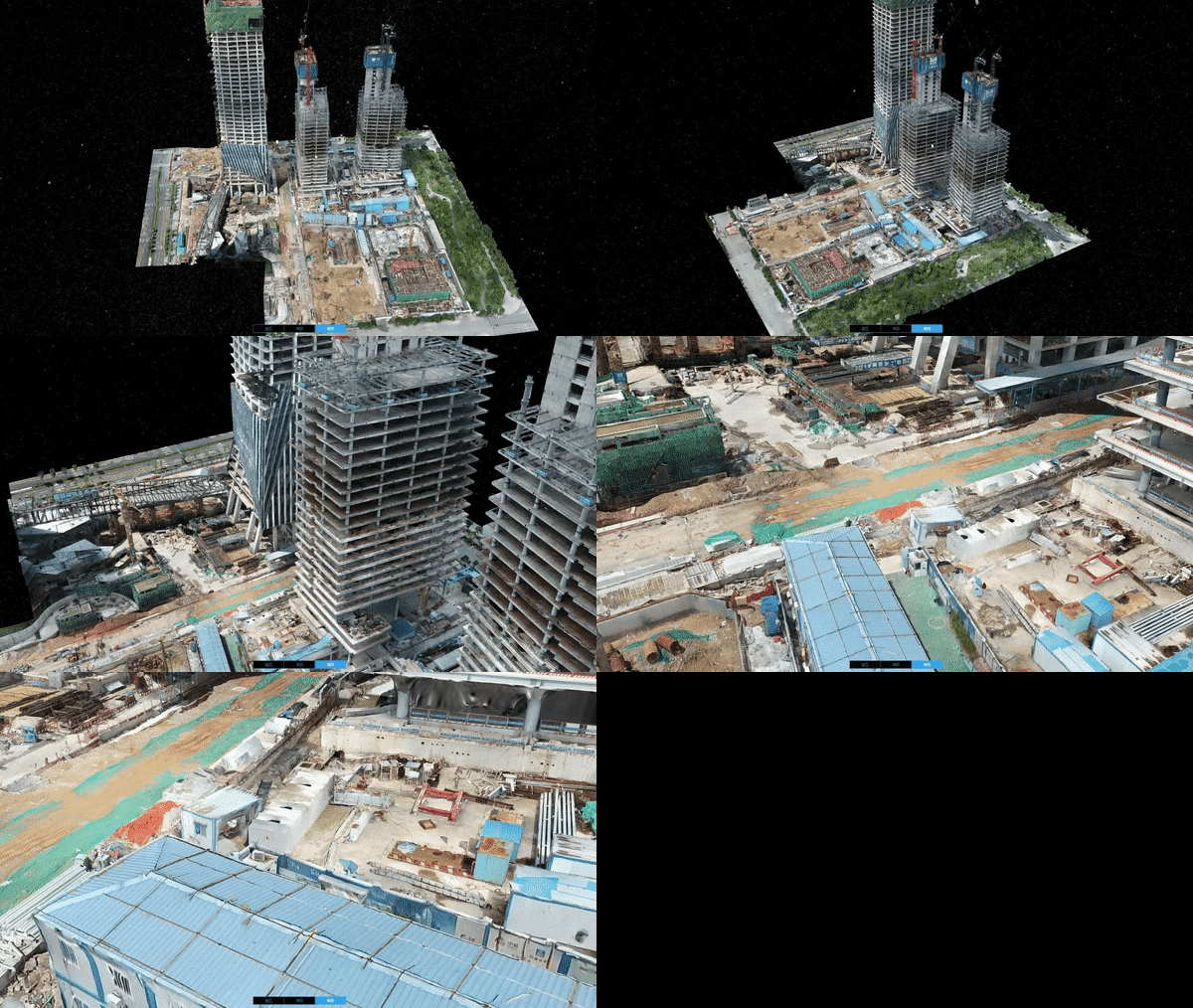
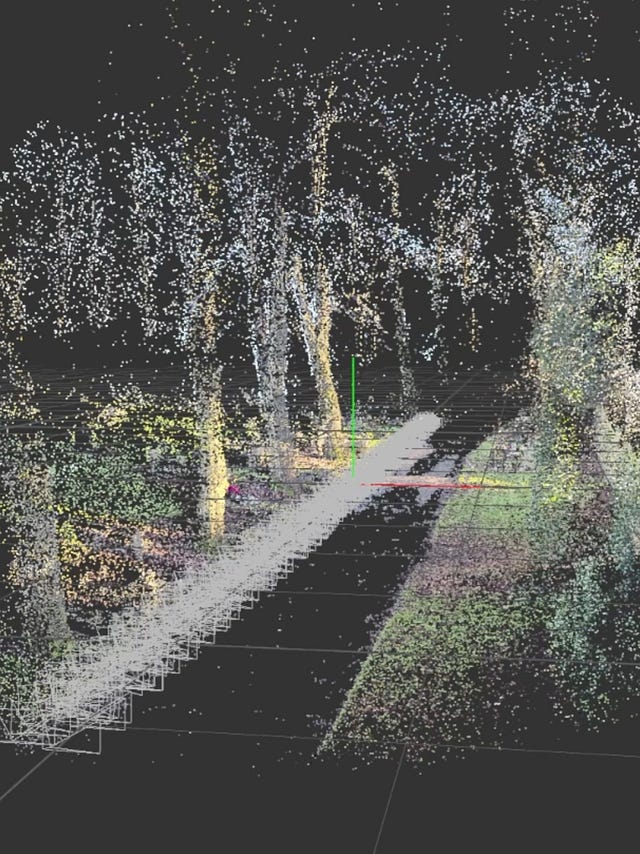
This is rendering-on-demand, and in simulation theory, the only things that ever really need to be rendered are the immediate elements: you never need to calculate a whole planet, you just need to calculate what the satellite will see. Think of it like a dream. Your dreams do not need to create a whole planet for you to have an Earth-like experience. It only appears that way.
You don’t need to crunch the cosmos. You just need to simulate something like you are experiencing right now by artificial means. The simulation hypothesis persists in part because so far it has not been conclusively proven to be impossible (or even unlikely) that experience as such can be simulated.
What Vazza Himself Admits
To his credit, Vazza is more candid than most physicists in this tradition about what his argument actually reaches. However he only comes clean in the conclusion.
His conclusion names his target precisely: he has ruled out what he calls the “Matrix scenario”—a simulation produced by future descendants or machines in a universe that obeys physics like our own. To be clear, it is a specific, maximally demanding variant of the simulation hypothesis—maximally demanding not because the simulating universe must share our physics, but because the simulation itself is assumed to need to compute physics all the way down to tiny scales, everywhere at once. But that is not Bostrom’s proposal, despite citing him. Vazza claims to have “confidently” refuted this Matrix version. However, fans of the film will point out that the simulation in the Matrix only shows us an unnamed city and some mountains glimpsed in the second film. Neo never flies out into space and the physics of that world appear as largely mutable—remember, there is no spoon. “This steak does not exist.” Cypher makes it clear, “The Matrix is telling my brain that it is juicy and delicious.” So to even claim to have refuted the Matrix-specific scenario is questionable as well.

Vazza anticipates objections to quantum computing (but that doesn’t help because limits come from thermodynamics, not hardware) and to parallel processing (also doesn’t help—Lloyd’s result shows that spreading energy across more processors just slows each one down proportionally). Vazza even runs a Monte Carlo simulation—asking what the fundamental constants of a simulating universe would need to look like for the whole enterprise to be feasible. He does find that workable combinations exist, but they require a universe with physical constants differing from ours by many orders of magnitude.
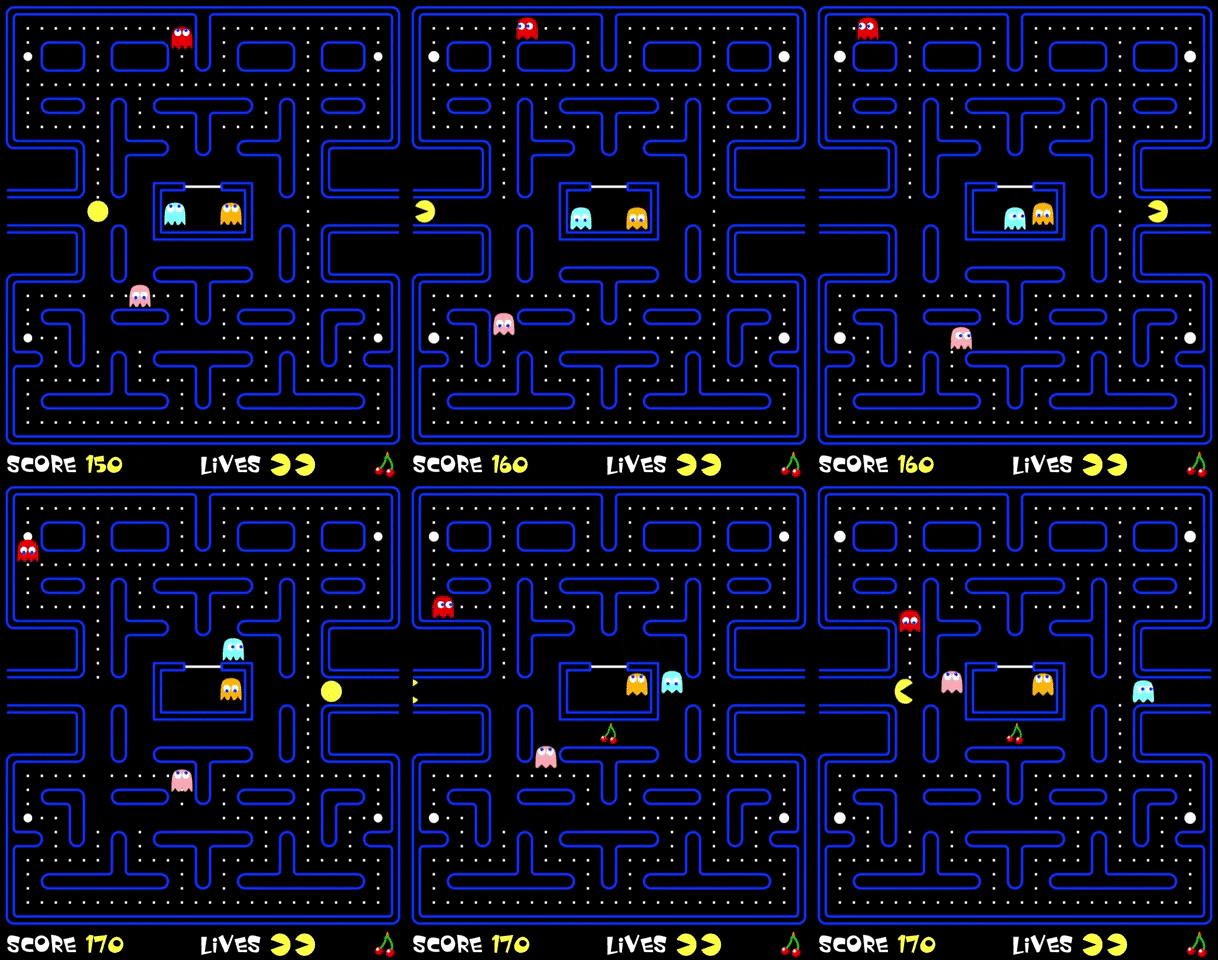
That result concedes more than Vazza seems to realize. The simulation hypothesis isn't ruled out in principle—only for universes that play by our physical rules. And in Section 4.6 he goes further still, acknowledging that if the simulating universe operates under entirely different physical laws, the question becomes “entirely outside of what is scientifically testable, even in theory.” He illustrates this with a Pac-Man analogy: conscious beings in a 1980s arcade game could never deduce the existence of gravity, a third dimension, or expanding spacetime. They would have no framework for reasoning about the substrate running them. Neither, by extension, would we. Vazza's methods work only on universes that already share our physics playbook—which is precisely the assumption his argument needs to justify, not just flatly assume.
It should also be noted that Vazza does briefly acknowledge the experience-only variant of the simulation hypothesis—the relevant one on the table—and attempts to dispatch it in a single paragraph. His move is to suggest that shared, consistent experience between multiple agents would “quickly escalate” into something as computationally demanding as his planet-level simulation once physical experiments are involved. However, this is not an argument. It is an assertion—he simply declares the escalation happens and moves on. The escalation from “agents need coherent shared experience” to “therefore Planck-scale computation is required everywhere at once” is exactly what is in dispute, and exactly what Bostrom’s rendering-on-demand framework denies. Simulation theorists will tell you that shared consistency doesn’t require a globally pre-computed world. It requires local coherence at the point of inquiry: the electron produces the photon when asked, the wall is solid when walked into, the sky is blue when looked at. If you’re not measuring atoms there are no atoms. It is a virtual reality. There is no moon. Nothing in that picture demands the unobserved interior of the Earth be running at any resolution while no one is probing it. Vazza’s escalation only works if you already accept the bottom-up physicalist framing, assume the microphysical chain is truly ontic (that is to say really real) and thereby prove the thing you’re supposed to be proving. The result is one throwaway paragraph standing in for the one point of engagement that actually matters to the simulation hypothesis.
However, the simulation hypothesis proper generally refers to Bostrom’s proposal (which Vazza cites)—can experience be simulated? Whatever the answer to that question may be, we believe we can comfortably infer that it is almost certainly far less than what Vazza has calculated at any of his chosen resolutions.
As Bostrom himself recently noted in his Simulation Argument website’s FAQ: “Critiques based on the assumption that a simulation would have to be fully comprehensive (e.g. Vazza (2025)) thus miss the point.”
So What Would Actually Refute the Simulation Hypothesis?
The question seemingly nobody in the physicalist camp has deeply considered is whether experience itself can be simulated—not physics, not planets, not neutrino propagation, just the first-person stream of experience as such at convincing enough inquiry-specific levels of detail. As one simulation theorist and NASA physicist, Tom Campbell puts it, you don’t have to render all the quantum and chemical reactions happening inside all of the stars in the night sky; on the contrary, “Dots of light are cheap.”
Bostrom’s argument lives or dies on the philosophy of mind, not on astrophysics or quantum mechanics. Refuting it requires engaging with questions about consciousness, subjective experience, and what computational processes would or wouldn’t be sufficient to sustain them. There is also the matter of the intrinsic nature argument—the philosophical position that physical descriptions of the world, however complete, leave open the question of what matter fundamentally is at its base. That we don’t know. All we know is how matter interacts with matter—but that doesn’t tell us anything about what’s underneath the interactions themselves. If the intrinsic nature of the physical world is itself experiential or informational in character (as some philosophers have seriously argued it is) then the very substrate that physicalists invoke to rule out simulation may be itself closer to mind rather than matter. This is not a settled question, and it is precisely the kind of question simulation theory forces us to ask. (In fact, Bostrom brings up the word mind over twenty times in reference to mental experience being rendered, not the cosmos.) These are the hard questions that define simulation theory’s actual philosophical commitments. These are the issues that one must engage with. They don’t yield to the holographic principle, or the Bekenstein bound, or to the question of whether or not information is physical. These concerns, the concerns of physics, become irrelevant to the argument of whether or not experience can be artificially generated.
Vazza’s paper is not without value—it places genuine and novel limits on the misnamed “Matrix scenario”, and the neutrino physics does give us an important benchmark for how deep a pancomputationalist interpretation could go. But the scenario Vazza chose to refute was never what the simulation debate was actually about. It’s the simulation hypothesis as a physicist imagines it: a physically comprehensive, bottom-up, globally consistent rendering of the cosmos, produced by a civilization that operates under our laws. Refuting it is something of an accomplishment. But, as we have shown in our Commentary, it is not the framework that is actually proposed, nor is it being claimed by serious simulists.
However, what Vazza, Kaku, Hossenfelder and the like are absolutely guilty of is misrepresenting the simulation hypothesis by refuting a strawman, and sharing their conclusions far and wide. This is more than unfair to both simulation theorists and the public at large.
The simulation hypothesis, as originally formulated, requires simulating subjective experience. Full stop. That problem is still wide open. And astrophysics, however impressive its tools, is simply not the right instrument for it. If anything should be investigated it’s the cost of computing experience as such. But before assuming that surely crunching what we experience must be hugely expensive, prepare to be humbled by research like Markus Meister and Jieyu Zheng’s The Unbearable Slowness of Being: Why do we live at 10 bits/s? They state, “Every moment, we are extracting just 10 bits from the trillion that our senses are taking in and using those ten to perceive the world around us and make decisions.” And, “The information throughput of a human being is about 10 bits/s.”
Many of us feel that the visual scene we experience, even from a glance, contains vivid details everywhere. The image feels sharp and full of color and fine contrast. If all these details enter the brain, then the acquisition rate must be much higher than 10 bits/s.
However, this is an illusion, called “subjective inflation” in the technical jargon. People feel that the visual scene is sharp and colorful even far in the periphery because in normal life we can just point our eyes there and see vivid structure. In reality, a few degrees away from the center of gaze our resolution for spatial and color detail drops off drastically, owing in large part to neural circuits of the retina. You can confirm this while reading this paper: Fix your eye on one letter and ask how many letters on each side you can still recognize. Another popular test is to have the guests at a dinner party close their eyes, and then ask them to recount the scene they just experienced. These tests indicate that beyond our focused attention, our capacity to perceive and retain visual information is severely limited, to the extent of “inattentional blindness”.
And elsewhere:
Jieyu Zheng, a graduate student in Meister’s lab who co-authored the commentary, says she was not initially convinced by the estimate they calculated [...] ”But then I found this shockingly small number in almost every behavior,” she says, after they determined the bit rates for other timed behaviors reported across the psychology literature—including reading, playing video games and memorizing numbers.
This processing rate is 100 million times slower than that at which sensory information comes into the brain, leaving a huge gap between what the brain takes in and what it uses.
“We call it the largest unexplained number in brain science,” Meister says.
Sure, it may turn out to cost a lot to compute those 10 workable bits per second—but whatever that cost turns out to be, it is almost certainly many orders of magnitude less than calculating physical reality at the Planck scale across the whole universe. Experience, we believe, is unlikely to be that expensive even at its most depth-defying. An important question to the simulation scenario would be: is the “trillion” bits that our brain is supposedly filtering into 10 workable bits actually exist on their own, or is it merely the 10 workable bits that are truly rendered?
In the last analysis, what the simulation hypothesis seems to demonstrate is that physical science, by its own methods, cannot distinguish between a universe that is fundamental and a universe that performs whenever engaged. Aye, therein lies the rub. That has to be incorporated into the debate if one is to even take place.
It has been over twenty years. Imagine if it were your own field. Imagine how tired you would be. Not only tired, but disappointed. We philosophers love a good fight, and so far we’ve seen a lot of claims and a lot of gloating that has nothing to do with the core issues of our discourse. As far as we are concerned, you haven’t even entered the ring yet.
Our honest hope is that our Commentary will help put an end to this two decades long misrepresentation of an active and lively discourse that many call home. With that in mind, our closing word for now will be this: if you wish to refute simulation theory, if you are actually interested in engaging with this topic authentically, we must insist that you begin with the actual letter of our literature before declaring yet another empty victory.
For the curious visit simulism.com where we monitor the situation on simulation theory.
This post is based on a commentary published in Frontiers in Physics: Edge, E. & Brown, C.A. (2025). “Commentary: Astrophysical constraints on the simulation hypothesis for this Universe.” doi:10.3389/fphy.2025.1561873
 | A guest post by
|
The easier explanation is a multiverse where ours is a small fraction of a larger computer. If the layer above ours has Graham's number ofnparticles to work with at 1000x the speed of light, then one can easily do a full perfect Planck length simulation...even in an Everett Many Worlds version.
Yes, this is not a great objection, but I would also test there aren't any real ways to "disprove" simulation ideas and that's what makes them not scientific hypotheses, but philosophical ones. In particular, *any* finite stream of experience could theoretically be simulated by a suitable simulating computer. The key word is "finite" - there's some very precise theoretical math arguments that can be made here. Even better, the size of the program can be bounded: suppose you have an entire "videotape" of your lifetime. A program that simply emits that videotape hard-coded, is formally a program that "simulates" your lifetime - and that is clearly very small in "astronomical" terms, thus a program that does it with generalizable rules is just even smaller. It's just much, much larger than any program we have ever written. So actually, yes, it's possible - but I'd also argue what do you get with explaining power, because *anything* could be simulated in the simulation. I suppose it does something like maybe it increases reductionism, by reducing mind to the mere flipping of bits inside someone's giant computer, which could be deleted by the throw of their switch. Heh ...