


So you want to know more about simulation theory? Why are so many people willing to entertain such an exotic-sounding idea? Have they seen too many late-90s movies? Is there anything really to it? Are these people just… you know, confused? Well, like any other concept, if we want to approach it sincerely we might consider its intellectual lineage; the history of ideas that encouraged its development. But mapping a genealogy of simulation theory begins with the interesting problem of where to start.
Shall we begin with the Gnostics? The Buddhists? Maybe with Pythagoras, the Upanishads, or Plato? The honest answer is that simulation theory in its current, computational form is a late 20th-century invention. But before computers came on the scene, there were, of course, philosophers interrogating the world before their eyes. Since recorded history, thinkers have asked: What is the world made of? How are things sustained? What is the mind? What can possibly offer an account of things? And what am I actually looking at right now here in front of me?
The ideas that would influence simulation theory begin across the ancient world. Long before anyone had a computer, thinkers from unconnected traditions kept running up against the same suspicion: that the world in front of us is not, in the last analysis, the last word on what’s real—and that something deeper and more fundamental lies behind or underneath the world of appearances.
This lengthy blog post (about 52-pages, single-spaced) is an effort to cover the history of these ideas in a general way. Here you’ll find the earliest recorded interrogations on matter and appearance, through the philosophers who turned that doubt into rigorous methodologies of inquiry, into the century that built an actual machine capable of generating interactive micro-universes all its own, and up to the physicists and philosophers still debating the issue today.
This was originally going to be called The Fast and Dirty Guide to Simulation Theory. While this is not at all fast by today’s standards, it is dirty insofar as it is non-exhaustive. That’d be something closer to a textbook. This is for those folks interested in getting a better handle on simulation theory in general, even if your interest is in dismantling it. In fact, this was assembled for both fans and critics alike, because there are just so many misconceptions and assumptions about simulation theory afloat in both scholarship as well as among general audiences, that it is worth the effort to lay out a rough history of the concept so we all know what we are really talking about—as opposed to what we think we’re talking about.
Like any history, it is not a clean stacking of ideas, one naturally leading to the other. There are eddies thinkers get lost in. Ideas emerge that inform others, but themselves do not flower for long. This history is more like a fleet of boats heading in a general direction, but that do not all find home in quite the same port—some, not even in the same hemisphere. But these thinkers do share similar enough concerns to be included in a history of simulation theory.
For something book-length, consider Dr Rizwan Virk’s The Simulation Hypothesis: an MIT Computer Scientist Shows Why AI, Quantum Physics, and Eastern Mystics All Agree We Are in a Video Game, or Dr David Chalmers’ Reality+: Virtual Worlds and the Problems of Philosophy. For the rest of you, here’s a bookmarkable blog post that we hope you find useful, if not at the least interesting.
To begin, we’ll allow Hans Moravec, one of the founders of simulation theory, to set the stage:
What is reality, anyway? The idea of a simulated existence is the first link in our disturbing chain of thought.
Enjoy!
What is Simulation Theory?
Simulation theory, or simulism, is a late-20th, early-21st century movement in science and philosophy that examines the possibility of our experience as the constructed result of a computer external to our “universe.” Simulation theory is often confused with pancomputationalism, the approach that the physical universe itself is a kind of computer or computation. The idea of being trapped in a compelling computer simulation is first worked out philosophically by Stanisław Lem in 1964; in 1977 Philip K. Dick declared to a crowded room, “we are living in a computer programmed reality” and elaborated from there; in the 1990s Hans Moravec starts to generalize the concerns; and it becomes an in-depth field just a few years later in 2003 when Nick Bostrom, David Chalmers, and Tom Campbell all publish groundbreaking work on the subject.
Simulation theory would open with divergent concerns, explorations, and metaphysical arrangements. For instance, in some versions a perfect simulation, down to the molecule, is considered. In others, the simulation is more like a virtual reality, so only what a player looks at is computed at any given time. In some versions, there are other beings—programmers that reside outside of the simulation alongside their super advanced computers. In others, there’s no need for such beings at all. And others still profess that the computer itself is like an AI, but even more advanced: in fact, it is consciousness itself.
With such diversity, it is vital to come up with some kind of criteria that can provide us with a framework to point at something and be able to say with a fair degree of certainty: this is simulation theory. We’ll offer three:
A computational supersystem.
A subordinate subsystem.
You might be in one.
1. A Computation Supersystem
All variants of simulation theory must suggest the existence of a computer from which our world is generated. The universe itself cannot be both the simulation and the computer, because they are then identified as the same thing: there is no simulation in that case, there is just the computer computing. Further, as we shall see, there are other problems with equating the computer with the simulation, as no where in computer science does such an attitude hold. The computer is separate from what it generates and is more fundamental than the simulation in the ontological hierarchy.
2. A Subordinate Subsystem
All variants of simulation theory must suggest that there is a simulation, and that this simulation is generated by such a computer. This subordinate system cannot exist on its own, as it is the supersystem’s own output. It is entirely dependent on the supersystem in absolutely every way. It is generated from the supersystem. It is a simulation insofar as it is nonfundamental in relation to the supersystem. It is a simulation also in that it must be an informational-based reality. It would be wise to end this definition here to allow room for the sheer variety already in the field regarding the specifics of how the simulation itself is computed (what are each versions requirements, features, limitations, rules, purposes, etc).
3. You Might Be in One
All variants of simulation theory must suggest we might be in one, because without it, we could have been discussing a video game. A version of simulation theory (or a theorist for that matter) is not required to affirm that our experience is the result of a computer simulation; however there must be room within it for some probability that it is true—even if that probability is small.
In a nutshell: a candidate for simulation theory must postulate that there is a big computer somewhere that generates simulated realities and we might in fact be in one. Have that in your ontological makeup and you probably have some kind of simulation theory on your hands.
Any candidate for simulation theory is also going to be an information-theoretic model. John Archibald Wheeler is likely the most well-known proponent of the position with his famous “It from Bit.” This means that information is understood to be the fundamental dynamic of the cosmos. Information is more central, more important than any notion of “matter.” (Indeed, “matter” might be woefully naïve when we’re talking about a world generated by a big computer somewhere.) All three items on this proposed simulation theory criteria list are, in fact, claims about information-theoretic conditions. The computer is obviously some kind of information processor. The simulation is made of information since it comes from the information processor. And our experience and even ourselves too would also fundamentally be made of information coming from that very same processor should it be true that we’re in a simulation. (Even if we are all just brains in vats being fed a simulation, our experience and sense of self would be entirely based upon the information the computer provides through stimuli.)
This is what simulation theory should be at a bare minimum.
Now, before simulation theory was formalized, there were hunches, ideas, and discoveries that sound a lot like simulation theory. The question becomes: where to draw the line? In the case of say Christian Gnosticism we have basically a programmer at a higher level that creates an artificial world that human beings are trapped in/subject to. Should we call this a version of simulation theory? Or when Hindus or Buddhists describe the world as ultimately something like a virtual reality experience, should these schools of thought be called simulation theory?
To be useful, the answer has to be no. However, they cannot be overlooked, nor can they be dismissed. As we will see, the ideas that sound almost exactly like simulation theory have existed since some of our earliest texts. Therefore, we cannot have an honest history of simulation theory without them. So, how can we introduce a split?
The two features that make simulation theory distinct are that it is always (1) an information-theoretic ontology coupled with (2) a big computer. That is what makes simulation theory different from, say, a big mind imagining a world peopled with little dreams. It also means simulation theory affirms that the universe is ultimately constrained by computational rules, as opposed to no rules, arbitrary rules, or even God’s rules. And because digital computers can’t hold a true continuum, only approximate one, the universe is at bottom likely finite and discrete rather than infinite and continuous. Granularity eventually arrives with its irreducible chunks: bits. That makes it simulation theory proper, rather than us being a dream in the mind of God.
For simulation theory to be meaningfully distinct it must incorporate computer science into its ontology. I am not sure there is a metaphysics in the ancient world that does so in exactly the same way that simulation theory does. As we will see in the following entries, there are many ideas that sound like “living in a computer simulation” long before the idea was ever formalized. To be able to understand these earlier concepts as distinct and within their own traditions is essential. The fact that they sound so similar to simulation theory really only means that humanity has been considering this kind of possibility for a very long time.
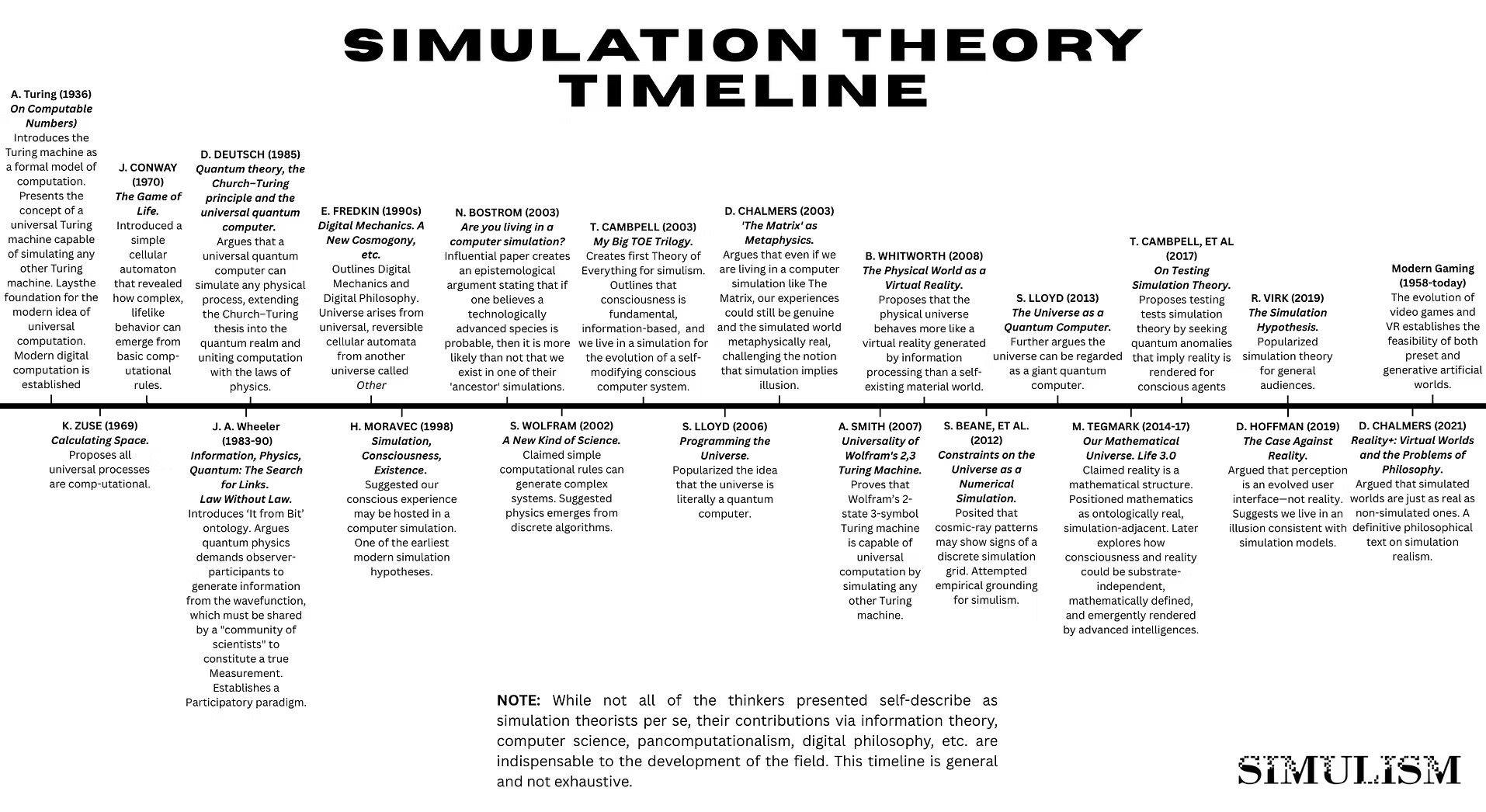
Before the Machines
The Ancients
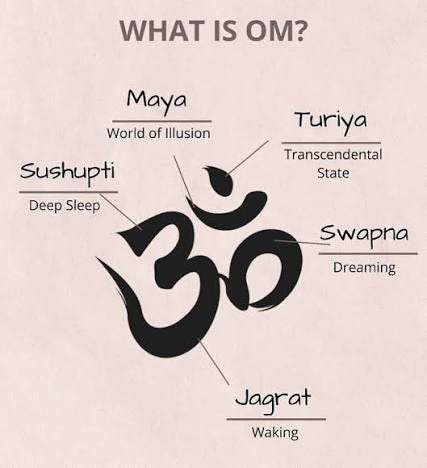
Rig Veda (1500–1200 BCE)—Maya
The Rig Veda are ancient Sanskrit holy books. In them we find maya. The word’s earliest attested meaning is something along the lines of a generative power by which gods bring physical form into being and hold the world’s order in place. Sanskritist William Mahony’s read on this earliest sense, in The Artful Universe (1998): “the wondrous and mysterious power to turn an idea into a physical reality.” Maya is a magical projection that results in the world. The Shvetashvatara Upanishad describes Brahman (the ultimate, all-encompassing reality underlying the cosmos in Hindu thought) as the one who “casts his net of appearance over the cosmos.” Later, maya would be reinterpreted to mean illusion. Modern scholars, including Radhakrishnan, read this later sense, mithya, as closer to “dependently real” rather than to just flat illusion; Shankara’s own formula, through Advaita Vedanta, is simpler: Brahma satyam, jagat mithya: meaning Brahman is real, the world is mithya (dependently real). Later still Erwin Schrödinger, founder of quantum mechanics, adopted this exact doctrine as his own metaphysics (mediated this time through the Eastern-inspired Schopenhauer and the Sanskritist Paul Deussen) and stated the core maya claim almost verbatim as his own position about reality: “the plurality that we perceive is only an appearance, it is not real.”
No explanation of maya can be complete without covering the story of Narada. Narada asks Lord Krishna to reveal to him the true meaning of maya. Krishna agrees, but asks Narada for a cup of water. Narada goes to the closest house where he meets a woman so beautiful that he completely forgets about his question, marries the woman (this guy!), has several kids with her, inherits a business, and builds a very happy life. Years pass and a terrible flood wipes everything away, including Narada’s whole family and everything he’s built. In total despair, Narada suddenly finds himself standing at a well, looking down at his own reflection in a pool of water. No time has passed. He hasn't lived that life at all. Krishna appears before him, “This is maya.” Maya can be thought of as involving play as we interact with it (life) like a drama or a comedy; we live our lives like a role, and we interact with the world like an endless game of discovery: how do things work, what will happen next to us, what do I really care about, who do I believe I am, what’s the big picture? Maya is experience delivered to our souls in the form of the world to help us understand choice, our own minds, beliefs, and impermanence. What Narada experienced at the mouth of the well today we might be tempted to describe as something of a simulation. Maya is the seed of what will become so many schools of thought—simulation theory being but one of them.
Maya is our first recording of the world as not the world but as a kind of great magical act. But that concept itself may prove to be even older, as one can imagine such a worldview finding home in the earliest cases of shamanism and animism.
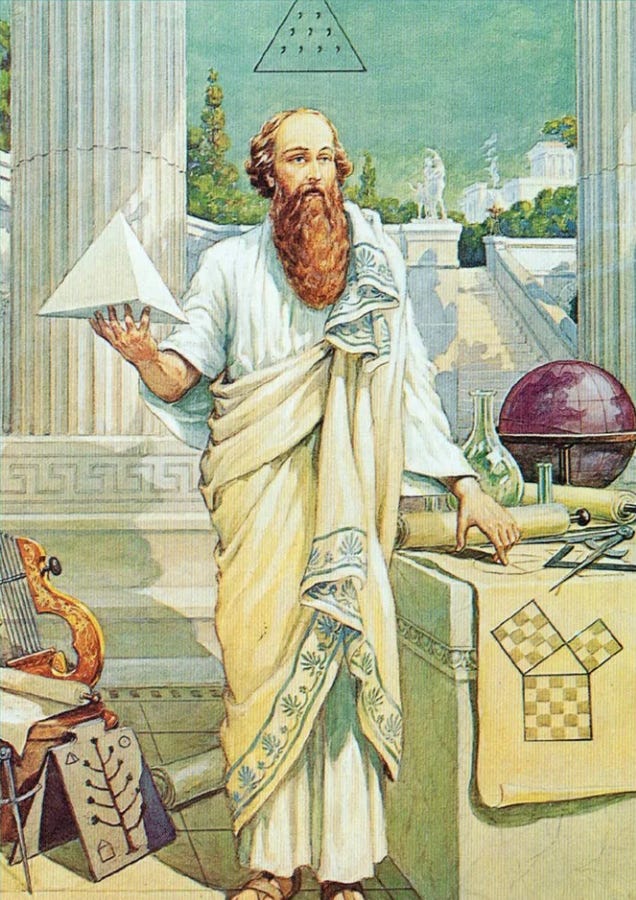
Pythagoras (570–495 BCE)—Numbers are Reality
Pythagoras left no writings. What we do have is Aristotle, two centuries later, reporting that the Pythagoreans “supposed the elements of numbers to be the elements of all things” (Metaphysics). The motto: All is number. This is the first claim on record that reality’s substrate is formal rather than material—something interpretations of quantum mechanics will go on to affirm centuries later. With maya, we had an early account of experience as a virtual reality. With Pythagoras we have another core intuition surface: reality is formal. Reality is created and supported by its underlying structure, via ratio, pattern, arrangement, relation, geometry, and the like.
This is significant to simulation theory because it marks an intellectual shift from focusing on the world of matter and phenomena to focusing on the world of irreducible elements with their own internal logic—specifically quantity, and the science of quantity: math—and what those elements both tell us and what they can produce. Simulation theory requires such a shift because it too must assume phenomena are ultimately formal (digital) if they’re ultimately being computed, and treating number as ontologically fundamental is a strong conceptual advance in that direction. To see the world as being made of math would turn out to be an extraordinary leap that would become part and parcel with science-making for basically all time.
Interestingly, Pythagoras himself was something closer to a shaman or a magician than to his philosophical contemporaries. He’s known to have run a mystery cult in which numbers and their relationships to things were regarded as keys into the deep nature of reality. He was savagely mocked in his own time by Xenophanes and by Heraclitus alike who called him, “the prince of charlatans.” Aristotle was no fan either. Nevertheless, Pythagoras would go on to inspire countless scientists, mathematicians, artists, and mystics alike throughout history.
Indeed, echoing Pythagoras, Leibniz—who co-invented calculus (and in 1673 built the first mechanical calculator capable of multiplication and division!)—envisioned a calculus ratiocinator: a formal system in which any dispute could be settled through calculation. The name of the invention roughly translates to think-in-ator. His own description of how it would work, from The Art of Discovery (1685): “there would be no more need of disputation between two philosophers than between two accountants. For it would suffice to take their pencils in their hands, to sit down to their slates, and to say to each other: let us calculate.” Have a problem? Let us calculate. Should we invade France? Let us calculate. Wife angry? Let us calculate. That was the idea. The answer could be computed.
Today, math is part of how we understand reality itself. Without math, there is no science. Pancomputationalism, the position that reality is fundamentally computable, is now a defensible one, and it’s not uncommon, particularly among mathematicians and some cosmologists like Max Tegmark’s Mathematical Universe Hypothesis, which treats number and mathematical structure as foundational to reality itself. Mathematician Gregory Chaitin explained:
Pythagoras said ‘all is number’, God is a mathematician, the Universe is built of one, two, three, four, five. And the new version of this Pythagorean idea, this new view which is Digital Philosophy, says the world is discrete, it’s built out of zeros and ones, out of bits, and God is a computer programmer.
In a separate interview, Chaitin captures the central detail in this Pythagorean worldview, the demotion of matter:
The idea is that matter is no longer at the center stage. Physical objects are no longer the center stage. Tables and chairs and matter is no longer the fundamental thing. If this viewpoint is correct, the fundamental thing is information, and I would say zero and one bits, in fact. You know it’s like Pythagoras I think said everything is number: 1, 2, 3, 4, 5. And this new version says everything is zero and one bits. I think that’s a very interesting viewpoint. You know it may sound trivial, said this way. But there is an awful lot around it.
There is a huge debt to Pythagoras that can’t be overlooked. With him we have the explicit assumption that an understanding of the formal is one of the most important clues in making sense of reality.
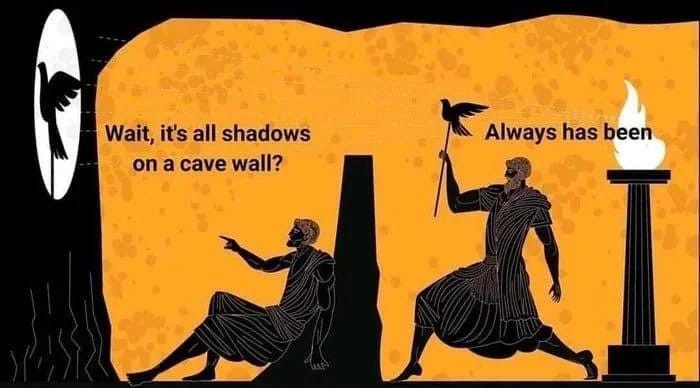
Plato—(375 BCE) The Cave
Everyone knows the story of Plato’s cave. It’s basically the Resurrection fable of Western Philosophy. Republic VII: prisoners that are chained from birth “see only their own shadows, or the shadows of one another” thrown by a fire they can’t turn around to face. They are screen-bound from womb to tomb.
Plato is talking about ignorance, of course—the philosopher’s raison d’être. The question with this illustration is: What if all that we think we know is but a staged contrivance? A contrivance so thorough that we were actually born into it and have never noticed it before. A contrivance that also, when you think about it, represents the absolute extent of everything we know about ourselves, the world, and each other. What if we were to one day escape?
Eventually, leaving our chains behind, we would exit the cave and encounter the sun for the first time, and we would see the whole world; a true cosmos that is much richer and deeper than the now insignificant, flickering puppet-show in the encaved murk behind us. Plato is asking us to think about knowledge, experience, and education; how deep understanding comes from turning away from the performance and to the Source of all things. That Source, in Plato, specifically meaning a more fundamental dimension where the world of appearances spring from.
Plato conceived of the Theory of Forms arguing that the physical world is not as fundamental as the Forms. Forms were the timeless, absolute, non-physical, unchangeable essences of all things, behind all things. The objects we encounter here in the world of matter merely imitate, or resemble them. They are shadows of that pure Form that exists downstream of it.
Interestingly, Plato’s cave is something of a localized form of the concept of maya—what if maya was happening, unfolding in a single room? That’s basically the idea of Plato’s cave. The world is seen as a contrivance that you can become aware of once you ask, “What is the Source? What is outside of the maya-cave?” Maybe it’s a discovery or understanding that retrieves Pythagoras above: all is number. In the case of Plato, it wasn’t number, it was the true reality of Forms. Both Plato and Pythagoras are suggesting that the issue worthy of our attention is not matter, but formal, idealized systems or entities, as the bedrock of reality.
The key that plays into simulation theory is that Plato has introduced a supersystem and a dependent subsystem. His two-world architecture includes the World of Senses, which is physical, spatiotemporal, and in constant flux; and the supersystem World of Forms, which is eternal, unchanging, and intelligible. Every actual chair is downstream of, and dependent upon, the Form of Chair; every act of beauty is downstream of the Form of Beauty itself—all of which exist in this ideal space. Obviously, simulation theory also proposes that there are two worlds: a virtual reality (the senses) and a computational equivalent to the World of Forms.
With the Forms, Plato approaches the same question that simulation theory does—what does our world’s reality depend on? Plato’s answer is a higher realm that supports and explains this one. Structurally speaking, this is the idea of a supersystem generating a substrate. (In a later entry, materials scientist Simon Duan will verbatim propose a Platonic Computer responsible for our simulated experience.)
It is easy enough to understand why Plato is brought up in reference to The Matrix (1999) so very often. The Cave and The Matrix both dramatize the experience of mistaking shadows, or virtual reality, for the real world. Every simulation theorist inevitably invokes Plato at some point or another in their careers just as they will The Matrix. The Matrix is Plato’s Cave: The Movie—Rated R for sci-fi violence and brief language. And as Morpheus says, “Unfortunately no one can be told what the Matrix is. You have to see it for yourself.” This is the core of the Cave parable in so many words: You have to actually see the bigger picture. It has to become part of your experience.
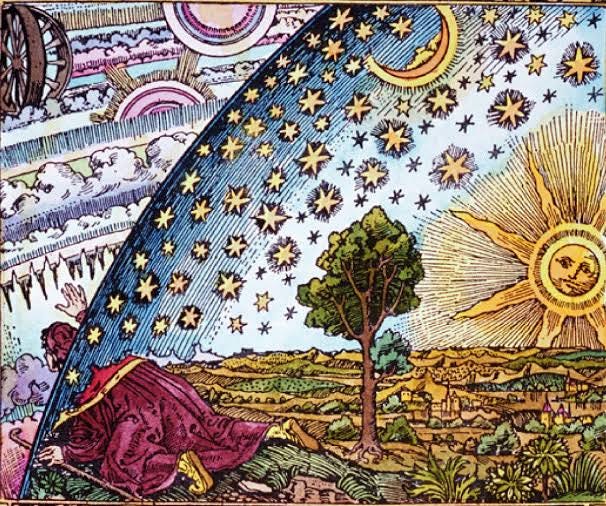
Gnosticism—(2nd century CE) A False Cosmos
Ah, Gnosticism—Christianity’s heretical Silmarillion. “Gnostics” is a catch-all term for a diverse group of early Christians that believed salvation comes through wisdom or gnosis. In the Sethian texts like the Apocryphon of John, the material world is not made by YHWH, the true God of Abraham, but by a flawed, ignorant lesser being—Yaldabaoth!, the “Demiurge” meaning craftsman—who believes himself to be all supreme, boasting, “It is I who am God, and there is none other apart from me.” Then, a voice from above immediately corrects him, renaming him Samael— “god of the blind.” Basically, insulting him as a cosmic idiot and calling him out. It turns out Yaldabaoth/Samael is just one of many celestial beings. Nevertheless, he demands exclusive worship, while he keeps humans preoccupied with material distractions in a false cosmos. Humans, of course, must never come to know the true nature of their world. Enter: Sophia.
Sophia, where we get the word philosophy (philo-sophia), is Jesus’s feminine spirit-twin in the Gnostic cosmology, something called a syzygy; and Sophia’s journey in this fable is a mirror of the plight of humanity. Her story informs us on what we are supposed to commit ourselves to while we rage against the material false world, and that is to pursue what she represents: Wisdom.
Structurally, this is pretty close to what we think of when we think simulation theory: a creator, a manufactured world, and a hidden, true reality beyond it. However, the Gnostics assume an outright hostility towards the material world. Part of salvation is coming to realize that the material world is something of a prison to escape and transcend.
Gnosticism has had something of a resurgence of interest online today. Some folks in simulation theory groups and forums make regular mention of Gnosticism. The Matrix is quoted during the opening bumper of Aeon Byte a long-running gnostic podcast. You’ll also find it in high concept conspiracy tangents that sometimes crossover into simulation theory territory. Very cynical or pessimistic interpretations of simulation theory can obviously lead to some dark and paranoid roads, where one should “protect your loosh” (basically, vital essence) as YouTuber Hyperborean Knowledge put it. So, for the Gnostics, not only is the world phony, but it’s made by celestial adversaries to boot. Naturally, any being occupying a higher realm with influence upon our own would be godlike to us in the same way that if we were in a simulation, the programmers on the terminal end would be nothing short of all-powerful to us as well (a point Bostrom makes in his 2003 paper, below).

Nagarjuna—(150–250 CE) “When Emptiness is possible, everything is possible”
Madhyamaka Buddhism’s core thesis is that nothing has svabhava—independent, inherent existence. This was a genuinely radical claim even within Buddhism at the time. The earlier Abhidharma schools held that phenomena themselves (dharmas) still had their own inherent nature, even if composite objects didn’t. Nagarjuna denies it all, stating: nothing exists independently alone as an object. Everything exists only relationally.
Whatever is dependently co-arisen
That is explained to be emptiness.
That, being a dependent designation,
Is itself the middle way.*
*the Buddhist path
Emptiness is as much an epistemological diagnosis of the nature of things as it is a religious reality to be explored, experienced, contemplated, and embraced. Emptiness is not nothingness here. Emptiness is better thought of as dependence. Things co-arise, that is to say: you and the object you experience are both entirely dependent upon each other. You both share phenomenal unfolding together. One does not exist without the other. This, it is argued, is a more complete, comprehensive worldview when we consider the tension between subject and object. An image later attributed to Zen puts it: “Two clear mirrors facing each other outside time.” If you wanted to account for more than just your own POV, there’s the image of Indra’s Net: a cosmos of perfect jewels each reflecting the other endlessly in a great interconnected web of existence.
Emptiness is an essential concept because it introduces a deep negativity to phenomena—that is to say, matter, the whole notion of an object, is a fairytale because it cannot be isolated (it’s like Carl Sagan said, “If you want to bake a pie, first you have to create a universe.”); an object has no inherent nature at all, only relation; and at root, it is virtual.
In simulation theory, a simulated object has no substance apart from the process generating it—the resonance with computational ontology is why physicist Carlo Rovelli cites Nagarjuna directly in the book Helgoland (2021), closing his own reflection on it with an image that could be lifted straight from the Vedas: “reality, including ourselves, is nothing but a thin and fragile veil, beyond which... there is nothing.” (p. 75). There is no phenomena without a witnesser, and no witnesser without phenomena. Later, we will see this exact notion in the concept of rendering-on-demand.
Vasubandhu / Yogacara—(4th century CE) Mind Only
Where Nagarjuna denies inherent existence, Yogacara denies that objects exist outside consciousness at all. Now there’s a real G! In the Twenty Verses, Vasubandhu begins by citing the Lord Buddha himself: “Everything in the three realms is nothing but mind.” (Nilanjan Das, the translator, glosses the three realms as the “three worlds into which one may be reborn.”)
Verse 1 begins: “This is all appearance only” (the Sanskrit vijñapti-mātra, which others render as “representation-only”). Then comes the hard question, which his dialectical opponent asks in the following verse: If there’s no external world, why do appearances arise at particular times and places, across many minds, with causal effects? (A simulated world faces the same demand: it, too, has to be ‘intersubjectively coherent.’) Vasubandhu answers with analogies: dreams for place and time; hungry ghosts, who all see the same river of pus, for shared experience (gross, but it works: they share the same karma, and therefore have the same appearance); and nocturnal emissions for an example of an illusion having real world effects.
His case that there’s no external world to begin with comes later (Verses 11–15). Vasubandhu argues that matter can’t be either of the two things his opponents offered, a collection of atoms or one solid whole, because both collapse into contradictions. Start with atoms. An atom, by definition, has no parts. But if one atom touches six others, it needs a side facing each one, which means it does have parts, and then it isn’t an atom. If it truly has no parts, it can’t touch anything partway: contact would be total, the atoms would merge, and a pile of them would take up no more room than one. Either way, nothing bigger gets built from atoms. In terms of the tother option, they consider matter as one solid whole. Then you couldn’t cross the ground a step at a time, because stepping on one part would mean stepping on all of it at once. Neither works, so there’s no coherent external object for our appearances to correspond to.
Then comes the next question: how can good company or bad company shape us if there are no external people? I’m not just enjoying folie à deux on my own, am I? Vasubandhu answers in Verse 18: “Appearances are mutually constrained, in virtue of their dominance over one another.” In other words, his use of “dominance” means that an appearance in one mind helps cause an appearance in another, so minds hold a shared world steady by influencing one another, not through an external object. They are transmitting information about a dream they are sharing.
The generator in this scenario is not a computer but the momentum of karma: “traces” of past action and habit shaping what appears next. Video games today have a kind of morality mechanics, where your choices change what happens, including which groups you can and cannot roll with, as well as what ending you ultimately get.
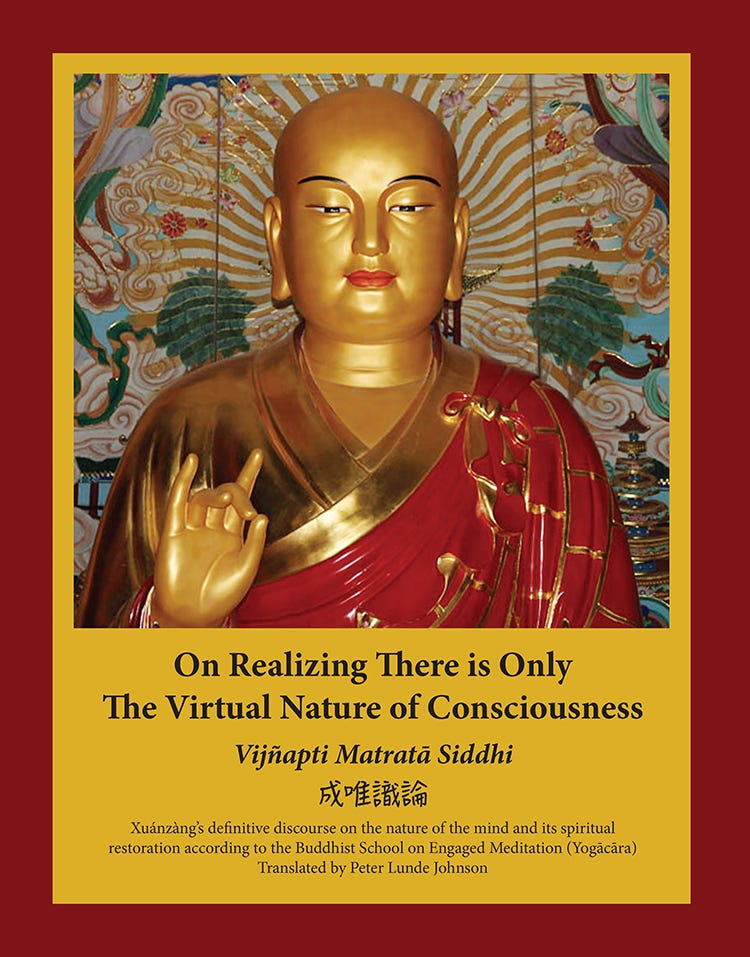
A later commentary develops the idea. Peter Lunde Johnson’s translation of the 7th-century Cheng Weishi Lun, compiled by Xuanzang, is titled The Discourse On Realizing There is Only The Virtual Nature of Consciousness. This legendary named commentary is on Vasubandhu’s Thirty Verses, drawing on Dharmapala and others. It’s a whole bunch of thinkers all with commentary. One of the two theses it sets out, from Nanda and Bandhuśri, reads:
Some say that the inner evolving consciousness creates simulations (pratibhāsa, 似) that appear as external objects through the power of conditioning or ‘perfuming’ (vāsa, 熏習) the mind with speculations (vikalpa, 分別) about identity and purpose. When these speculations arise as the permutations of consciousness, they simulate the existence of real identity and purpose. Although these mental images arise within consciousness, because of their simulation through the power of speculation they appear to be external objects. This is why, since the very beginning of time, sentient beings of all kinds have mistakenly held that identity and purpose really exist apart from consciousness.
The Analogy with Dreams (svapna, 患夢):
This can be compared to those who have dreams. Because of dreams, the mind creates mental images (nimitta, 相), objects that seem to be external to it and are incorrectly held to really exist as such.
A note on the word: “simulation” and “virtual” are the translator Johnson’s choices for terms that others typically render as “semblance” or “appearance.” The Chinese means “to resemble.” Nothing explicitly computational is meant, but the structure it describes, a mind generating appearances that present as an external world, is the one that simulation theory builds on.
A world that is entirely representational and mentally based is arguably a virtual reality. Because the world we experience depends on consciousness, the mind sits above that world of representations in the ontological hierarchy, not the other way around. The world has no existence outside the mind at all, yet it is causally efficacious within its domain: dream objects, for instance, still have real effects, and, on our reading, the mutual constraints among minds are what keep a shared world consistent. The way out of mistaking it for ultimate reality, he says, is waking up (in his sense, a transcendent awareness): “The absence of objects in dreams isn’t recognized unless one is awake.”
Just as a dreamer can’t tell the dream is unreal until waking, anyone inside a virtual reality can’t recognize that its objects aren’t real until they step outside it.
Zhuangzi—(4th century BCE) The Butterfly Dream
“Have you ever had a dream, Neo, that you were so sure was real? What if you were unable to wake from that dream? How would you know the difference between the dream world and the real world?”
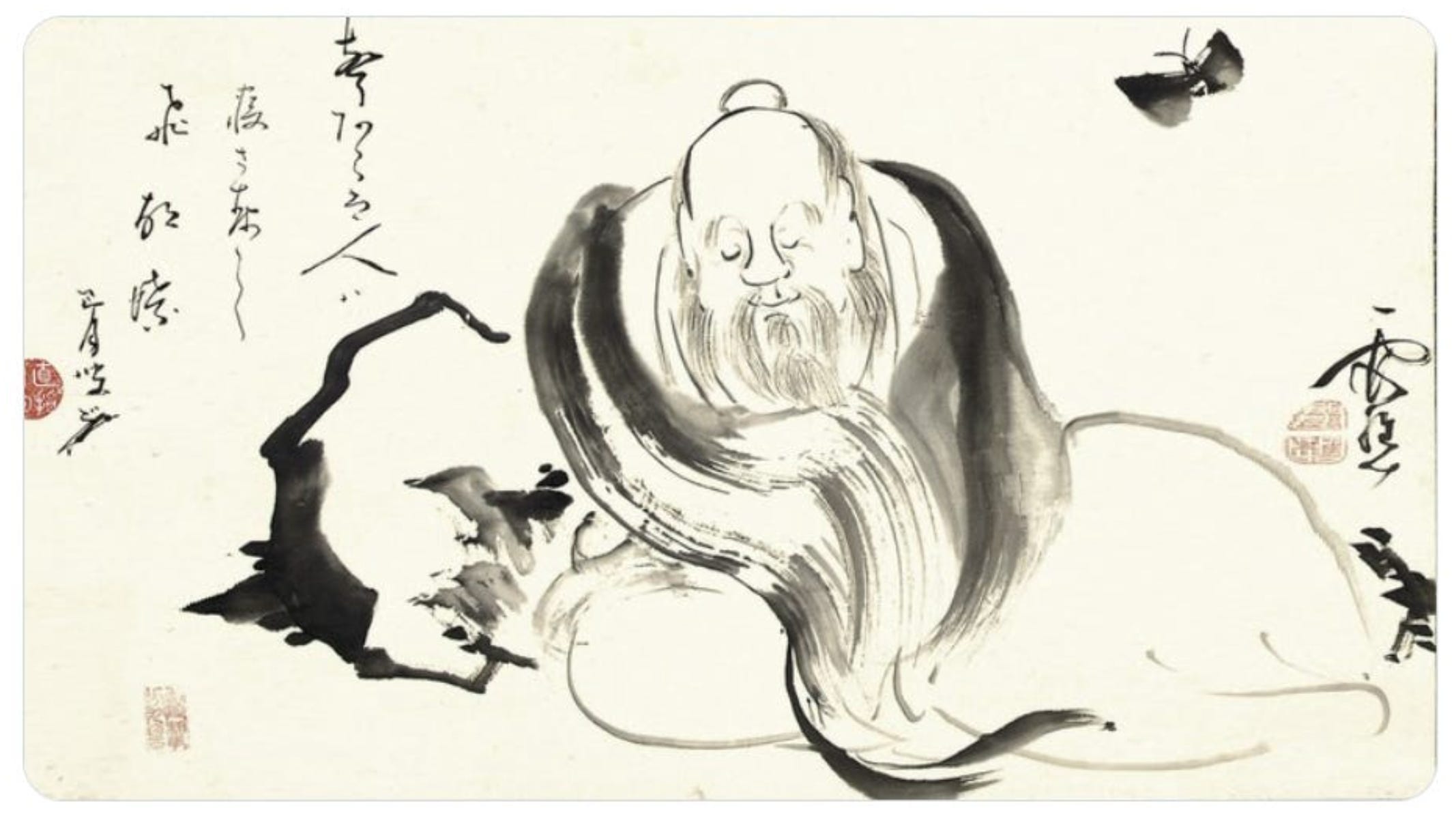
Daoist, Zhuangzi, upon waking from a particularly vivid lepidopteran night-vision, he famously wrote, “I do not know whether I was then a man dreaming I was a butterfly, or whether I am now a butterfly dreaming I am a man.” Here we find the classic demonstration that the felt certainty of experience (i.e. “this is real”) carries no helpful evidence with it.
Dreams are the great teacher for us, because they inject a completely alien experience into our otherwise more-or-less ordinary, predictable, everyday lives. You can be a butterfly. If you can be a butterfly a few hours out of the night, if you can dream a full day’s work in detail, what kind of certainty can we really have about experience? Sounds like maya all over again.
Al-Ghazali writes in Deliverance from Error, there may be a further wakefulness beyond our ordinary wakefulness, which might, in fact, feel more real than our ordinary wakefulness should we experience it: “your waking state would be dreaming in relation to that new and further state.” Maybe one day we’ll wake up to an even more fundamental experience than this one we live every day—then this will then feel like nothing but a dream.
In the following section, Descartes takes up this line of thinking with famous results.
Before the Machines
Early Moderns

Descartes—(1641) The Evil Genius
Descartes famously took the time to hole himself up in a cabin during the winter to dismantle all of his cherished beliefs. His goal in this intellectual adventure was to find a strong foundation for the new emerging sciences, namely physics, with the use of just his own “natural reason.” But accomplishing this goal required that he uncover what is absolutely certain, and cannot be doubted even in the slightest. After some time, it seemed nothing was safe from this approach.
In fact during this examination, he discovered that using the external physical world as a foundation for science and philosophy ultimately turned out to be no good at all—he could doubt that, no problem. Later, in Meditations I, he famously notes what if, “some evil genius exceedingly powerful and cunning has devoted all his powers in deceiving me.” This is, structurally speaking, the simulation hypothesis—an external agent generating an artificial, experiential world. Now, it was not that Descartes believed in such an evil deceiver. Rather, he took the possibility of his ignorance intensely seriously during this exercise. In so doing, he realized that he cannot truly tell when he is dreaming, and further, our experience of the world could be the result of an all-powerful, deceiving external agent.
This led Descartes to the one thing he could not doubt: his own existence. He could not doubt his own existence precisely because the process of doubting is itself a way of proving something is real: the doubter. “Cogito ergo sum,” “I think, therefore I am.” Since I can (1) doubt the world, (2) and be deceived by someone or something—I can, at the minimum at least affirm that I, the thinker, exist, as an entity that can doubt and be deceived. Everything else, even math and logic, is fair game.
Berkeley—(1710) Esse Est Percipi
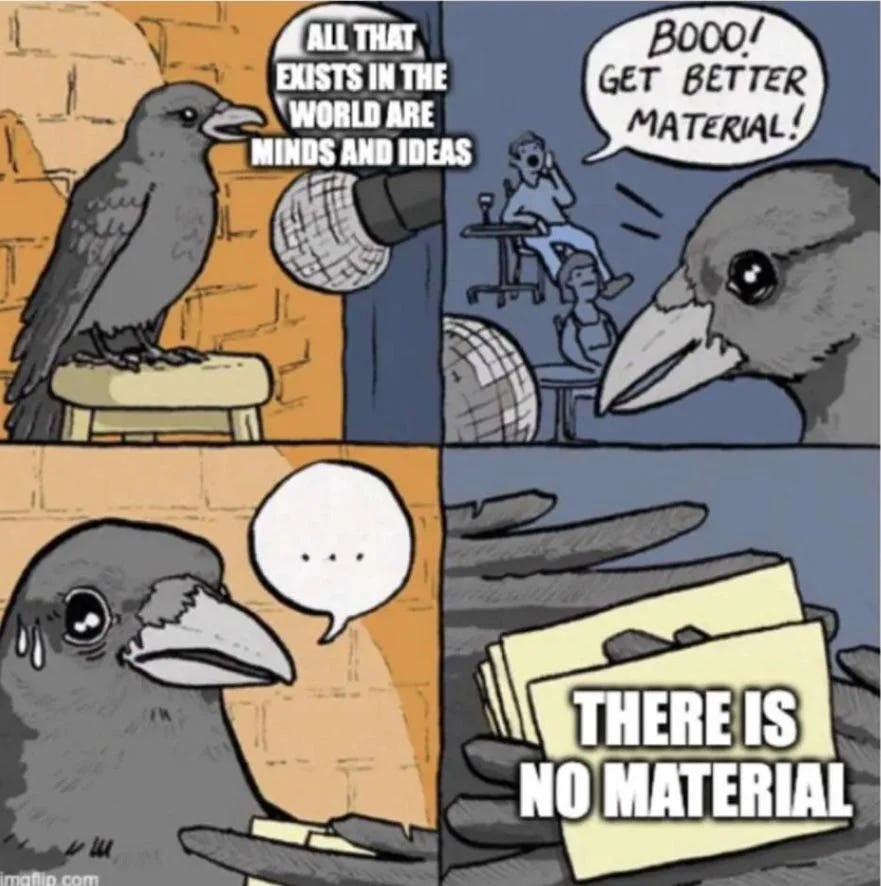
In A Treatise Concerning the Principles of Human Knowledge, the Irish philosopher and future bishop George Berkeley made one of the boldest claims in Western philosophy: of the things we perceive, “Their esse is percipi.” To be is to be perceived. His view, which he called immaterialism (later labelled subjective idealism), is that there are only ideas and the minds that have them. There’s no mind-independent matter sitting out there responsible for appearances, and he thought the very notion was unintelligible. The physical world is made of ideas.
That sounds like the world blinks out of existence whenever you look away. However, this is the famous misreading of Berkeley. His own example is the table in his study: when he’s out of the room, it still exists, because “some other spirit actually does perceive it.” Later he states it outright: objects of sense can’t exist unperceived, but we can’t conclude they exist only while we perceive them, since there may be some other spirit that perceives them.
Further, the ideas of sense aren’t under our control: I can’t choose what I see when I open my eyes. So some other Will must produce them. That’s God, the perceiver who never blinks.
Berkeley is proposing a world that depends on mind, generated and sustained by a more fundamental mind. Berkeley’s God is closer to a server; the server keeps the track of the world’s state whether or not any player is engaging. Its cousin above is vijñapti-mātra: all is representation. The difference is what grounds this process—Berkeley uses God, Yogacara uses karma.
Kant—(1781) Phenomena and Noumena
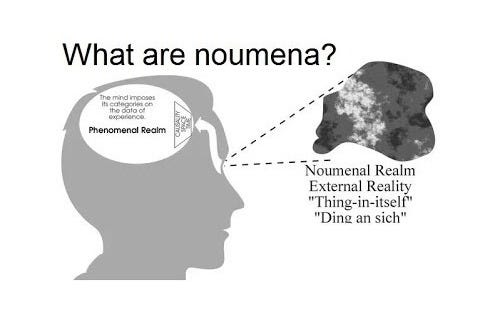
According to Kant, the world we see, “Phenomena,” is supported by/and a shadow of a greater world we cannot see: the Noumena. In Critique of Pure Reason, he writes, “We can have cognition of no object as a thing in itself, but only as an object of sensible intuition.” We never touch the noumenal—the thing-in-itself, das Ding an sich, or, reality as it truly is—rather, we only have access to the phenomenal rendering that our cognitive apparatus produces, which imposes structural order: like time, space, and causality. You don’t see the world at all; what you see a human-ified version of the world. You wouldn’t be able to “see” anything without your built-in anthropic lens to filter, organize, and make sense of the world. According to Kant, what lies beyond Phenomena we cannot meaningfully approach directly. Kant will say that we might be able to approach it indirectly through ideas like moral law, freedom, and God.
Logic of The Machines: A Century, Decade by Decade
Let’s take a breather.
Everyone we have read so far has expressed some form or another of things might not be as they seem. There is wide agreement, across cultures and times, that when trying to get to the bottom of the big questions, beginning with things as they simply appear is considered a bad approach.
So far, our lineage has been free of any discussion of technology. That’s about to change. Rather, we have covered the philosophical implications of powerful formal systems (math, logic, and numbers), along with perception, reasoning, dreams, illusions, experience, reality, ontological hierarchies, and the mind. But it is not until the arrival of digital computation that simulation theory actually begins to be articulated.
With the arrival of Enlightenment thinkers like Descartes science, technology, and philosophy would find themselves becoming evermore intertwined. Eventually technology, specifically computation, would start to play an explicit role in the development of science and philosophical inquiry, as well as in its proliferation.
When it comes to simulation theory, we will see the explicit object of inquiry turn towards computers and computation itself. This is due to computers’ ability to generate an array of impressive feats including detailed physics simulations. The question becomes: If I can create something just like my experience using a machine built of mere digital computation, what impact, if any, does this have on our understanding of the mind and reality? Bearing in mind, computation is simply math and logic made manifest—if a machine that can turn math and logic into compelling experience, what might that say about the nature of experience itself?
In the next sections the development of computation and technology will be covered, as these fields are obviously essential to an understanding of simulation theory. If this history were truly comprehensive, there would be lengthy portions on the development of virtual reality, physics engines, environmental procedural generation, haptic devices—not to mention the evolution of gaming from PONG to prompt-based game development. Rather, we will (less ambitiously) stick to covering the development of computation and the metaphysical intellectual projects it inspired. Covering every milestone in graphics and interface development for instance would make this book-length blog post considerably longer. (That being said, a common understanding of the development of gaming or physics simulations is certainly extremely helpful in appreciating simulation theory, as they represent tangible, real world examples of the core of thesis of the framework’s overture.)

1850s–1950s—Logic Becomes a Machine
George Boole (1847/1854)—The Murmurs of Binary
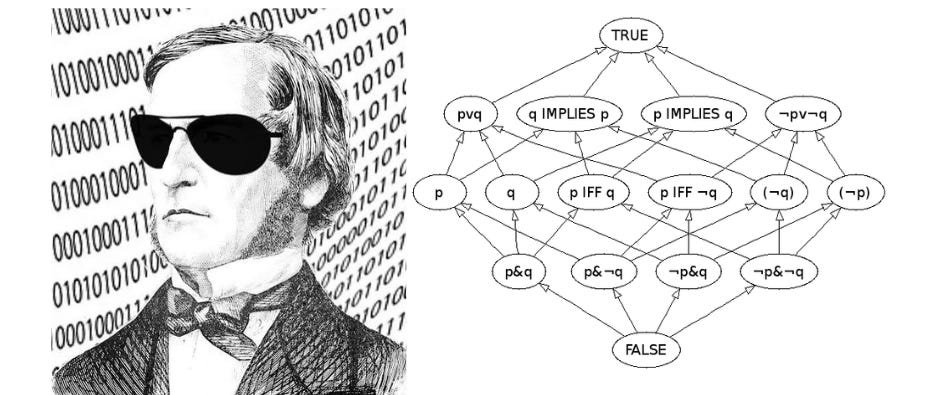
Boole will be known for Boolean Algebra, which became the basis of modern computation. His system is an algebra of classes—x, y, z stand for classes of things (“black things,” “birds”)—with 0 and 1 as two special classes: 0 for "Nothing," the empty class, and 1 for "the Universe," the class of everything, the opposite of “Nothing.” But buried in that system is a passage that would matter more than he could have possibly known. Boole writes:
“Let us conceive... of an algebra in which the symbols x, y, z, etc. admit indifferently of the values 0 and 1, and of these values alone. The laws, the axioms, and the processes, of such an Algebra will be identical in their whole extent with the laws, the axioms, and the processes of an Algebra of Logic.”
If you limit his classes to just 0 and 1, and every law of ordinary algebra turns out to already be a law of his logic too!
Little did Boole know that his discovery would one day lead to everything you can do in the palm of your hand while on the toilet: access the world’s media library, talk to any person on the planet, get real time weather and traffic data, edit a video, shoot a video. For a man who died in 1864, I’m sure he’d be impressed with himself if not agog with horror. Works include The Mathematical Analysis of Logic and the awesomely named An Investigation of the Laws of Thought.
Kurt Gödel (1931)—the Incompleteness Theorems
In September 1930, at a conference in Königsberg, David Hilbert closed an address with the manly declaration, “Wir müssen wissen, wir werden wissen” (“We must know, we will know”). At that same gathering, the 24-year-old Gödel announced the result that would end the dream behind Hilbert’s cry. The pursuit of a mathesis universalis, a complete, mechanizable science of all exact truth, Gödel showed would never be achievable.

Gödel demonstrated that any consistent formal system rich enough to do arithmetic contains true statements it can’t prove, and, in his second theorem, that it can’t prove its own consistency using only its own rules.
Since a simulated world would have to be a formal system, its inhabitants could never use its own rules to certify that those rules are coherent. Vouching for it would take a vantage point that is wider than the system can provide. This is basically the mathematical cousin of Descartes’s problem: trying to use reason to prove reason trustworthy from the inside.
What Gödel doesn’t show is that an outside must exist. A stronger formal system could vouch for the weaker one, and would face the same limit itself, and whether physical reality is a formal system at all is an assumption. Gödel’s work offers us a hint: a world that is nothing but formal structure can’t be the last word on itself.
Alan Turing (1936/1950)
Turing’s 1936 paper, “On Computable Numbers, with an Application to the Entscheidungsproblem,” sets out to solve a decision problem in mathematical logic. The tool he builds to do it is what he called elsewhere a “thinking machine,” otherwise known as a universal machine: “It is possible to invent a single machine which can be used to compute any computable sequence.” That might sound obvious, or like a tautology. But this was written before computers existed. And Turing’s formulation is why every computer since has been (thankfully) a general-purpose, programmable machine rather than requiring a different hardwired device for every individual task.
The same year, Alonzo Church—Turing’s own doctoral advisor, though the two worked independently—proved an equivalent result through a completely different formal system: the lambda calculus. These discoveries lead to the Church-Turing Thesis—the claim that anything intuitively “computable” (done by a human with just pencil and paper) is also computable via no less than three overlapping formal models: Turing machines, the lambda calculus, and the Herbrand–Gödel general recursive functions (which Kleene proved equivalent to both shortly after). What this means is computation doesn't care what notation realizes it—Turing machines, lambda calculus, and recursive functions all reach the same place by three unrelated paths. Computation, it turns out, is widely approachable.
Turing would later become famous for the Turing Test: can we tell digital, man-made minds from human minds? The movie Blade Runner opens with a sci-fi version of such a test going horribly wrong. Turing’s work would open up another philosophical line of questioning: is the universe itself running on a substrate, like a computer?
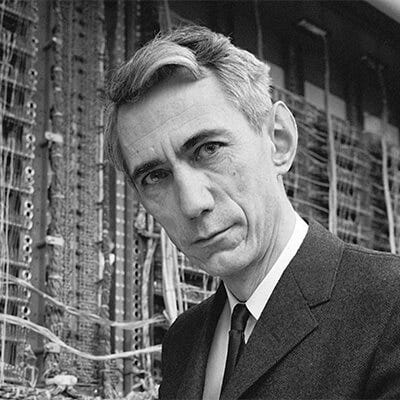
Claude Shannon (1937)—A Symbolic Analysis of Relay and Switching Circuits
Eighty-three years after Boole developed his binary logical algebra, a 21-year-old master’s student at MIT, Claude Shannon, figured out how to build it into a machine. Shannon realized an electrical relay, open or closed, is a physical instantiation of Boole’s 0 and 1. That means an arrangement of open or closed switches can carry out any operation of symbolic logic! Every digital circuit built since, in a real sense, is Boole’s logical reasoning wired into matter. Historian Herman Goldstine said, “This surely must be one of the most important master’s theses ever written.” Shannon himself said he “had more fun doing that than anything else in my life.”
It was the first step toward what would soon be known as “thinking machines,” and within two decades, artificial intelligence. By January 1950, TIME was running a story titled “The Thinking Machine,” in which Shannon, then at Bell Labs, was working out how to make a calculator play chess, while “machine-radicals” asked, “Isn’t this [playing chess] thinking?”
Shannon’s own 1950 paper on chess explains why he chose this game as an intelligence test: people agreed chess takes thinking, so a machine that played well would be a test of whether machines could think. That same year Turing asked, “Can machines think?” and in a 1951 BBC broadcast he said he believed “the attempt to make a thinking machine” would help us understand how we think ourselves.
On August 31, 1955, Shannon co-signed, with John McCarthy, Marvin Minsky, and Nathaniel Rochester, the proposal for a Dartmouth summer study on “artificial intelligence,” one of the first documented uses of the term in the field’s sense. By the early 1960s, CBS aired a program called The Thinking Machine with Shannon among its guests. The computer was, early on, considered as a kind of device that “thinks” in some sense, and therefore, a kind of mind of some type.
With his invention, Shannon very much ushered in the era of the mechanical mind.
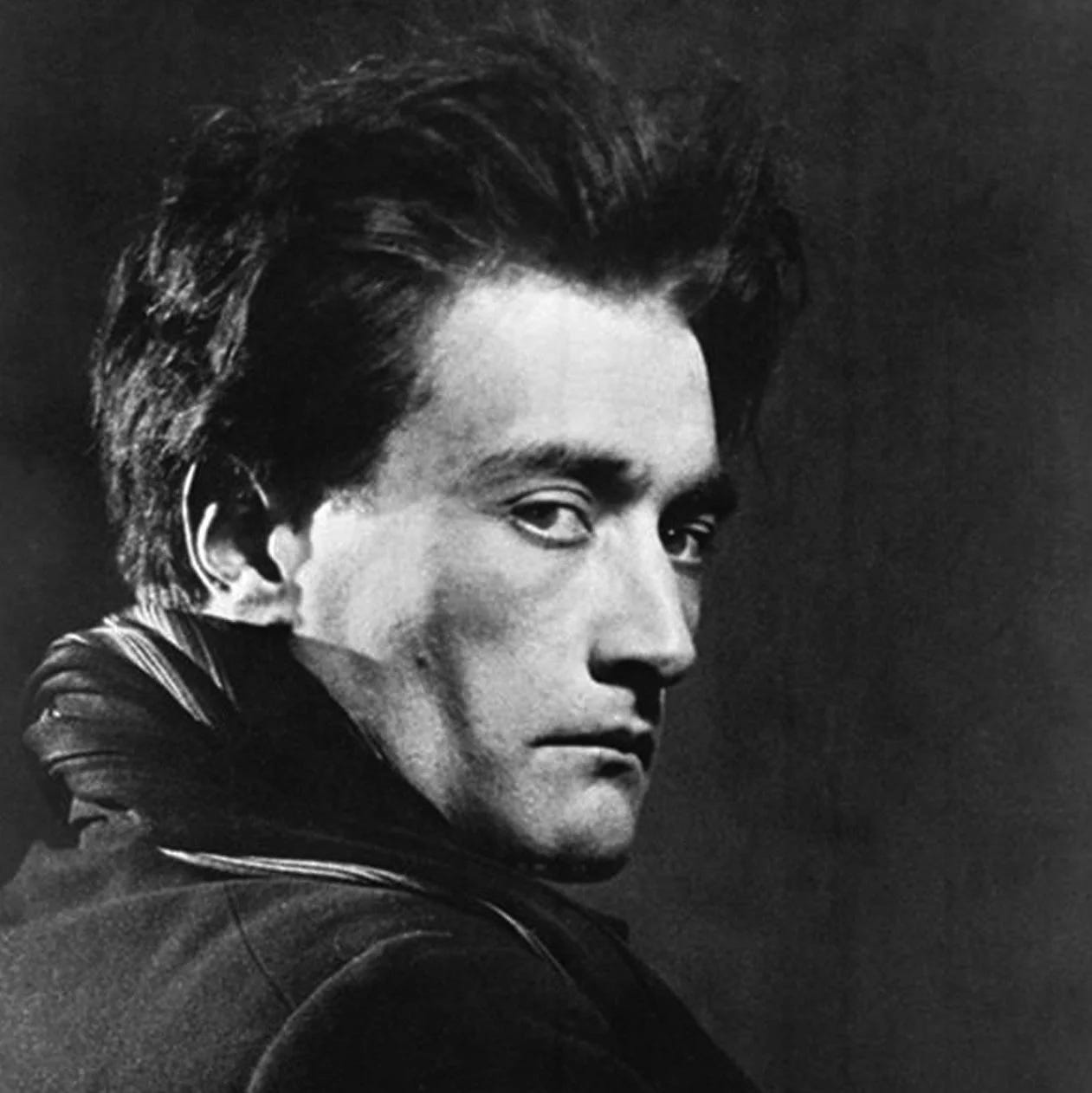
Antonin Artaud (1938)—“Réalité Virtuelle”
A brief aside into art and madness. In 1938, the French avant-garde poet, playwright, and theatre theorist Antonin Artaud, described the illusory nature of characters and objects on stage as “la réalité virtuelle”—the first published use of the phrase virtual reality. Artaud was not describing technology, but rather live theatre, arguing that audiences and actors should treat the drama on stage as reality rather than fiction held at arm’s length. Artaud became a madman spending some time in an asylum. He was also a mystic, as well as something of an occult magician. Jaron Lanier popularized the English term in the 1980s and tends to get most of the public credit for it.
The Birth of the Digital Information Age
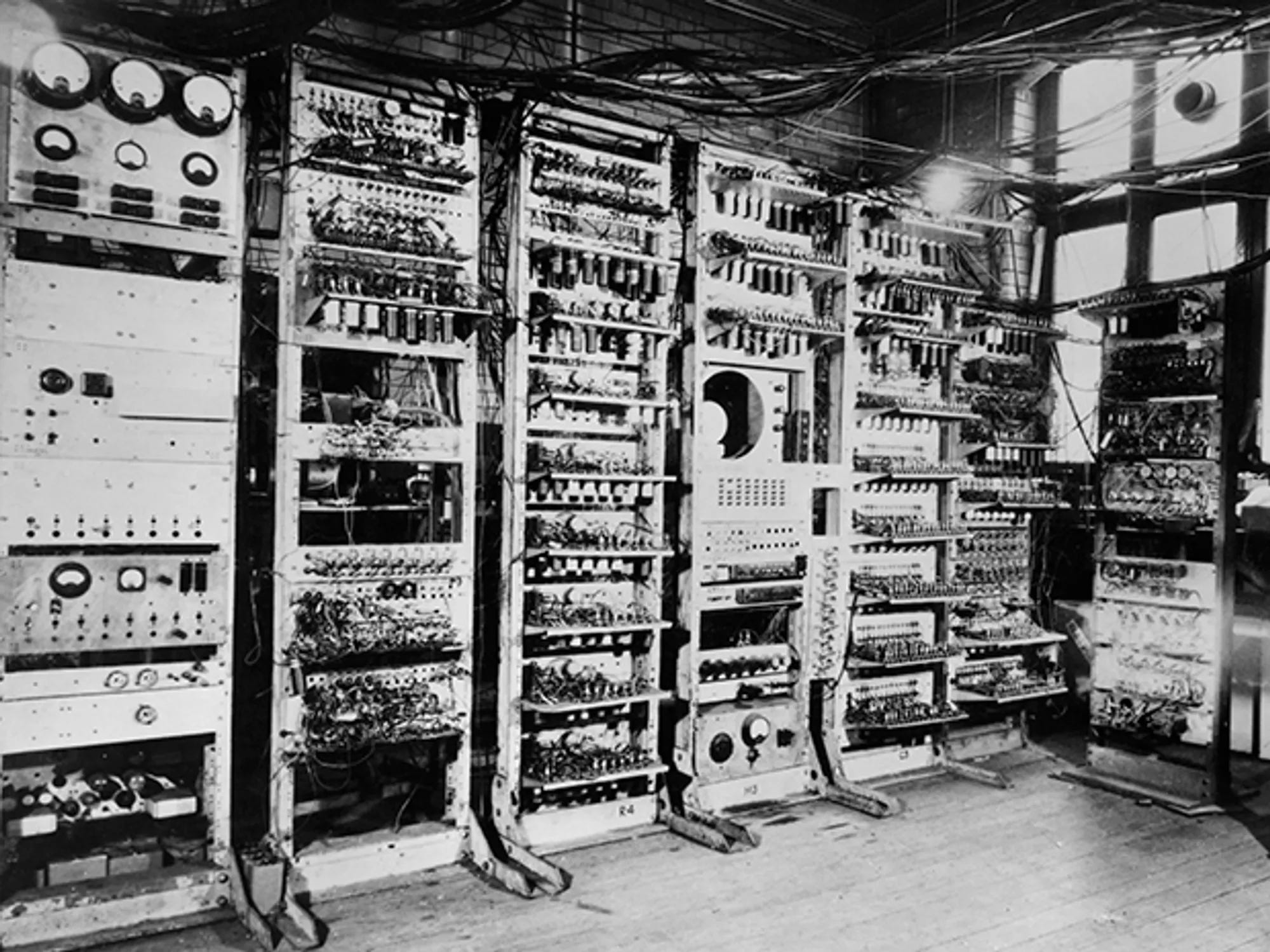
Before moving on, let’s take a quick review of these three thinkers directly involved with the creation of the computer: Boole, Turing, and Shannon (sorry Gödel). How did the computer happen?
First, Boole proves that logical reasoning itself can be reduced to just two values: 0 or 1, on or off, yes or no. So thought, or at least a form of thought, judgement, can be turned into a binary algebraic system.
Then, Turing proves that a single machine design, in principle, can compute anything computable—so there is no need for different hardwired devices per task. No word-processing hardware, no separate image-editing hardware. A single general-purpose computer, a Turing machine, is theoretically achievable. The word for it is universal.
Finally, Shannon takes up the challenge and with Boole and Turing’s insights offers an actual blueprint: proof that algebraic logic could be built out of a machine consisting of switches, wires, tape, and electric current.
So Boole provides the logic; Turing describes the computer’s universality; and Shannon offers the hardware solution. Thus the computer is born, and with it, the Digital Information Age.
Digital computers, these so-called “thinking machines,” became essential to the sciences as they turned out to be invaluable to both math and science modeling. Phenomena could be accurately represented digitally; this includes virtual worlds and physics simulations, but now also AI-assistants grown from neural networks have emerged as well. All of this is entirely the result of digital processes: sequences of zeroes and ones. Indeed, the computer is arguably science’s best invention, insofar as it is basically a companion-tool for the performance of doing more and better science-based work. Not to mention easily providing the infrastructure for instantly communicating that work to other fellow scientists around the world.
From the 30s onward computation becomes so pervasive due to its extraordinary utility that it begins to get mixed up into scientific and philosophical thought—computationalism is formed and its ideas spread. Genes are seen as codes that carry information; information becomes a foundational concept to physical theory; the social sciences take on cybernetic metaphors; even the mind is seen to be like a computer.
Digital computers have proven to be one of the most significant inventions in human history, with implications we still haven’t fully exhausted nor entirely reckoned with today.
1960s–1970s
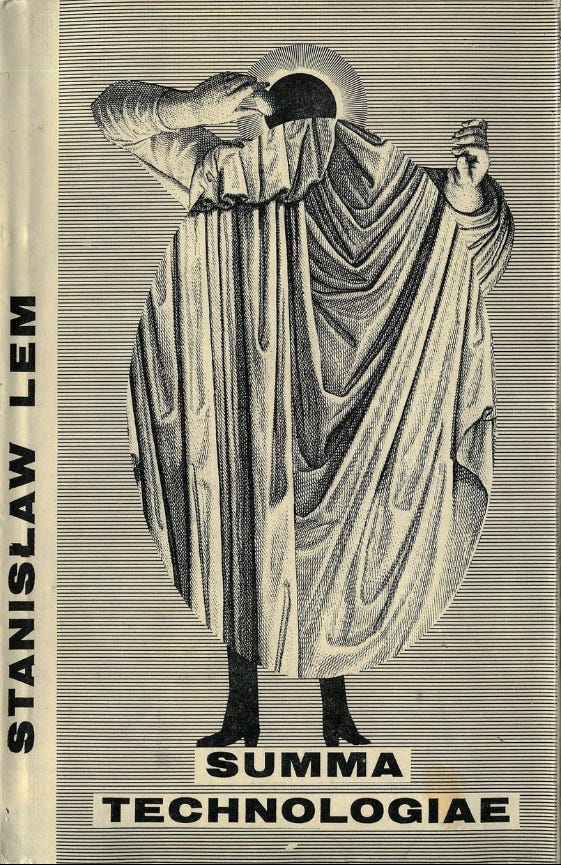
Stanisław Lem (1964)—Summa Technologiae, Phantomatics, and the Dawn of Virtual Worlds
We begin with someone ahead of their time, who took up the idea of the computer as the basis for the rising field of cybernetics. Lem was a Polish science-fiction writer and philosopher best known for Solaris. His translator called his late essay, Summa Technologiae, his most mature and philosophically ambitious work. The title is a dig at Aquinas’s Summa Theologiae: a secular counter-encyclopedia built on cybernetics, rather than scripture. In it, Lem anticipates an array of technologies, which he christened with names of his own: ariadnology for search-engine theory, cerebromatics for direct brain interference, intellectronics for artificial intelligence, and so on. In the text, Lem treats technological and biological evolution as one continuous problem, and inside it we find arguably the first work of philosophy to wrestle seriously with computer-generated worlds.
Phantomatics is his term for a technology that generates a fully immersive artificial world that is indistinguishable from ordinary reality once you’re inside. The machine that does this he calls a Phantomat, and, of note, it is powered by a computer.
We shall ask, Is it possible to create an artificial reality that is very similar to the actual one yet that cannot be distinguished from it in any way? The first topic focuses on the creation of worlds, the second on the creation of illusions. But we are talking about perfect illusions. I do not even know whether they can be called just illusions.
The Phantomat feeds false information through the ordinary sensory channels. He explicitly contrasts it with cerebromatics, which alters the brain itself (a brain-machine interface, a la The Matrix). Lem says one of these machines could give you the experience of climbing the Alps or commanding a medieval army without ever leaving the room. This isn’t dissimilar from the holodeck featured in Star Trek, only in Lem’s scenario, the user is trapped inside. Phantomatics specifically refers to a situation with no built-in “exits”: nothing inside a true phantomatic experience lets you detect it or step back out. It's Plato's cave, only now without any hope of escape, sealed forever in the world of representations.
What can a person connected to a phantomatic generator experience? Everything. He can climb the Alps, wander around the Moon without a spacesuit or an oxygen mask, conquer medieval towns or the North Pole while heading a committed team and wearing shining armor. […] he can enter into a duel with Iago to avenge Othello or get stabbed himself by Mafia hitmen. He can also experience enormous eagle’s wings growing on his back; he can fly and then become a fish again and spend his life on a coral reef; as a shark he can career with his mouth wide open toward his victims […] he can die and be resurrected many times over.
The phantomatic machine is a technological form of maya. What’s special to Lem is that the machine responds to the user’s feedback, so what it produces keeps evolving instead of being a fixed recording. He also discusses simulating people, and what each might cost in computing: he argues that it’s easier to convincingly simulate a generic character rather than someone like Einstein, since the latter would require matching the complexity of a genius’s mind.
Lem was among the first to see that the computer would eventually generate a complete artificial reality, one seductive, immersive, and detailed enough to go unnoticed by the person inside it. However, Lem never asks whether we are the ones inside. That we are already in a simulation. That crucial step, “you might be in one,” is absent from Lem’s scenario. He does for see it as a real possible future, but, since he doesn’t outright propose it, it is not yet simulation theory proper.
Ivan Sutherland (1965)— “The Ultimate Display”
In 1963, Ken Knowlton, an American computer graphics pioneer and artist developed BEFLIX, the first programming language for computer animation, while working at Bell Labs.

Then, in 1965, Ivan Sutherland published “The Ultimate Display” which briefly covers the frontier of computer graphics, novel forms of interfacing with computers at the time—using stylus light pens, joysticks, and the like. Sutherland also covers kinesthetic feedback using computers. Today, we call them haptics: devices the give physical feedback to a user. Sutherland points out that a joystick, for instance, used in flight training could be programmed to offer the kind of physical resistance that a pilot would experience when facing the elements (like wind sheer)—a kinetic simulation.
Sutherland sees a deep future in this technology, bringing it even into quantum physics, stating, “With such a display, a computer model of particles in an electric field could combine manual control of the position, of a moving charge, replete with the sensation of forces on the charge, with visual presentation of the charge’s position.” The paper ends with:
The ultimate display would, of course, be a room within which the computer can control the existence of matter. A chair displayed in such a room would be good enough to sit in. Handcuffs displayed in such a room would be confining, and a bullet displayed in such a room would be fatal. With appropriate programming such a display could literally be the Wonderland into which Alice walked.
Once again, we have another description of a technologically-enabled maya room. A holodeck of sorts.
In 1968 Sutherland went on to build the actual first head-mounted display, nicknamed the Sword of Damocles for the literal reason that it was too heavy to wear unsupported and had to hang suspended from the ceiling above the user’s head.

Sutherland’s work would go on to inspire what became known as Virtual Reality. Thanks to his early work, consumer VR headsets are now commonplace.
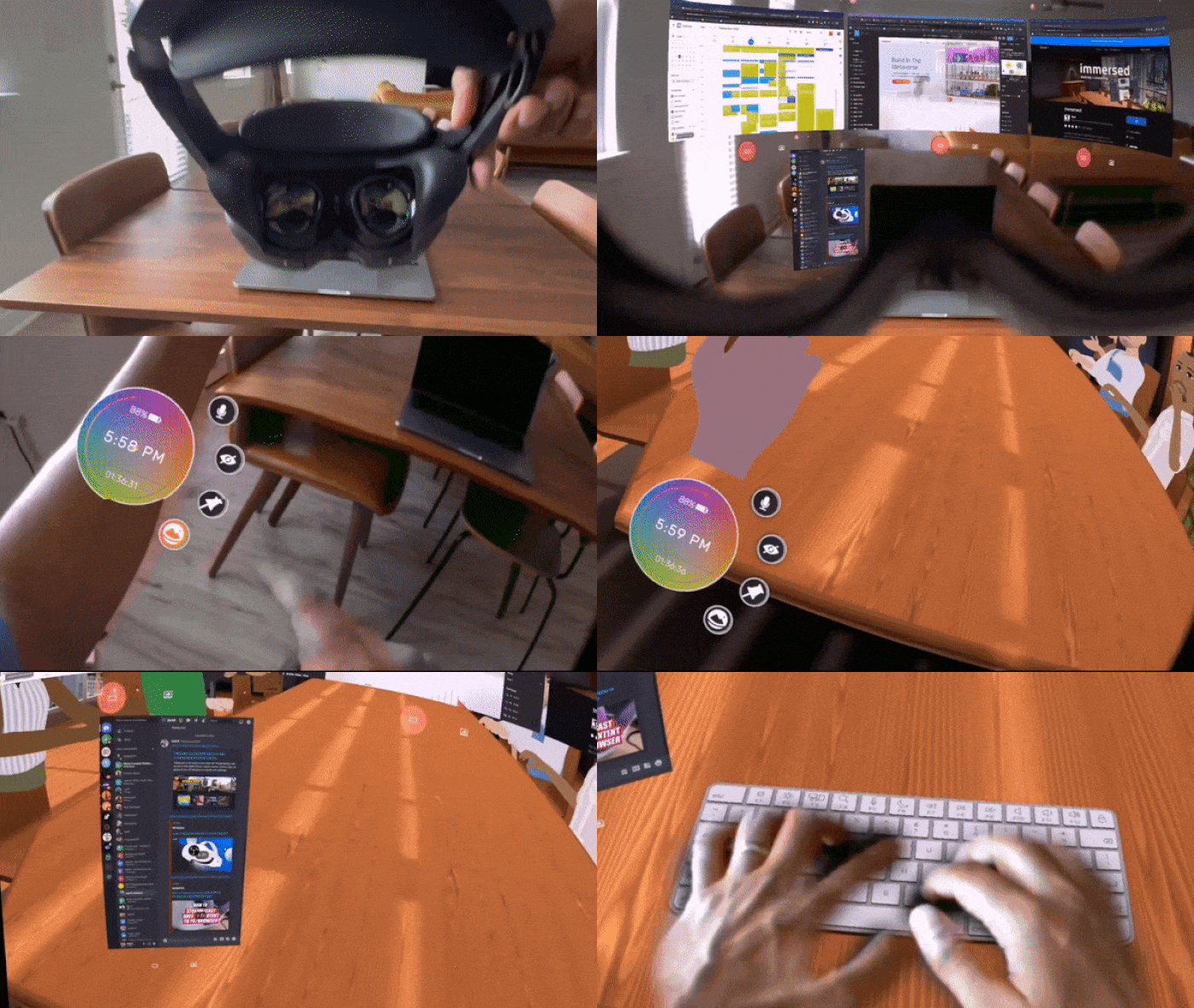
What Sutherland and Knowlton understood that computer-generated elements and their displays would make the computer primarily a visual medium; not simply a text-based one. And they were right. Computer-generated images and graphical interfaces like desktops and icons became the norm. Further, computers can provide us with a simulacra of our experience that is virtually indistinguishable from the real thing, as well as with artistic representations that were previously impossible to produce. An “Ultimate Display” offers the programmer God-like control over the user, to the point of creating a whole reality complete with physical consequences.

Hilary Putnam (1965/1967)—Functionalism and Substrate Independence
In “Psychological Predicates” (1967, also known as “The Nature of Mental States”), Putnam is credited with the argument that mental states are multiply realizable—in other words, that the same “psychological state,” like pain, can occur in mammals, reptiles, and mollusks despite radically different underlying physical structure. If pain isn’t identical to any one physical state, but is instead defined by what it does (alerts one to address/end the pain), then in principle nothing about a mind should rely exclusively on carbon, neurons, or biology specifically. This Philosophy of Mind concept is called functionalism: its the function of states that makes them noteworthy, not their physical structure. It’s their arrangement and organization that matters. Incidentally, Putnam compared it to a universal Turing machine (a computer), saying the hardware is irrelevant, it’s about the functions themselves that matter.
This leads to a secondary idea: substrate independence—function and structure do not stand in a one-to-one correspondence, and the same function can be performed in different physical systems. Basically another way of almost saying the same thing. Substrate independence is the bedrock underneath every later claim that a simulated mind, running on entirely different hardware, could still be a real mind. It doesn’t matter what generates a mind, what matters is that a mind can be generated though a certain type of organization. Whether you are made of carbon and sugar or silicon and electricity with the right functional organization both should be able to “feel pain.”
Putnam’s ideas of functionalism and substrate independence will be brought up again later, notably with Bostrom (below); however, it’s worth noting that functionalism is the most popular version of Philosophy of Mind among working philosophers (Phil Paper Survey). So whether or not one agrees with functionalism, one is expected to address it.
Interestingly, Putnam would eventually turn against his own creation, publishing a formal systematic critique of his own work in the 1988 book Representation and Reality. Nevertheless, functionalism remains the dominant paradigm among philosophers, cognitive scientists, and AI developers.
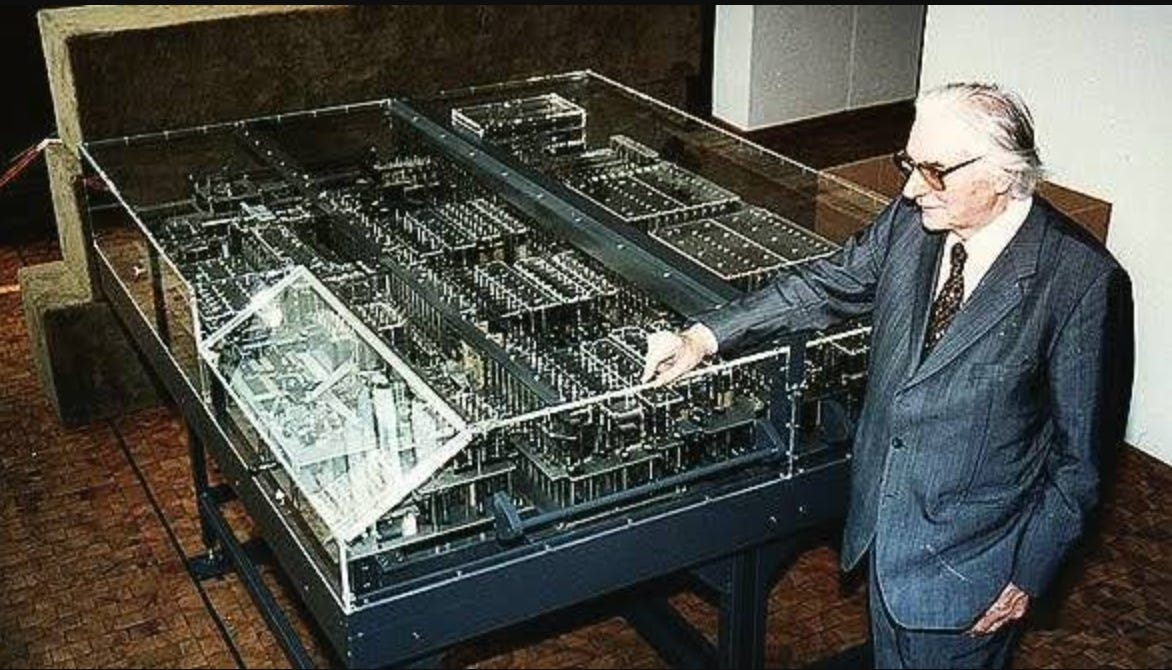
Konrad Zuse (1969)—Rechnender Raum (“Calculating Space”)
It might come as no surprise to the psychologists in the room that the engineer who built the first programmable computer in the 1930s-40s (awesomely named, the Z1) is also the first person to propose, formally, that the universe itself might literally be a giant computer—namely, cellular automata: physics as computation running on a discrete grid—like binary played out in space. Zuse’s work offers the foundational idea for what later gets called Digital Physics.
The book is short, about seventy pages, and grew out of a 1967 article. Its picture is austere: space is a grid of cells, each holding a number and updating from its neighbors by a fixed rule at every tick—and what we call physics is just what that grid is doing. Zuse draws on von Neumann’s self-reproducing automata and builds small examples in which stable moving patterns, his “digital particles,” travel, collide, and pass through each other. He doesn’t claim a complete model of the universe, and he’s candid about the hard cases: for instance a grid sits awkwardly with relativity, and quantum behavior would be extremely difficult to model, though he argues neither refutes the idea. Note what the thesis is, though: physics is computation. It doesn’t say a bigger computer is running us, which is the extra step that makes it simulation theory proper. Rather, this was an effort to begin modeling physics itself as computation.
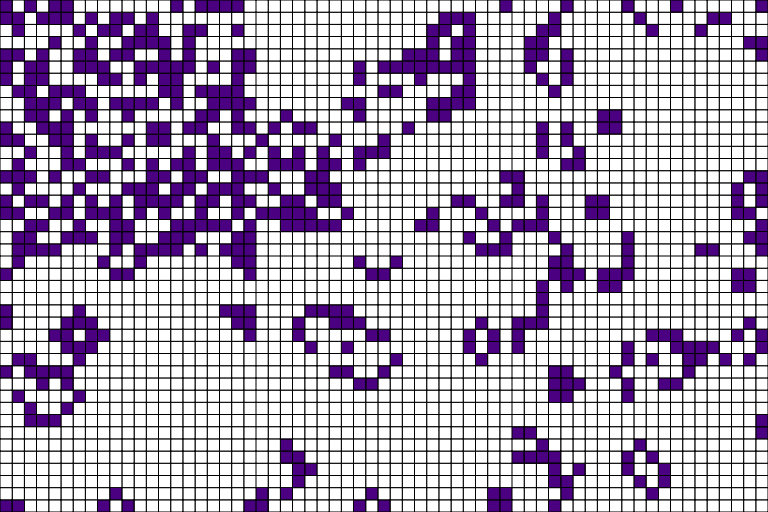
John Conway (1970)—the Game of Life
Few in science are famed for demonstrating something not just profound but also very cute! Conway’s experiments using cellular automaton in computers, popularized in Martin Gardner’s October 1970 Scientific American column, demonstrated what Zuse proposed in “Calculating Space”: a small set of local rules, applied uniformly across a grid, generates a wide variety of “Critters” in the form of gliders, oscillators, and other structures that spring forth entirely organically, simply as a consequence of four local rules.
Conway’s Game of Life illustrated that complexity emerges from very simple computation. Indeed, it was called the Game of Life because the output from these rules looked as if they were little organisms, or physical processes on tiny scales; seeds would grow into megastructures, some would sustain, and others would disintegrate.
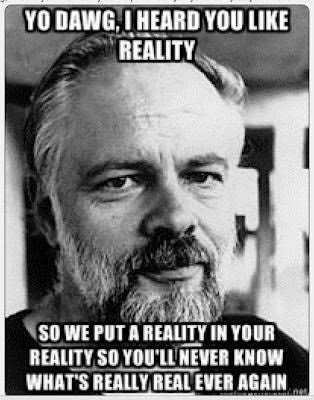
Philip K Dick (1977)—“We are living in a computer programmed reality…”
It is worth mentioning that author Philip K. Dick, who addressed a crowd in Metz, France during a science fiction and fantasy convention, stated unequivocally and entirely free of any irony whatsoever: “We are living in a computer programmed reality, and the only clue we have to it is when some variable is changed.” He explained:
I, in my stories and novels often write about counterfeit worlds, semi-real worlds, as well as deranged private worlds, inhabited often by just one person, while meantime the other characters either remain in their own worlds throughout or are somehow drawn into one of the peculiar ones. This theme occurs in the corpus of my 27 years of writing. At no time did I have a theoretical or conscious explanation for my preoccupation with these pluriform pseudo-worlds. But now I think I understand. What I was sensing was the manifold of partially actualized realities lying tangent to what evidently is the most actualized one, the one which the majority of us, by consensus gentium, agree on.
His metaphysics offers that multiple worlds are created through a dialectical tension between a “dark counter-player” and “Divine Programmer” which results in a “struck off world.” These are other realities that branch out, and occasionally we can sense them either through visions or deja vu.
Dick explains that two of his novels Flow My Tears, the Policeman Said and The Man in the High Castle were inspired by memories of an alternate timeline, a more prison planet-like earth. He situated this other reality across “orthogonal time” and even asked the crowd if any of them “remember” a similar kind of extra-authoritarian earth, a “different present.”
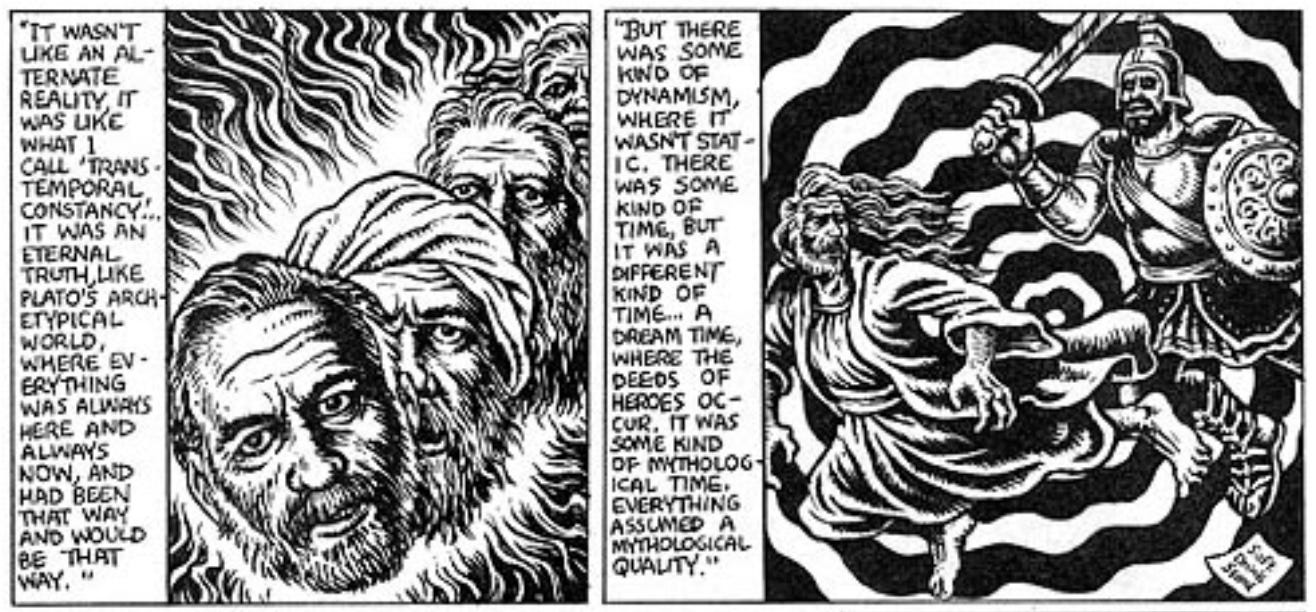
Captured by R. Crumb’s comic “The Religious Experience of Philip K. Dick” (Weirdo #17, 1986), Dick was, by all accounts, a mystic. While recovering from a wisdom-tooth extraction in 1974, the author answered his front door to receive a painkiller delivery. The woman making the delivery happened to be wearing a Christian ichthys (“Jesus fish”) pendant. Dick did not know what this symbol was. The light caught it, glinted in his eye, and he reported that the light became a pink information-rich beam. He experienced Platonic anamnesis—a sudden, total recall of a past life as a persecuted Christian in ancient Rome, where the fish sign was a secret identifier. It was like a download.
Separately, in the weeks that followed, the same pink light returned while Dick was listening to the Beatles’ “Strawberry Fields Forever,” this time, the lyrics morphed into a warning him that his infant son had a specific life-threatening hernial condition. Dick told his wife Tess, and they rushed the child to the hospital. Doctors found nothing at first—but at Dick’s insistence a second examination was performed. Indeed an undiagnosed, potentially fatal inguinal hernia was discovered and treated just in time.
Eight thousand pages of personal notes (later published as The Exegesis (2011)) poured out of this experience, along with the VALIS novel trilogy (1981-82) . The worldview he describes in those pages can easily be called gnostic simulism. We are deliberately deceived in a “computer programmed” simulated world he refers to as “The Black Iron Prison.” Escape can come in the form of Platonic anamnesis (remembering the deep, primordial truths we have forgotten via a sudden rush of information); or through contact with a divine form of living information that can cross into our phony universe, which he called a Plasmate. This being can reprogram individuals to awaken them as well: it is a cyber-gnostic Holy Ghost.
As far as we are aware, this is the first time an individual of note stated publicly that they personally believed we are living in a simulation, based that claim on their own experience, and provided some kind of theoretical basis for it.
1980s
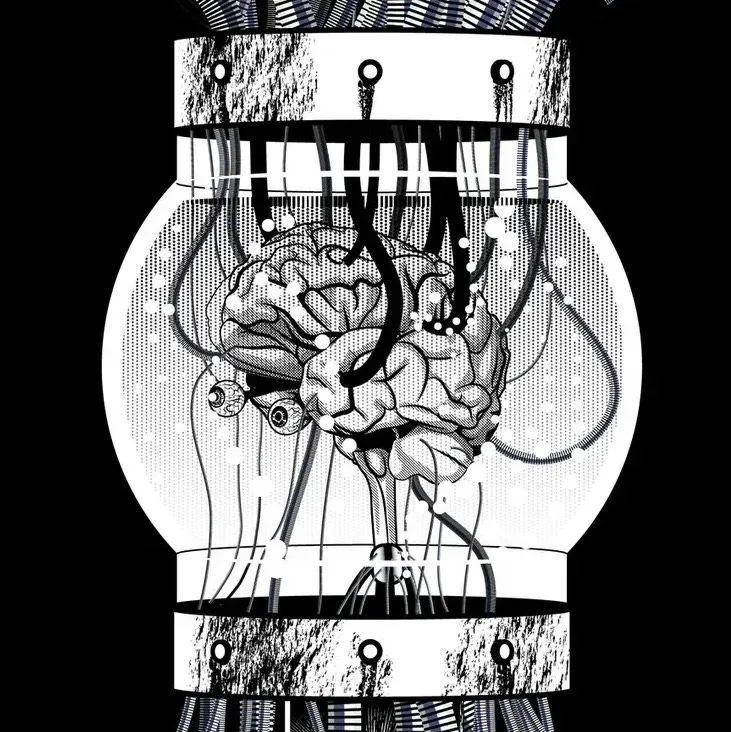
Hilary Putnam (1981)—the Brain in a Vat
Putnam returns—and you’d think it was Halloween! This time updating Descartes’s evil genius for the computer age: could you be a brain in a vat? Arguably, yes! Imagine our experience of the world is generated by electrical impulses from a computer which gives you the impression of having a body, having friends, a life, a big wide world to explore and pay rent in. All of this should be possible simply by stimulating the parts of the brain. When Neo wakes up in a pod in The Matrix, that’s the brain in the vat scenario, only the machines were kind enough to let Neo keep his body (so they could harvest its bioelectric power). Thoughtful. Experience might be reducible to electrical pulses; if that’s true then all we really know about is those pulses firing—nothing about the outside world.
Interestingly, Putnam raised the scenario in order to mount an argument against it. (His approach is a strange, almost circular one: if you had always been a brain in a vat, living a full and rich life, never seeing your true envatted state, then saying “I am a brain in a vat” would technically be false, because your words “brain” and “vat” could only refer to the things in the experience being delivered to you in your mock world. Critics have debated this for decades, because it’s clearly kind of a flim-flammy claim that seems to only prove something about whether the sentence can be stated truthfully. I mean, if I'm envatted, I'm envatted, right? So it’s far from cut and dry, and not really worth getting tangled up in. But fun to argue—I guess. Really, it’s up there with “are fish wet?” if you ask me.) The important point is that if experience depends only on what the brain is doing, a brain given the right stimuli could experience a world just like this one. In essence, Descartes's evil genius returns, now armed with technology that can influence the naked brain directly.
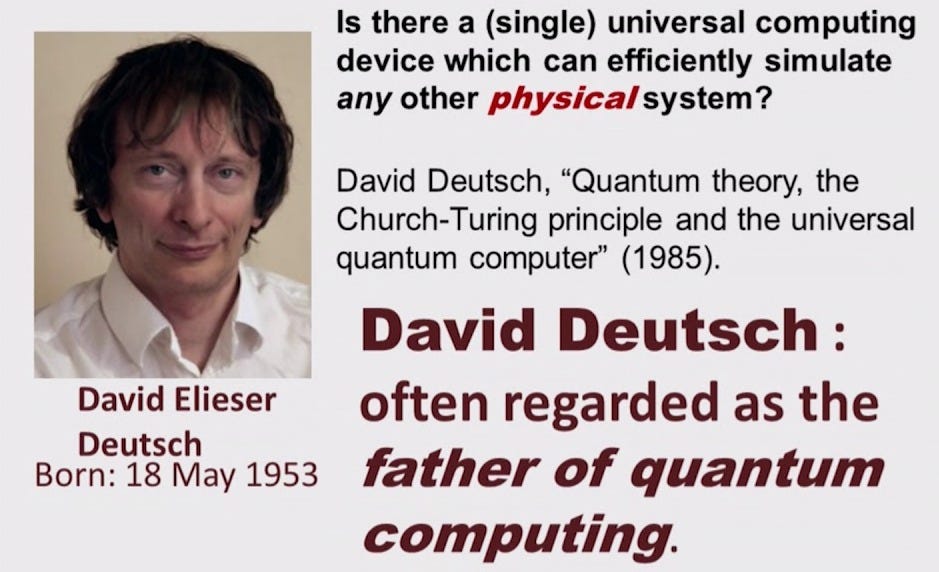
David Deutsch (1985)—“Quantum Theory, the Church-Turing Principle and the Universal Quantum Computer”
In 1982, master of quotes and bongo-player, Richard Feynman flagged a physics problem: classical computers can’t efficiently simulate quantum systems—the resources needed to do so blow up exponentially as the system grows. Feynman speculated that a computer built from quantum mechanics itself might do the trick!
Deutsch took Feynman’s proposal and built upon it by reframing the Church-Turing thesis (above) only now as a claim about physics rather than just about pure math—what he calls the Turing Principle: “Every finitely realizable physical system can be perfectly simulated by a universal model computing machine operating by finite means.” His argument: a classical Turing machine (a computer) can’t actually guarantee that every finitely realizable physical system can be perfectly simulated because it’s simply too expensive, but a quantum computer—built on the same rules nature itself runs on—can.
Interestingly, this isn’t a claim that quantum computers can compute anything new. Deutsch himself is clear that nothing here falls outside what a classical machine could compute in principle, given enough time. So the difference is efficiency, which is the promise of quantum computers. Hopefully.
A quantum computer running on quantum physics should, in principle, be able to simulate any physical system without hitting the exponential blowup that Feynman identified. Simply put: a quantum computer should be able to simulate quantum physics.
1990s
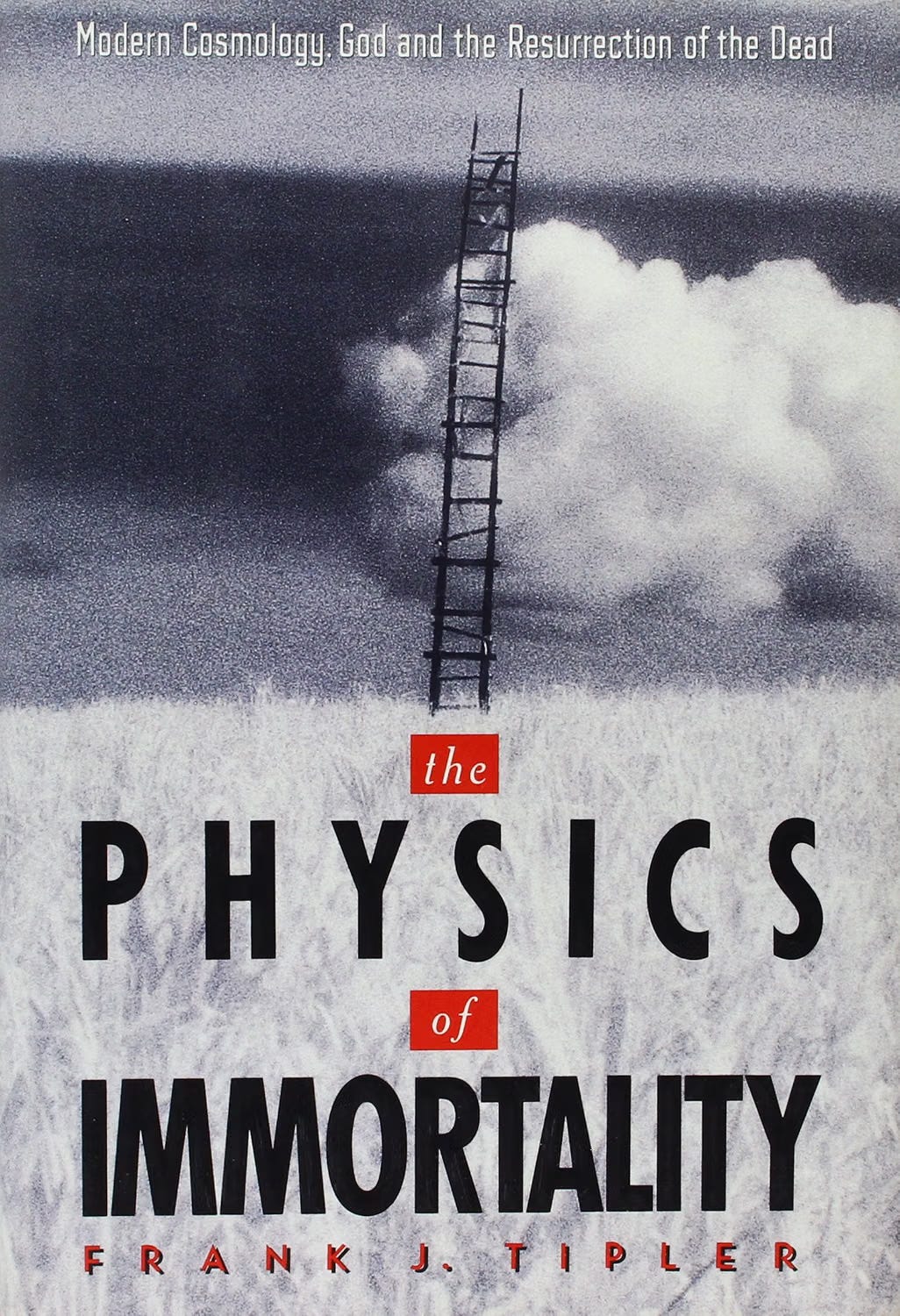
Frank Tipler (1994)—The Physics of Immortality, and the Omega Point
Frank Tipler—a mathematical physicist (famous for proposing that a cylinder spinning near the speed of light that would warp spacetime sufficiently enough to permit time travel into the past)—argued from general relativity and computation theory that as the universe collapses toward a final singularity (the “Omega Point”) a sufficiently advanced future civilization would command effectively infinite computational resources, and would use said resources to computationally resurrect every person who ever lived, in as much detail as the historical record allows. This is might be a way to avoid a cosmic Armageddon: put it all on a computer and hope for the best as the universe around us accelerates into a singularity of matter.
Dainton later reconstructs Tipler’s logic cleanly: “the dead will be resurrected when the computer capacity of the universe is so large that the amount of computer power needed to resurrect [them] is a negligible fraction of the total.” This sounds wacky. It’s worth noting Tipler’s work was met with heavy skepticism from mainstream cosmology (for instance, the collapsing-universe premise alone has since fallen out of favor given accelerating expansion). However, to Tipler’s credit, today there are several startups developing AI interfaces that are trained off of the remaining digital footprint of departed loved ones—in a sense, resurrecting the dead through digital simulacra. This concept is not far removed from Bostrom’s idea of ancestor simulations in his canonical paper (below).
Edward Fredkin—Digital Mechanics and Digital Philosophy
If there’s any person in this lineage worth spending time on, it’s Edward Fredkin. He coined the term “digital physics” outright in 1978, teaching a course under that name at MIT, before later preferring “digital philosophy” instead. Fredkin published a series of foundational papers, which are necessary to cover.
Fredkin’s pitch:
[T]he study of certain phenomena from computer science suggests that there are computer systems (cellular automata) that may be appropriate as models for microscopic physical phenomena. Cellular automata are now being used to model varied physical phenomena normally modelled by wave equations, fluid dynamics, Ising models, etc. We hypothesize that there will be found a single cellular automaton rule that models all of microscopic physics; and models it exactly. We call this field DM, for digital mechanics.
Fredkin’s key papers and what each one contributes:
“Digital Mechanics” (1990, Physica D)—Physics itself is at bottom a reversible universal cellular automaton: a discrete, rule-based process like a computer, and not a continuous field.
“Finite Nature” (1992)—Expanding on Digital Mechanics, Fredkin continues: space, time, and every quantity of physics will ultimately turn out to be discrete, not continuous, at some fine enough scale. This is Fredkin’s Finite Nature Hypothesis. Nothing, including space, will be found to be infinite or continuous: there are only finite, discrete systems at bottom.
“A New Cosmogony” (1992)—Taking Finite Nature as given, Fredkin asks what could lie behind or before the computation running our universe, and proposes a term for it: “Other”—a place with laws and structure of its own, but which doesn’t itself raise the question of origins, because origin is a concept peculiar to our world alone. Here is a long aside, but, as mentioned, Fredkin is an important thinker to know:
As to where the Ultimate Computer is, we can give an equally precise answer, it is not in the Universe - it is in an other place. If space and time and matter and energy are all a consequence of the informational process running on the Ultimate Computer then everything in our universe is represented by that informational process. The place where the computer is, the engine that runs that process, we choose to call “Other”.
Where did Other come from? This question is actually quite easy to fence with. The nature of systems of laws that can support computation is very much broader than the nature of systems that are limited to the physics of our universe. In other words, many of the properties of our world that are necessary for our world to take the form it has are not necessary for other kinds of worlds that can support universal computation. Universal computation, the kind that can simulate other general purpose computers, is even a property of all ordinary commercial computers.
There is no need for a space with three dimensions; computation can do just fine in spaces of any number of dimensions! The space does not have to be locally connected like our world is. Computation does not require conservation laws or symmetries. A world that supports computation does not have to have time as we know it, there is no need for beginnings and endings. Computation is compatible with worlds where something can come from nothing, where resources are finite, infinite or variable. It is clear that computation can exist in almost every kind of world that we can imagine, except for worlds that are sterile or static at every level. Universal computation is essentially synonymous with the idea that something interesting is going on. Worlds where nothing interesting will ever happen are the only kinds of places that cannot support universal computation. What is certain is that worlds that are qualitatively beyond our power to imagine are also capable of supporting computation.
Why this quote? What makes “A New Cosmogony” particularly important here is that Fredkin has finally made an attempt to tarry explicitly with the question that has been floating around in the background since Zuse’s “Calculating Space” in 1969: what could the computational supersystem, the big computer, be like?
Fredkin states the obvious: the Ultimate computer would not be constrained by physics. A computational reality would be governed by computational laws. Not particles. Such a computer would not have to abide by anything remotely familiar to what we experience in our universe. This begins a courtship that we will see throughout simulation theory’s development: the Ultimate Computer as the epistemic frontier.
While Fredkin is not a simulation theorist per se, here, he provides an exploration of what a computational reality could be like given what we already know about computation in general. Namely, that computation is incredibly general. In essence, you need many more rules to support three-dimensional biological life forms than you need to have a computational reality doing work.
So, what makes Fredkin essential to simulation theory is that he has described the computational supersystem reality in a general way and has identified our universe as a subordinate subsystem reality. (What will make simulation theory distinct from Fredkin is that a simulated universe does not need to be continually computed; it could be rendered-on-demand and merely a probability when in the background and completely virtual—a critical difference.) Fredkin’s scenario also does not necessarily require computer programmers or engineers beyond the computational dimension itself. In terms of the purpose of the computation, Fredkin makes the point that to solve some answers, sometimes all one can do is run a computation. Perhaps our experience, our universe, is answering a question, or a series of questions, running a computation to reach a result. He elaborates that the process generating our universe could be a form of intellectual or purposeful activity unlike anything we’d recognize as human or biological thought. Maybe some kind of condition generated by the computer itself, or maybe something just wholly alien to us.
Among his freest work is “On the Soul” (2000, an unfinished draft), in which Fredkin tries to bring the soul into digital physics, treating it as an informational construct rather than a mystical one: a description of the world (W), an interpreter that defines how a particular brain-body processes it (P), and the dynamic content being processed (Q). Running, it is a “dynamic soul”; at rest, like a program on a disk that is not being run, is a “static soul.” He even coins a unit for it, the “soulecule.” It sounds vaguely like Plato’s anamnesis: we never learn anything new, we only remember (something Philip K. Dick brought up above.)
Generally speaking, Fredkin’s contributions, which would inform later iterations of simulation theory, are: (1) nature is finite, discrete, non-continuous; (2) an information-theoretic cosmology; (3) and a description of the Ultimate Computer. Even without his speculations on the metaphysics of a digital soul—for these reasons alone Fredkin is indispensable to the development of simulation theory.
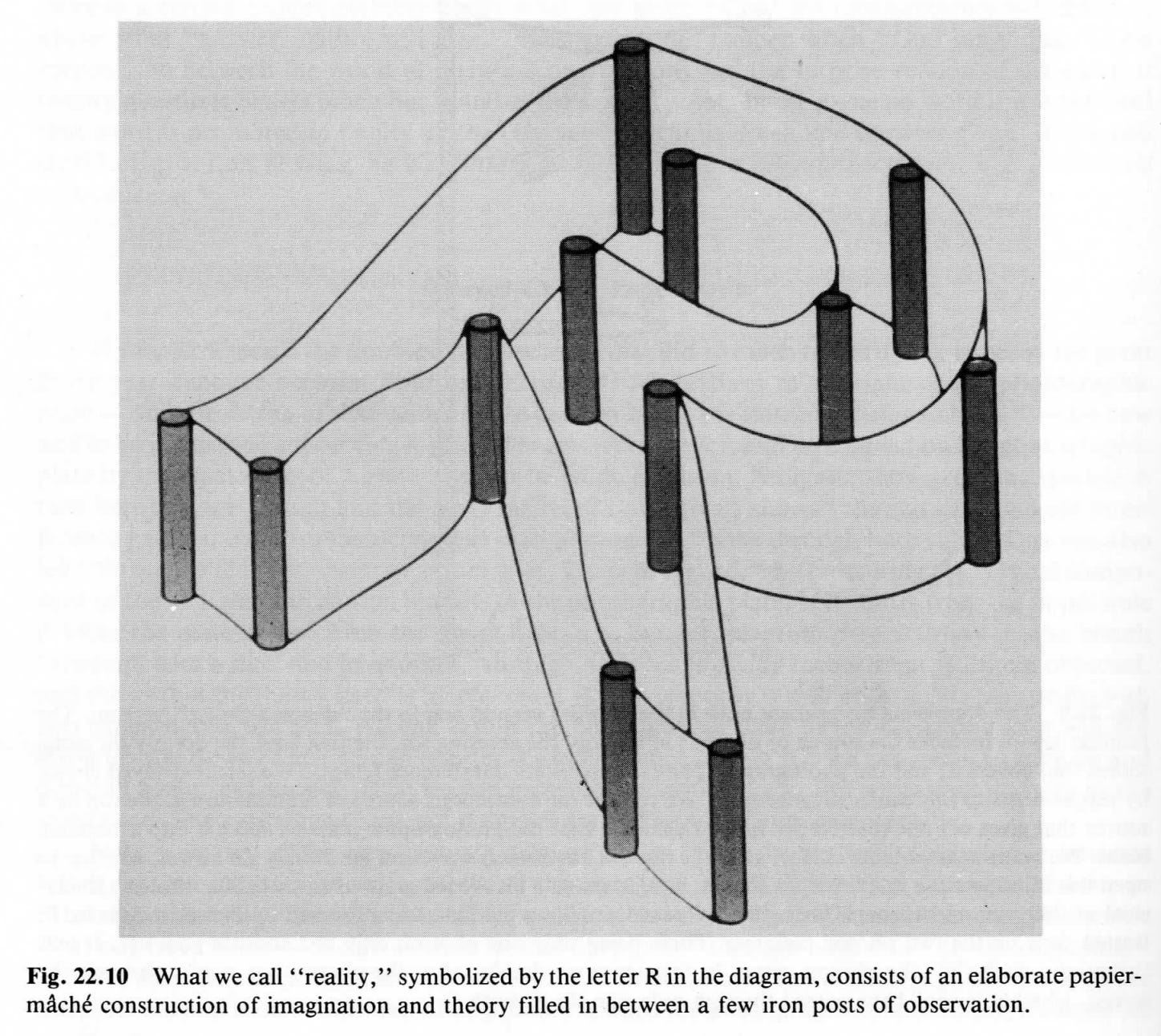
John Wheeler—“It from Bit,” Quantum Foam, and the Participatory Universe
Wheeler is among the greatest theoreticians in 20th-century physics. Working with his mentor, Niels Bohr, he co-developed the first general theory of nuclear fission in 1939—the collaboration that made him internationally known before he’d turned thirty. He went on to work on the Manhattan Project, then later led the conceptual design of the first family of thermonuclear weapons at Los Alamos. After the war, he almost single-handedly revived American interest in general relativity, and mentored a run of physicists who became giants in their own right, including Richard Feynman, Hugh Everett (the “many-worlds” interpretation), Kip Thorne, Jacob Bekenstein—supervising more Princeton physics PhDs than anyone else in the department’s history. Along the way he named or popularized much of the vocabulary black-hole physics now runs on: “black hole” itself, “wormhole,” “quantum foam,” and “geon.” Stephen Hawking called him the “hero of the black hole story.” Max Tegmark described Wheeler as “the last Titan, the only physics superhero still standing.” And his work is foundational to simulation theory, vis-à-vis his idea: “It from Bit.”
Wheeler first floated the idea at a Santa Fe Institute conference in 1989, then formalized it the following year in “Information, Physics, Quantum: The Search for Links.” His famous summary of the claim:
It from bit symbolizes the idea that every item of the physical world has at bottom—at a very deep bottom, in most instances—an immaterial source and explanation; that which we call reality arises in the last analysis from the posing of yes-no questions and the registering of equipment-evoked responses; in short, that all things physical are information-theoretic in origin and that this is a participatory universe. [emphasis in original]
Working independently of Fredkin (above), Wheeler lands on the same destination from the physics perspective rather than Fredkin’s computer-science perspective: information, not matter or energy, is the actual issue worth discussing.
However, Wheeler did not wrestle with cellular automata; rather, his information-theoretic approach zeroed in on the epistemological and ontological complications of quantum mechanics in relation to the observer and the measurement problem. Indeed, his mentor was none other than Niels Bohr, one of the founders of the Copenhagen Interpretation.
Wheeler’s groundbreaking delayed-choice double-slit experiment, first proposed in 1978, went on to push the envelope of quantum mechanical weirdness: a photon’s path can be measured as either a wave or a particle depending on a choice made after it has already passed through the apparatus—meaning a later choice appears to determine what already should’ve happened. Wheeler demonstrated that a particle can go through 99% of an experiment and still not be definitively “real” until that experiment comes to a close. Bizarre stuff. With that (along with all rest of the history of quantum mechanical experiments to consider) Wheeler insisted that the word “observer” is not only naïve but woefully incorrect. We are participants. We cannot merely observe quantum systems. We play a central part in their evolution: namely how they collapse from an unfixed probability (known as a “wave”) to a fixed, registrable, distinct value. Indeed, participancy is true to such an extreme that it even has an effect on systems that have should already made certain choices in the past.
Wheeler pushed this all the way into a formal cosmological claim: the Participatory Anthropic Principle (PAP), his own extension of Brandon Carter’s famous Anthropic Principle. Where Carter’s version says only that we should expect to observe a universe compatible with our own existence, Wheeler’s goes further—arguing that if nothing is “real” until observed, than the universe is entirely dependent on us. Full stop.
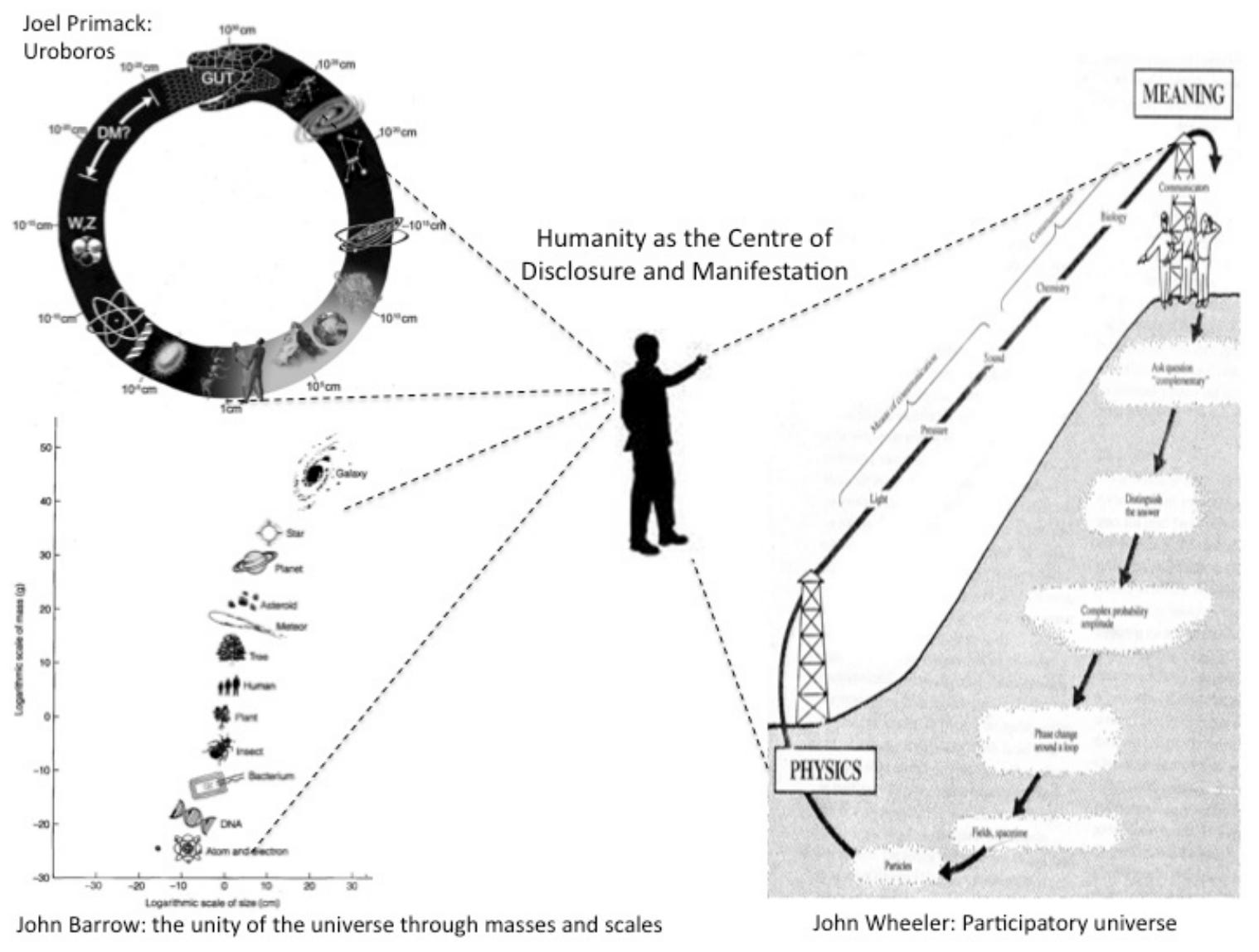
Before the experiment was done and Wheeler was vindicated, he originally explained the same logic at cosmic scale: delayed-choice experiments performed today using light from quasars that began their journey billions of years ago, rather than using lasers in a lab, should abide by exactly the same principle. The photons are not formally “collapsed” until they’re observed, even if they “began occurring” billions of years ago. So sincere Wheeler was that he argued observers arriving billions of years after the Big Bang are retroactively necessary for the universe to settle on a particular thread of its own history. Otherwise, it only exists probabilistically.
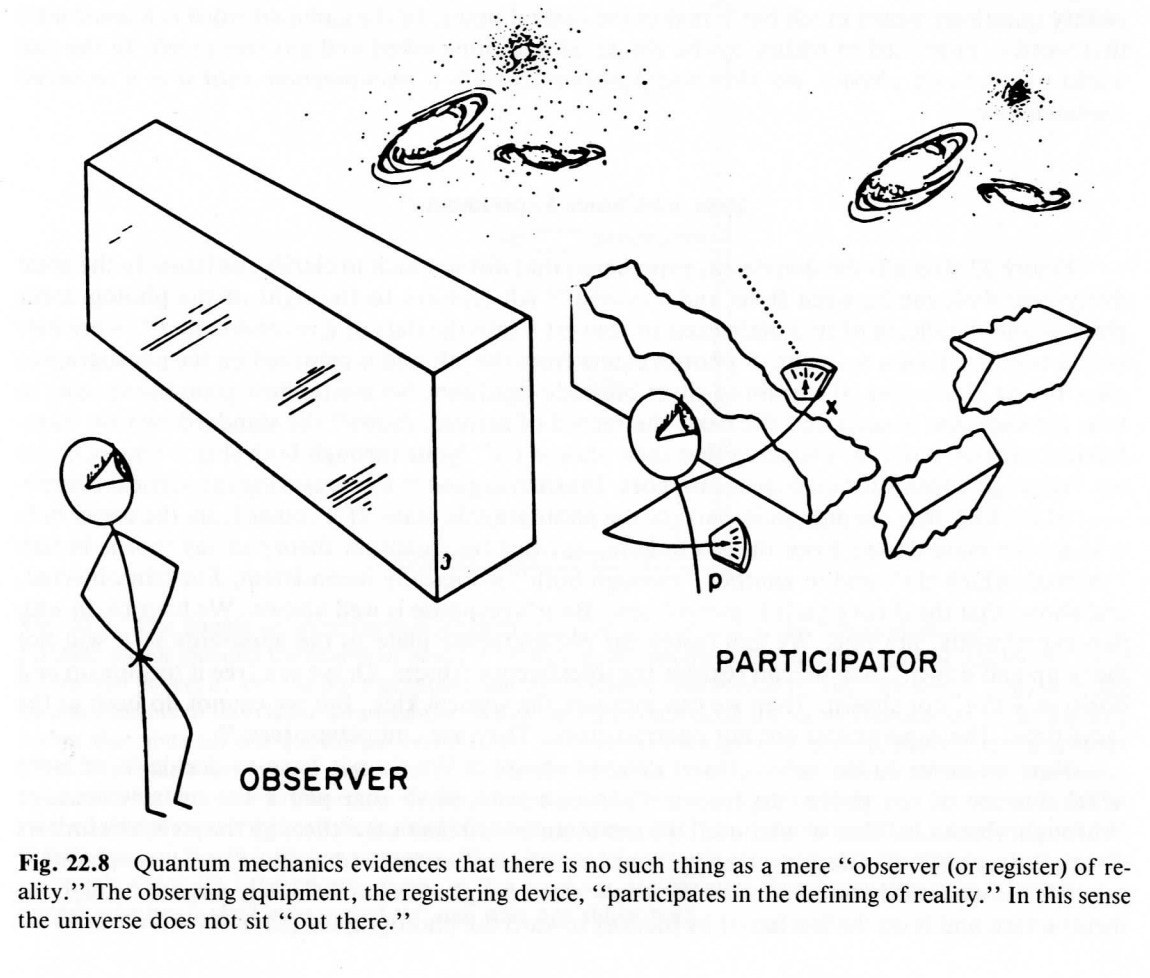
To the simulist, “participant” is an obvious synonym for “player.” “Player” meaning not a spectator standing outside the simulation, but an agent whose participation helps determine what needs to be computed.
Wheeler was not alone in taking the observer this seriously. Andrei Linde, arrived at a strikingly similar conceptual boundary: “Without introducing an observer, we have a dead universe, which does not evolve in time.” The observer does not merely witness the universe’s history; in the quantum description, the observer becomes part of what makes an evolving, knowable history possible by collapsing the wavefunction through participatory interaction/measurement.
Wheeler is arguably the most important physicist for the development of simulation theory before it was formalized in the following years.
Hans Moravec (1992/98)— The Creator, “Pigs in Cyberspace”; “Simulation, Consciousness, Existence” The Birth of Simulation Theory
We’ve saved Moravec for the end of this section for reasons that will become apparent.
Hans Moravec, famed roboticist, inaugurates simulation theory in a 1992 speculative presentation at the American Library Association’s LITA program (San Francisco, June 29, 1992) and then at NASA’s Vision-21 Symposium, Interdisciplinary Science and Engineering in the Era of Cyberspace, at the Lewis Research Center. The conference there covered space colonization, advanced robotics, simulations and virtual reality, quantum computing, artificial intelligence, and incorporating the new concept of cyberspace into space travel. Moravec’s talk “Pigs in Cyberspace” launched what would become simulation theory: “When connected to a virtual reality, the location you seem to inhabit does not exist in the usual physical sense, rather you are in a kind of computer-generated dream.”
Moravec then lays out a scenario. Robots, like satellites, are better adapted to space travel—they don’t have biologies that will instantly perish outside of a suitable atmosphere. So, obviously we’ll be sending more robots out into space rather than people anytime soon. Robots are already further from earth than human beings could ever hope to get to anytime soon, barring some massive technological leaps across multiple fields. Attendees at the conference had already predicted (shockingly) “that computers and robots will eventually become more intelligent than their human creators (predicted to occur 2030-2050).” Far enough into the future, those robots will be building whole infrastructures, “The final frontier [space] will be urbanized, ultimately into an arena where every bit of activity is a meaningful computation: the inhabited portion of the universe will [be] transformed into a cyberspace.” Future robots will turn as much of the universe as possible, from the atom to the planet, into usable computers for itself. If you’re smelling Technological Singularity-type thinking here, your nose is working. As part of this line of thinking, Moravec is willing to pull out the domestication-by-media card as part of his argument:
its possible to anticipate a time, a few decades hence, when people spend more time in remote and virtual realities than in their immediate surroundings, just as today most of us spend more time in artificial indoor surroundings than in the great outdoors.
Moravec then imagines human beings’ minds being downloaded, that’s right, into computers. We might have robot bodies, or we might have virtual avatars. “The picture has us become a ‘brain in a vat’…” The paper wraps:
The very moment we are now experiencing may actually be (almost certainly is) such a [simulation], and most likely is a complete fabrication that never happened physically. Alas, there is no way to sort it out from our perspective: we can only wallow in the scenery.
Moravec’s argument is based on the Ancestor Simulation scenario, which Bostrom will pick up and reinforce a few years later: advanced civilizations should be able to make detailed simulations of the past, therefore there is a very good chance that given the size and age of the universe this should already have happened—meaning we are likely in one.
A few years later, he would expand on these ideas in the 1998 effort “Simulation, Consciousness, Existence.” Here we have the first attempt to run separate threads of physics and philosophy through a simulation-theory lens. While the paper is more speculative than systematic, Moravec lays some groundwork for the discourse proper—covering Plato, Descartes, brain-in-the-vat, functionalism, quantum mechanics, technological advancement, and the like (the very material we have been building on in this blog post). In essence, his work touches on the concerns that will typify simulation theory going forward.
Since Moravec argued that any sufficiently advanced civilization would likely run vast numbers of ancestor and world simulations for research, entertainment, or resurrection of the dead—that means a randomly chosen conscious observer is therefore more likely to be inside one of the simulated worlds than in the one base reality that spawned them. Elon Musk would repeat this very argument on stage two decades later in front of all of the other big CEO tech giants at the 2016 Code Conference, and then also on The Joe Rogan Experience two years later before the rest of us non-trillionaires.
Moravec would also touch on arguments that David Chalmers, one of the most careful and deep thinkers in the field, would wrestle with as well: the ontological meaning of being an agent in a virtual reality. Moravec argued, “A possible world is as real, and only as real, as conscious observers, especially inside the world, think it is!” Chalmers would arrive at a similar verdict stating simply, “Virtual reality is genuine reality.” Chalmers would build, among many other things, an entire research project out of this question of the ontological status of things within a simulation.
Moravec even discusses life after death, which is part of Campbell’s domain in simulation theory literature. Moravec speculates a mind might, after physical death, find itself in totally different reality frames, even “reconstituted in the minds of superintelligent successors” after we “lose our ties to physical reality.” Campbell’s MBT allows for the kind of conscious, willful “movement” for agents like ourselves between systems within the Big Computer. However, it does not require death; one learns to access these systems through conscious intent. Similarly, Campbell states the choices we made during our “experience pack” (lifetime) are evaluated by a higher order process while we prepare for the next respawn.
In this way, Moravec provided preliminary work that Bostrom, Chalmers, and Campbell—three heavyweights of the field—would turn into major projects, or, at least, touch on in their own work. In the case of Bostrom, he’s explicit; in the case of Chalmers, Moravec is known via scholarship and a documented reading; and in the case of Campbell, Moravec might be known, however Campbell makes clear that his material is based on his own experience in exploring the larger reality of the big computer itself.
Moravec’s papers lay out the general groundwork that simulation theory finds itself concerned with. It is, in effect, the preamble for the field and covers, somewhat loosely, what the discourse will find itself examining time and again. What makes Moravec’s work specifically simulation theory, is that his work explores three general criteria: (1) a computational supersystem, (2) a virtual reality subsystem, and (3) that our experience could be such. Have those three issues in play and you’re wading in simulation theory. The only other thinker before him to do so was Philip K. Dick.
2000s—Enter Simulation Theory: The Decade Everything Turns
In 1998 Moravec publishes “Simulation, Consciousness, Existence,” his follow-up to 1992’s “Pigs in Cyberspace.” In 1999 The Matrix is released to much fanfare, as well as the virtual reality thriller The Thirteenth Floor. And in 2003 three major theoretical works on simulation theory dropped: Bostrom’s paper “Are you living in a computer simulation?”, Chalmers’ “The Matrix as Metaphysics”, and Campbell’s 800-page My Big TOE. This marks the launch of simulation theory proper as a robust philosophical discourse.
Upon pain of repeating the previous section’s closing, what might offer us a useful definition for simulation theory as a category of philosophical thought could be reduced to any model that includes these three major criteria: (1) a computation supersystem, (2) a virtual reality subsystem, (3) and our experience could be such.
Without these three, we are not quite talking about a simulation theory in the classic sense of agents interacting with a computer-generated world.
Ushering us into this strange, brave new era is none other than Nick Bostrom, whose paper was published early that year.
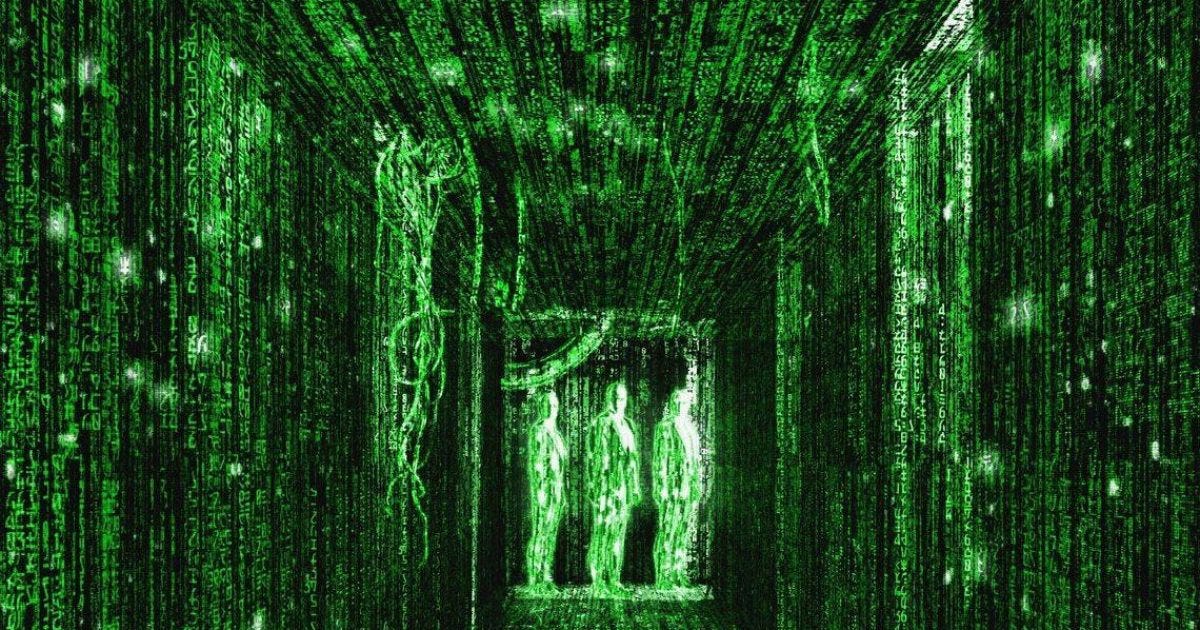
Nick Bostrom (2003)—“Are You Living in a Computer Simulation?”
The canonical paper that launched a million debates and late night discussions. Bostrom runs with Moravec’s ancestor simulation concept to famous effect; he does not start with extra dimensions or cellular automata dynamics, or any other novel requirements. Rather, he takes our world as is conventionally assumed (good ole physical material monism—conventionally we could say, “everything is matter”) and adds a single extra assumption: Putnam’s functionalism and with it substrate independence is valid; a mind can be instantiated in anything functionally equivalent to a “mind’s” processes (above). Substrate be damned. Bostrom’s initial assumptions here metaphysically-speaking were not seen as a stretch because as it stands the conventional wisdom already skews towards physical monism, and functionalism, as mentioned, is in fact the most popular Philosophy of Mind among professional philosophers (PhilPapers Survey).
So, with that patently non-exotic framing, Bostrom introduces a trilemma, a three-part problem, with some truly exotic results—either: (1) civilizations almost never reach the technological capacity to run high-fidelity ancestor simulations, or (2) they reach it but choose not to run them for some reason, or (3) “we are almost certainly living in a computer simulation.” Bostrom’s own framing here is careful—this is the Simulation Argument, not proof of any hypothesis—but it’s the paper that took the idea and placed it safely inside analytic philosophy, complete with in-depth probability calculations.
Now, when you factor in how old the universe is and how many advanced civilizations there might plausibly should be, the third horn of the trilemma becomes the one worth taking seriously—but obviously that is only if you’re already inclined to doubt the first two: that civilizations reliably destroy themselves, or that the ones who survive reliably choose not to run these simulations. There has been some pushback, and Bostrom has gone into detail about specifics in his original paper, given the amount of interest and furor it generated. Indeed, the paper has been cited on Google Scholar thousands of times. Where Moravec’s paper is a collection of loose speculations and interpretations, Bostrom’s paper is a work of real rigorous philosophy, which simply lays the possibility on the table probabilistically.
This level of engagement required Bostrom to maintain a Simulation Argument FAQ, clarifying the argument against two decades of objections; its own stated aim there is narrower and more careful than the pop-culture version, stating: “we have interesting empirical reasons to believe that a certain disjunctive claim about the world is true.” Bostrom also published other replies to his work. In that time, he has not been required to substantially modify his original argument. It continues to stand.
It is worth being specific about what makes Bostrom’s paper truly a work of simulation theory proper. In this paper, rendering-on-demand is introduced. This is the paper’s most fascinating and devastating blow: the computer would not and should not render all of physics. Instead, it should only present to the agent an intersubjectively coherent first person experience that is immersive amongst multiple agents, as in a massive multiplayer online game. Even 20 years after the fact, physicists still have trouble handling this notion (as we point out in Frontiers of Physics Edge & Brown, 2026). Here we have the specific ontological case being made in the contemporary era for interpreting the world as an actual virtual reality from within the analytic tradition. When we take in Bostrom’s argument for computational economy, what we are left with is an “ad hoc” experience that not unlike the arguments ancient thinkers made thousands of years before. He states, “While the world we see is in some sense ‘real’, it is not located at the fundamental level of reality.”
So, when we take a step back and look at it, Bostrom accomplishes two particularly impressive maneuvers with this deservedly famous paper: (1) he demonstrates that experience could be a simulation using a simple probability argument that employs the least exotic assumptions of reality; (2) from that, he achieves rendering-on-demand as a natural consequence of computational economy—possibly the most exotic interpretation of reality possible (no object permanence, spacetime is entirely non-fundamental, we live in a virtual reality, etc.) This is what makes the paper an accomplishment of particular and lasting note: physical realism can be easily undermined from within physics itself once computation is allowed into the fold.
It’s worth closing with this: Bostrom’s paper is so well-known that it is often assumed to be the only version of simulation theory—that the simulation type in question must be an ancestor simulation run by an advanced civilization. As we shall see moving forward, it becomes clear that while Bostrom offered a simple, coherent, logical scaffolding, his Argument is but one approach to the question: “are you living in a computer simulation?” What Bostrom did do, however, was nothing short of founding a new territory that would otherwise may have only been a blip—one marked by an explosion of papers, debates, books, interviews, as well as hugely successful pop culture influences like Rick and Morty.
Tom Campbell (2003–2007)—My Big TOE Trilogy, Simulism’s first Theory of Everything
Campbell is by far among the most interesting entries on this list. A former scientist for NASA, the Department of Defense, and U.S. Army Technical Intelligence, he did graduate coursework and thesis research in experimental nuclear physics at the University of Virginia before leaving the program short of the doctorate, going on to a decades-long career in missile defense and large-systems risk analysis. Alongside that day job, he also had what amounted to a part-time job studying the frontiers of consciousness with Robert Monroe, author of Journeys out of the Body (1971), negotiating fifteen to twenty hours a week in Monroe’s lab in exchange for training in how to go out-of-body—work that would eventually become the Monroe Institute.
Campbell one of the few absolutely confirmed simulation theorist on this list. Moravec claimed it was almost certain and even Bostrom famously “bunts” when asked whether we are actually living in a simulation. Campbell offers no such ambiguity, giving it a probability of 1: “We live in a computer simulation,” he’s said in countless interviews and lectures. Being a physicist as well as a confirmed simulation theorist, Campbell makes the unusual move of dismissing materialism entirely, claiming physics is all virtual, and takes consciousness itself as fundamental instead. If reality is virtual, then we return to Descartes: at least we can be certain of our own agent-hood. The player is real; the environment is representational—virtual.
The result is a Theory of Everything (TOE) he humorously titled My Big TOE—“My” for the subjective, first-person nature of the model, and “Big” because it claims to cover metaphysics as well as physics in one account. Shorthanded as MBT.
The headline accomplishments MBT claims include unifying general relativity and quantum mechanics with metaphysics and the origin of consciousness in one framework; solving the hard problem of consciousness by treating it as fundamental rather than an emergent byproduct of matter; explaining the measurement problem and the observer effect directly, rather than leaving them as brute mystery; explaining why reality is at root probabilistic (why the quantum?); why information became indispensable to quantum theory; why the speed of light is a constant; accounts for near-death and out-of-body experiences, and other anomalous phenomena as consequences of the system’s actual architecture rather than anomalies to explain away; and even covers morality, treating “good” and “evil” (socially profitable or unprofitable) as measurably lower- and higher-entropy choices within an information system. It truly is a Big TOE and it is the first logically complete and in-depth philosophy with simulation theory at the center.
The mechanics: assuming consciousness is fundamental, MBT describes consciousness as a binary information system requiring only awareness plus a free will choice function. That’s consciousness: awareness (information input) with a choice. These non-physical “reality cells” function similarly to cellular automata, but not on any grid of physical space—they’re the most basic units of consciousness itself, capable of differentiating this state from that state. (Nothing more is needed to bootstrap a whole reality from there.) That original consciousness then splits itself into countless pieces in an effort to discover strategies for lowering its own overall information entropy. Entropy is a system’s tendency to skew toward disorder; when that happens to an information system, things become incoherent, meaningless, chaos, noise—when you delete a file on your computer, you’re telling those bits to randomize, to scatter into incoherence. Lowering entropy means staving this off, which is accomplished through organizing coherence, cooperation, and in MBT, the system has developed a learning-based strategy for exactly that: social interaction. The system is, in essence, learning how to “get along” with itself, evolving by favoring choices that increase coherence and cooperation between its own individuated parts as opposed to choices that increase fragmentation and conflict.
Ostensibly, Campbell has taken Fredkin’s Other (above), the nonphysical computational supersystem, and declared it conscious—the Larger Consciousness System, with each of us cast as an Individuated Unit of Consciousness: distinct, but never actually disconnected from the whole, a networked strand within the larger system that is here to make choices that raise or lower the entropy of the whole system. Physical reality itself, in this picture, functions as a kind of VR trainer: a stable, rule-bound environment purpose-built to give each unit a consistent enough world to make real choices in and learn real consequences from. This is why the universe was made: to provide consequential feedback for player’s choices. We are basically agents in a simulation learning how to use choice efficiently (pro-socially). It is, in a sense, our moral training data.
Interestingly, Campbell proposed this idea before the widespread use of commercial AI—same for Bostrom, Fredkin, and every other computational-cosmology thinker on this list. None of them focused on how the computational supersystem would obviously be AI-like, and therefore “mind-like”. Today, when we imagine a computer sophisticated enough to generate a fully-convincing, fully-responsive VR experience, it feels almost obvious to say the machine doing that job would be an AI. None of them specifically modeled the supersystem as conscious itself, or an AI. And today, AI’s can produce virtual worlds from a single prompt.
Campbell’s motive for why the simulation would be run differs from Bostrom and Moravec’s ancestor simulation concepts of studying the past, or entertainment, or resurrecting the dead. Campbell places the motive on the system’s own survival: running the simulation is how the Larger Consciousness System lowers its own entropy and keeps itself from degenerating into noise. The computer is like a big mind that has broken itself into smaller minds, all with the shared mission of learning how to become a better, more effective and coherent organization.
“Why haven’t we seen your name in lights?” Campbell has said, recalling a question put to him during his London lecture. Campbell is not an academic physicist and has stated that he is no fan of writing papers. When the complete My Big TOE manuscript—eventually published as an 824-page trilogy—was first shopped to publishers in the early 2000s, it was rejected as unplaceable in the market, and Campbell self-published instead. Campbell grindingly generated some attention for the larger technical community, with his biggest supporter being the renowned German-American astrophysicist Bernard Haisch, formerly of Lockheed Martin’s Solar and Astrophysics Laboratory. In 2017, Campbell co-authored his first peer-reviewed paper on the topic, “On Testing the Simulation Theory,” alongside Houman Owhadi—a professor of applied and computational mathematics at Caltech—Joe Sauvageau, and David Watkinson, in the International Journal of Quantum Foundations. This paper covers the mechanics of rendering-on-demand in quantum physics experiments. Academic engagement with Campbell’s work has picked up since its publication, with fifty citations on Google Scholar.
Since the publication of his book, Campbell has uploaded thousands of hours of talks and interviews on his YouTube page, answering questions and going into granular detail on his model. What makes MBT of particular note is that it is a genuine attempt at a good ole fashion scientific Theory of Everything, and it appears to accomplish what it sets out to do albeit with a single assumption: consciousness exists. Campbell and MBT are the first and arguably most robust simulation theory model that attempts to provide a simulist explanation for the totality of experience.
David Chalmers (1966– )—The Hard Problem and the Case for Simulated Reality
Of everyone in this lineage, Chalmers may be the hardest to place on a single date as his real contribution is building the modern field. Indeed, before there was an academic discipline called “consciousness studies” with its own journals, conferences, and institutional weight, there was, in large part, David Chalmers making the case that it needed to exist.
Chalmers originally trained as a mathematician—obtaining a degree at the University of Adelaide, then Oxford as a Rhodes Scholar. At thirteen he’d read Douglas Hofstadter’s Gödel, Escher, Bach, and the seed it planted eventually won out: in 1989 he switched fields entirely, moving to Indiana University specifically to work under Hofstadter himself, finishing a 1993 philosophy PhD thesis Toward a Theory of Consciousness.
At the first Tucson “Science of Consciousness” conference in 1994, Chalmers gave the talk that named the thing everyone in the room had been circling without quite being able to say it: the hard problem of consciousness. The “easy” problems consist of how the brain discriminates stimuli, integrates information, reports on its own states and so on. They are hard in the ordinary scientific sense, but they are the kind that neuroscience will almost certainly go on to eventually solve. However, the real hard problem is different in kind: even a complete functional account of everything the brain does leaves open why any of it is accompanied by or produces subjective experience at all. He formalized it in “Facing Up to the Problem of Consciousness” (1995), then built it to book length in The Conscious Mind (1996) where he attempts to defend dualism against physicalism via the philosophical zombie: a being physically and behaviorally identical to a conscious person, but with no inner experience at all. It’s a “person”, but with no driver at the wheel.
He co-founded the Association for the Scientific Study of Consciousness, and later co-founded PhilPapers with David Bourget; the database that now organizes most of professional academic philosophy. Today he’s at NYU, University Professor of Philosophy and Neural Science and Co-Director of the Center for Mind, Brain, and Consciousness—NYU Philosophy being both the #1 program in the English-speaking world as well as globally. Chalmers is about as close to the top as one can conceivably reach in the academic world, and for twenty years he’s endorsed and researched the simulation hypothesis.
In 2003, Chalmers’ published the “The Matrix as Metaphysics” at the request of philosopher Christopher Grau on behalf of the Wachowskis for the accompanying website tied to the release of The Matrix. It was later published in Philosophers Explore the Matrix (Oxford University Press, 2005).
When the possibility of a matrix is raised, a question immediately follows. How do I know that I am not in a matrix? After all, there could be a brain in a vat structured exactly like my brain, hooked up to a matrix, with experiences indistinguishable from those I am having now. From the inside, there is no way to tell for sure that I am not in the situation of the brain in a vat. So it seems that there is no way to know for sure that I am not in a matrix.
Of important note, rather than just exploring the philosophical implications the film puts forth, Chalmers makes clear that a field worthy of serious consideration has been inaugurated with Bostrom’s particular effort.
The Matrix Hypothesis is one that we should take seriously. As Nick Bostrom has suggested, it is not out of the question that in the history of the universe, technology will evolve that will allow beings to create computer simulations of entire worlds. There may well be vast numbers of such computer simulations, compared to just one real world. If so, there may well be many more beings who are in a matrix than beings who are not. Given all this, one might even infer that it is more likely that we are in a matrix than that we are not. Whether this is right or not, it certainly seems that we cannot be certain that we are not in a matrix.
What makes “The Matrix as Metaphysics” required reading is Chalmers offers the first general overview of variations of the simulation hypothesis including multiple metaphysical arrangements as well as their consequences, speculation on what life would be like in a simulation, and explores nine possible objections to the premise outright. Chalmers is quick to make clear, “I will argue that the hypothesis that I am envatted is not a skeptical hypothesis, but a metaphysical hypothesis. That is, it is a hypothesis about the underlying nature of reality.”
For decades, Chalmers would continue to publish and speak on the simulation hypothesis, culminating in his 2022 book Reality+: Virtual Worlds and the Problems of Philosophy. In it, he offers: granting that we might be simulated, does that actually mean nothing is real?
He sets up five separate tests for what “real” could mean: (1) does it exist, (2) does it have causal power, (3) is it mind-independent, (4) is it non-illusory, (5) is it genuine (not a counterfeit). Take an ordinary cup versus a cup rendered inside a simulation. The simulated cup exists as a structure of bits, but existing all the same. It has causal power: it can be picked up, knocked over, interacted with by whatever’s inside that world. It’s mind-independent: its properties don’t depend on any single mind perceiving it; the simulation runs whether or not anyone’s looking. It’s non-illusory: it looks like a cup and, within that world, actually functions as one, with no gap between appearance and underlying reality. And it’s genuine, not a counterfeit standing in for a “real” cup somewhere else.
Chalmers argues a perfectly simulated cup comes out real by every one of the above criteria. Thus, if we are in a simulation, it is not a skeptical scenario in which nothing you believe is true. Instead, it is a metaphysical scenario where something other than what you assumed is generating the world. But inside the simulation, it is all still entirely consequential. “Even if I am in a matrix, my world is perfectly real,” as he put it in the 2005 paper that started this argument: a simulated tree is still a tree, just made of bits instead of atoms one level further down.
This hasn’t gone unchallenged. Steffen Koch, a philosopher at Bielefeld University, has pointed out that ordinary role-play and fiction can satisfy the first four of Chalmers’ five criteria just as well as a simulation can. A game of make-believe has causal power, mind-independence, and non-illusoriness within its own frame, yet nobody thinks the goblin at the table is real. If that’s right, the five-criteria test may prove less than Chalmers hopes for. Chalmers’ own reply leans hard on the fifth criterion, genuineness, and on permanence—a perfect, lasting simulation is doing something a five-minute game of pretend isn’t. Whether that fully answers Koch is still argued over.
Chalmers gives the likelihood that we are in a simulation 25% or so. “That is a big number, surely big enough to affect practical decision making in low-feedback contexts,” notes philosopher Peter Godfrey-Smith. And as recently as 2024, Chalmers published “Taking the Simulation Hypothesis Seriously” an engagement with notable critics of the field.
Seth Lloyd (c. 2005–06)—The Universe itself is a Quantum Computer
In 2006, Seth Lloyd published Programming the Universe: A Quantum Computer Scientist Takes On the Cosmos. Lloyd is not a simulation theorist, nor does he endorse it. In fact, he’s a critic of the project. Lloyd claims the universe computes itself, and quantum mechanics is basically the operating system it runs on. This pancomputationalist work sometimes gets confused with simulation theory by the casual observer. The universe is a computer is an entirely different metaphysical commitment than the universe is the result of a computer. Indeed, by necessity, one is suggesting the existence of a separate, more fundamental reality from the physical universe we experience: the computer. Despite equating the universe with computation, Lloyd is certainly not making any kind of simulation argument.
Further, where fellow pancomputationalists Fredkin and Zuse proposed classical cellular automata for the mechanics behind a fully digital computational universe, Lloyd proposes the universe itself is a quantum computer, continuously processing the information encoded in every particle’s state. His later paper, “The Universe as Quantum Computer” (2013), lays out the actual argument for why: entanglement, per Bell’s theorem, can’t be reproduced by any local classical system such as a cellular automaton, which Lloyd claims rules out Fredkin and Zuse’s version outright. Instead, a quantum computer, built from the same quantum rules nature runs on, can reproduce it efficiently. Lloyd even revives the French probabilist Émile Borel’s old thought experiment of monkeys typing on typewriters, updated for a computational universe analogy. Monkeys typing random noise into a computer, rather than onto blank pages, have a real chance of producing complex, ordered structures rather than gibberish, since short programs can generate enormous complexity. His point: quantum fluctuations are like the monkeys generating random phenomena, and the universe is the computer that eventually orders it. It’s quantum monkeys all the way down.
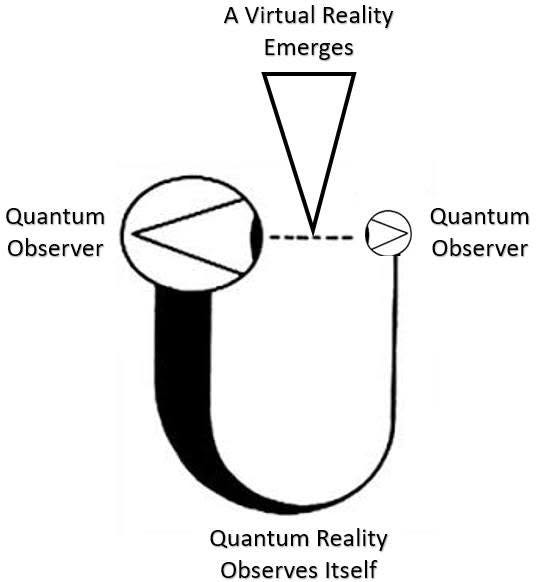
Brian Whitworth (c. 2007)—“The Physical World as a Virtual Reality” and Quantum Realism
Brian Whitworth might best be introduced with this demolishing quote regarding the reasons why physics must consider simulation theory. He writes:
VR theory is only on the table because objective reality theory doesn’t explain modern physics. In an objective reality time does not dilate, space doesn’t bend, objects don’t teleport and universes don’t pop into existence from nowhere. We would not doubt the world’s objective reality if only it behaved so physically, but it does not. Adjectives like “strange”, “spooky” and “weird” apply, and common sense concepts like object, location, existence, time and space simply don’t work. The world of modern physics doesn’t behave at all as an objective reality should.
In the early 20th century, physicists were presented with the completely unexpected world of the quantum, and have been struggling to try and maintain some kind of Newtonian orientation, some kind of physical-monist position, or have dismissed these seemingly unapproachable mysteries for the famous dictum, “Shut up and calculate” ever since. Over the course of several chapter length essays (which has culminated in something of an online book), Whitworth urges physicists to take their own observations more seriously.
Modern online games show that information processing can create virtual “worlds”, with their own time, space, entities and objects, e.g. “The Sims”. However that our physical world is a virtual reality (VR) is normally considered a topic of science fiction, religion or philosophy, not a theory of physics. Yet the reader is asked to keep an open mind, as one should at least consider a theory before rejecting it.
By his own account the whole project started with a single stubborn question: why does the universe have a maximum speed at all? Why should a speed limit exist in the first place, when nothing about “empty space” as an object seems to demand one?
Whitworth published “The Physical World as a Virtual Reality: A Prima Facie Case,” Research Letters in the Information and Mathematical Sciences, Vol. 11 (2007), an opening salvo for his “quantum realism” approach to physics, which includes a famous correspondence table that features the overlap between computing and physics; a formal list pairing a virtual-reality property with the exact physical phenomenon it would predict, and vice versa:
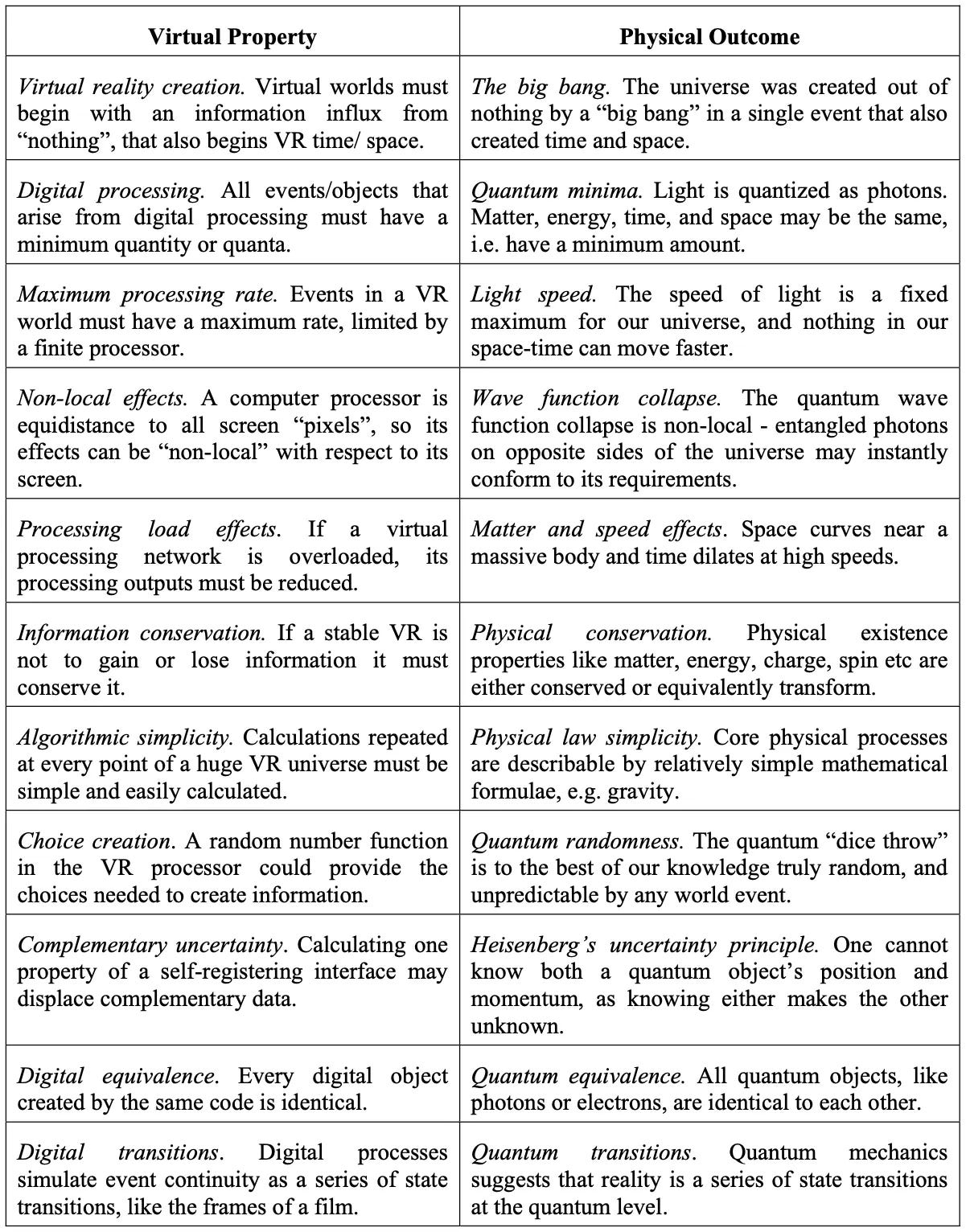
Whitworth was careful, even in this first paper, to lay out exactly how such a theory should be judged—a response to the obvious charge that any theory can be reverse-fitted to explain anything. He offers four possible verdicts: (1) the matches are spurious (assumptions chosen to force the fit), (2) coincidental (true but meaningless), (3) merely useful (a helpful new lens), (4) or veridical (actually true). Whitworth states the case only strengthens only if the matches are many, detailed, and unforced.
So what actually is quantum realism, and is it simulation theory? Depends which version of “simulation theory” you mean. Whitworth’s own one-line summary: in physical realism, the physical world is real and the quantum world is just abstract math describing it; in quantum realism, that’s reversed—the quantum world is the real one, and the physical world is the virtual reality it generates. That’s a virtualism claim of some kind for sure. But it’s not simulation theory in Bostrom’s or Campbell’s sense. There’s no external programmer, no posthuman civilization, no “base reality” running our universe as one project among many on separate hardware. The quantum level simply is the more fundamental layer. That makes quantum realism closer to Wheeler’s “it from bit” and the digital-physics tradition (Fredkin, Zuse, Lloyd) than to Bostrom’s ancestor-simulation argument, for Campbell’s larger consciousness system rendering experience on-demand. Nevertheless, his work in examining physics is indispensable to the field.
The 2007 paper grew into a genuinely sprawling project: a two-part, seven-chapter reconstruction of physics, running well over a hundred pages before the annex, glossary, and FAQ.
Part I works through the physical world level by level, treating space as a network of connected nodes and time as its discrete processing cycles, explaining the double-slit experiment and entanglement through a “client-server” model, and offering a testable prediction (colliding sufficiently intense light should create matter directly)!
Part II turns to the observer, taking on the hard problem of consciousness and, in a still-unfinished final chapter, trying to treat mysticism and science as two methods for studying the same thing. He is also combative: he dismisses many-worlds as a “zombie theory,” and he admits up front that one piece of genuinely incomputable physics would kill the theory. An annex, “Varieties of Virtualism,” written in dialogue with Tom Campbell. The whole project is fascinating, essential reading for the simulation theorist that wants to examine what it might say about physics.
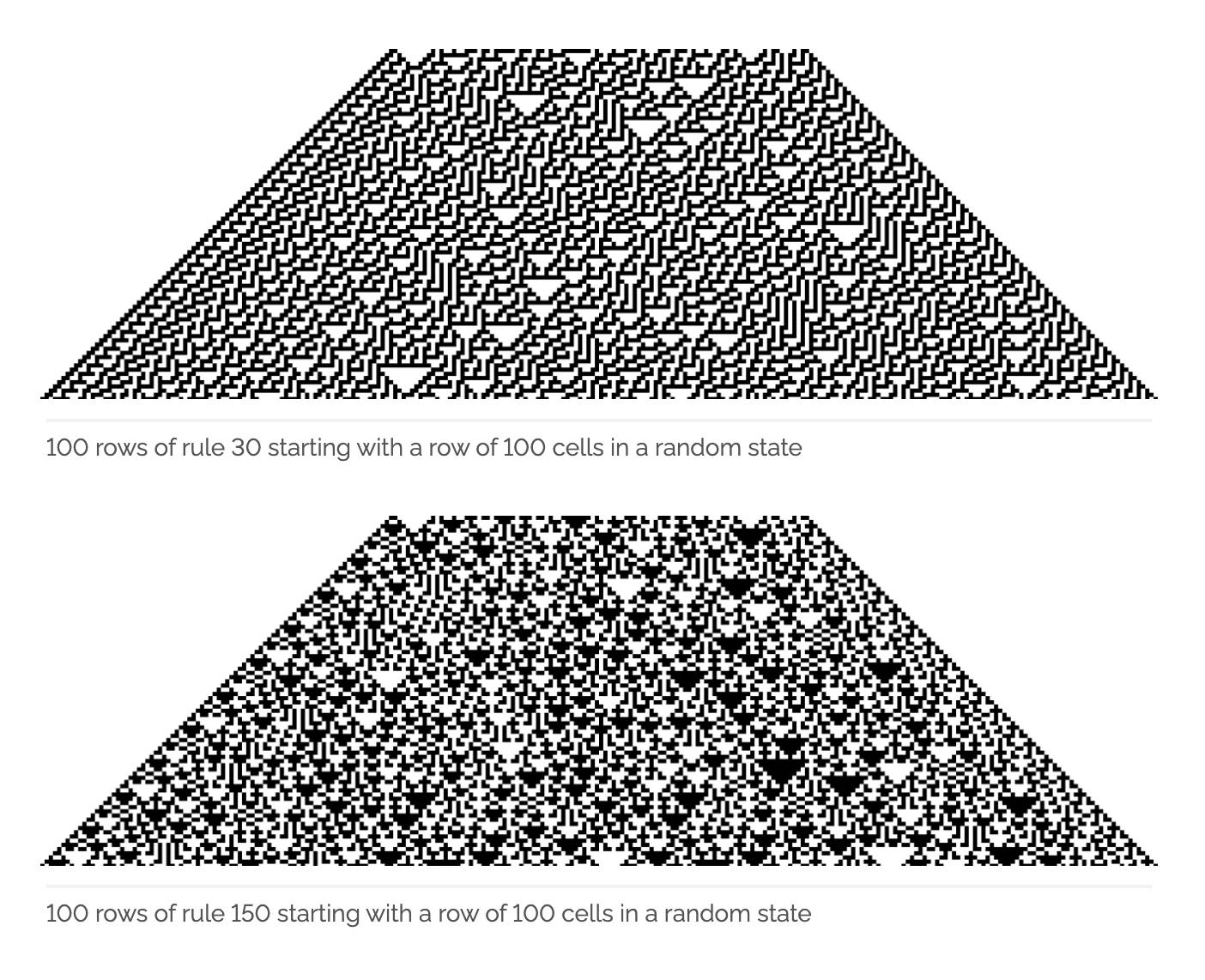
Stephen Wolfram (2002/2020)—A New Kind of Science and the Wolfram Physics Project
Millionaire science badboy Stephen Wolfram spent the 1980s and ‘90s systematically cataloguing the behavior of simple cellular automata—grids of cells updated by a uniform local rule (Conway above). While experimenting with them he found that even the simplest possible rules could generate genuine, unpredictable complexity.
His single most famous discovery, Rule 30, starts from one black cell and one trivial rule, and it produces a pattern with no discernible order at all. By his own account, Wolfram called it “the most surprising thing I’ve ever seen in science.” He spent over a decade turning that observation into a 1,200-page manifesto, A New Kind of Science (2002), whose central claim is that nature itself runs on the same principle: simple computational rules, not continuous equations, are the right foundation for physics, biology, and complexity generally, and that the universe at bottom may be nothing more than a giant cellular automaton computing itself forward one step at a time. (This lands Wolfram squarely in Fredkin and Zuse’s lineage of thinkers who treat computation not as a metaphor for physics, but as physics itself.)
Wolfram didn’t stop there. In April 2020, he and a small team of collaborators (Jonathan Gorard chief among them) launched the Wolfram Physics Project, an attempt to derive the whole of known physics (general relativity, quantum mechanics, the Standard Model) from a single, radically minimal starting point: a hypergraph.
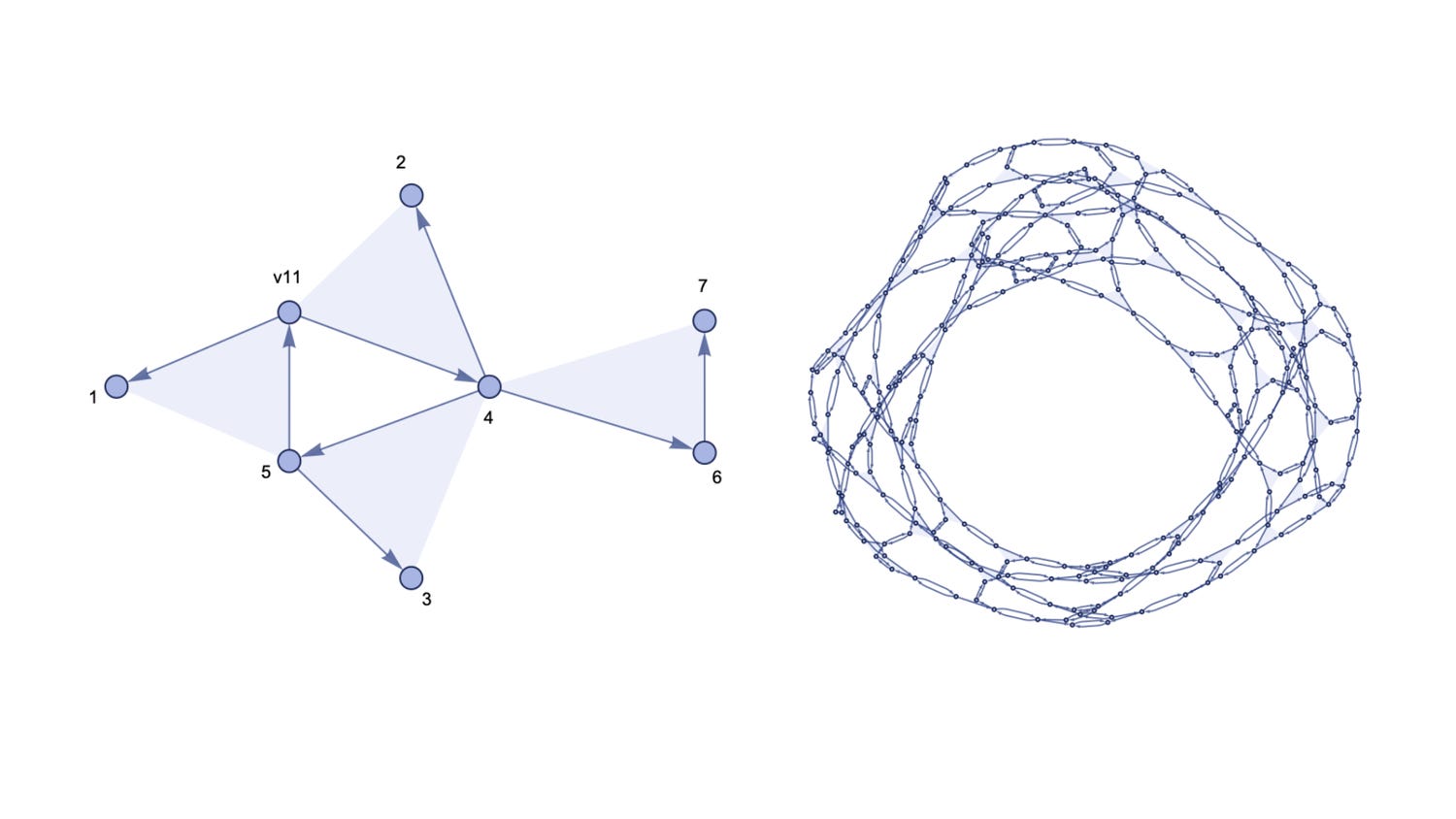
An ordinary graph connects points to other points one at a time; a hypergraph generalizes this by letting a single edge link any number of points at once. Wolfram’s proposal is that the universe is, at bottom, nothing but a hypergraph of abstract, structureless nodes connected by hyperedges with no built-in geometry at all—no distance, no dimension, no coordinates—updated over and over by simple local rewrite rules.
Space, in this picture, isn’t a container the universe sits in; it’s just the large-scale pattern that emerges from how densely the hypergraph’s nodes happen to be connected. Time is the process of the rule being applied, again and again, forever. Run the right rule-process long enough, Wolfram claims, and structures that look exactly like relativistic spacetime, quantum entanglement, and even gravity fall out the other end, entirely unplanned.
The physics community’s initial reaction was frosty. Wolfram announced the project himself, on his own website, rather than through peer review, and many physicists dismissed it as more marketing than physics. Sabine Hossenfelder, the physicist and science communicator known for her sharp public criticism of speculative theoretical physics, was openly dismissive at first, tweeting in 2020: “I looked at it and don’t think it’s interesting.”
Years later, though, she revisited the project in a widely watched video and came away considerably warmer—going so far as to treat it as a viable theory-of-everything candidate, and characterizing the whole thing, tellingly for this piece specifically, as “basically an attempt to put the simulation hypothesis on a solid mathematical basis.” She’s also careful to credit where it’s due: by her own account, it’s Wolfram’s collaborator Jonathan Gorard who did most of the actual technical work connecting the hypergraph model to real relativistic and quantum-mechanical structure.
Whether or not the Wolfram Physics Project ends up being the correct interpretation, it is a robust attempt to treat “the universe is a computer” as an actual, falsifiable research program.
2010s
Silas Beane, Zohreh Davoudi & Martin Savage (2012)—“Constraints on the Universe as a Numerical Simulation”
Beane, Davoudi, and Savage came at the hypothesis as working lattice-QCD physicists, people who already simulate pieces of the universe on grids for a living. Their reasoning: extrapolate current trends in computing power for that kind of simulation, and a future civilization could simulate a whole universe the same way, on a discrete space-time grid. If so, the grid should leave evidence, fingerprints. Their best candidate is the highest-energy cosmic rays. A cubic lattice breaks rotational symmetry, so those rays’ directions would show a faint cubic pattern instead of being perfectly random.
The same logic gives a limit from data we already have: the observed cutoff in the cosmic-ray spectrum implies that, if we’re on such a grid, its spacing must be extraordinarily fine, roughly a trillionth of a femtometer, about a trillion times smaller than a proton. They offer two caveats: they assume the simulators do what their own field does (a cubic grid), so a rendered-on-demand or non-grid simulation wouldn’t show this signature. And they don’t claim to have found the pattern, only that it could show up in the highest-energy cosmic-ray data.
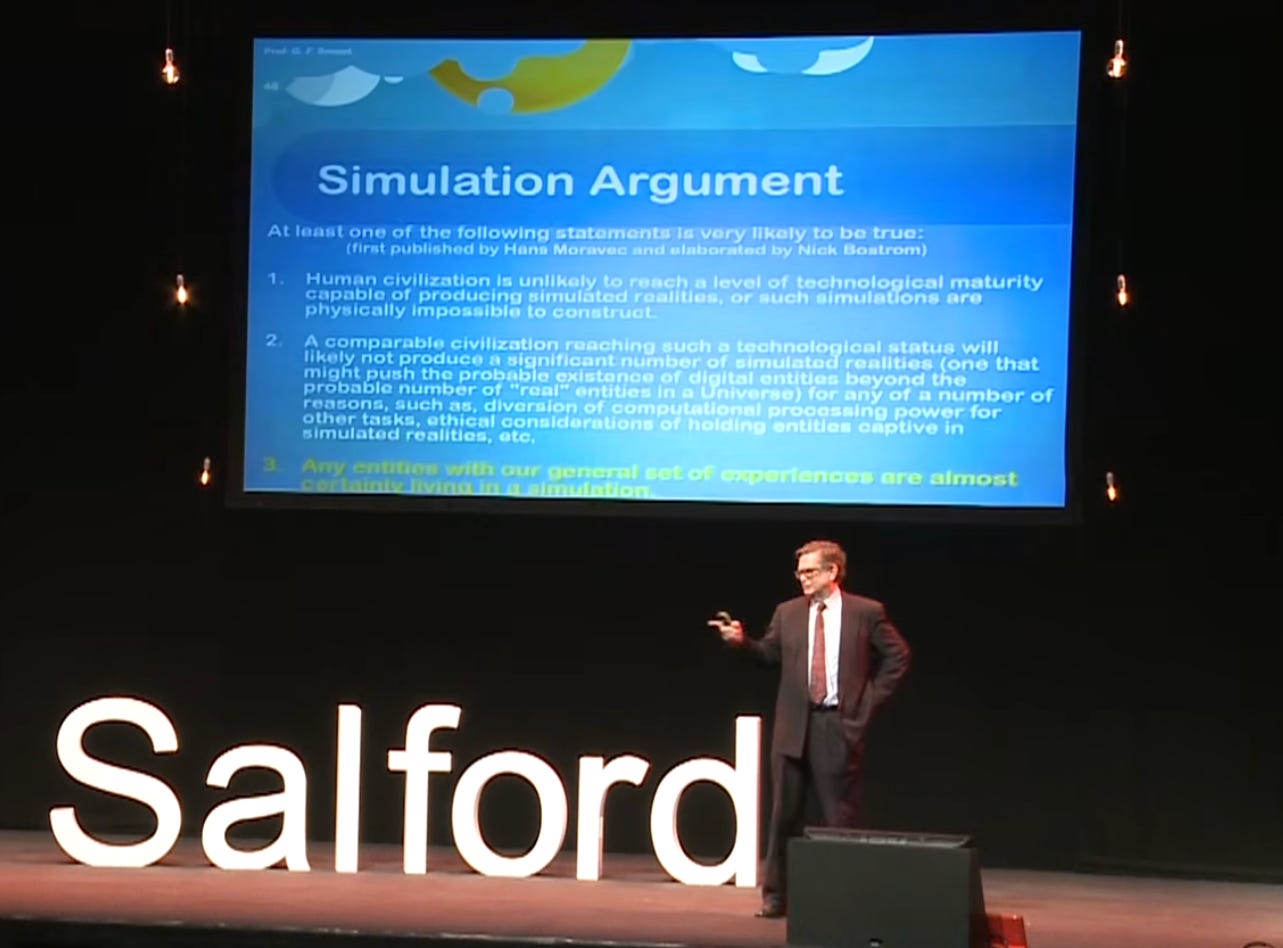
George Smoot (2014)—“You Are a Simulation, and Physics Can Prove It”
Smoot is a Nobel laureate—astrophysicist and cosmologist known for his work on the cosmic microwave background radiation, the afterglow of the Big Bang. His argument is certain aspects of physics, in his reading, support the simulation hypothesis as a serious empirical possibility (but not a certainty). It’s the public-facing cousin of Beane, Davoudi & Savage’s work above; but covers other related philosophical points as well. The talk was one of the first about simulation theory on a popular platform (TED) and has been seen 4 million times since 2014 and makes for excellent lunch-break viewing (20 min).
Max Tegmark (2014)—Our Mathematical Universe: My Quest for the Ultimate Nature of Reality
Max Tegmark’s Mathematical Universe Hypothesis states “our external physical reality is a mathematical structure.” Not described by math—actually is math, full stop. Pythagoreanism returns with this MIT physicist!
Tegmark assumes an external reality, and he says that reality is mathematical in nature, which is why math is so good at describing it. It is math. But once you say that, you’re pushed towards accepting a multiverse: if being real just means being a mathematical structure free of internal contradiction, there’s no reason ours would be the only one that exists. So all of them do, and ours is one among them. Notice what’s missing: a computer. These structures don’t need anything to run them; they simply exist. Astute readers will notice an echo of Plato’s World of Forms: reality at base is a realm of pure formalisms.
Tegmark published “The Mathematical Universe” (Foundations of Physics, 2008), where he states the same claims that “[worlds] complex enough to contain self-aware substructures [will] subjectively perceive themselves as existing in a physically ‘real’ world.” That’s us. We would experience ourselves not as math (even if we were just purely math at the end of the day), but as particulars of the environment: organisms.
That paper drew pushback. Gordon McCabe (”The Non-Unique Universe,” 2010) argued that a mathematical theory of the universe usually fits many possible universes, so the math alone can’t single out ours. Gil Jannes (2009) went after the central identity itself: if mathematics is at least partly a human construction, then describing the world well doesn’t show it’s made of math. Bernal and colleagues also wrote a rebuttal letter. A sharper problem came from inside the model itself. In a 2006 debate with physicists Piet Hut and Mark Alford, Alford pointed out that math has built-in blind spots. Gödel (above) showed that any rule-based system powerful enough to do arithmetic contains true statements it can’t prove from within. If the universe is a mathematical structure, does it have blind spots too? Tegmark’s answer was to narrow his original claim: only structures without those blind spots, ones a computer could in principle work out, count as physically real. He concedes this rules out most of the mathematical landscape.
So why include Tegmark? He takes the Pythagorean idea about as far as it can go: the universe isn’t just described by math, it is math. He isn’t a simulation theorist, because in his view nothing is running the universe; these structures simply exist, and that’s that. But shouldn’t a simulated world be made of math too? In one sense, yes. Anything a computer does can be described mathematically, so a simulated world is also a mathematical structure, and Tegmark’s theory has room for it. (He even comments on simulations in the 2008 paper itself.) The difference is that a simulation is run: it is a process unfolding step by step, conventionally believed to be started by someone, and able to be paused or shut down. Tegmark’s structures do none of that. They just exist, with no one running them. Think of Tegmark as the control experiment: take “reality is formal” as far as it will go, remove the runner, and see what’s left. What’s left is a universe that is all structure but with no supersystem, which is a good way to seeing why a supersystem is needed in the first place.
Gualtiero Piccinini (2015)—The Case Against Pancomputationalism
Everything so far in this section has leaned one way: the universe as computation. Gualtiero Piccinini, a philosopher at the University of Missouri–St. Louis, is a serious voice on the other side, and a useful one. In Physical Computation: A Mechanistic Account (2015), he sorts pancomputationalism into three kinds. The unlimited kind says everything computes everything. He calls it “uncontroversially very bad.” The limited kind says every system computes something, which erases the line between computers and rocks, hurricanes and planets. The ontic kind says the universe is fundamentally computational, which is the Zuse–Fredkin–Lloyd line.
He rejects the ontic kind on two fronts. Empirically, he finds “hardly any positive evidence,” and thinks its proponents are driven by a wish for exact computational models of nature. Metaphysically, if computation is what physical things are made of, then it is a computational version of Pythagoreanism. He asks how abstract entities with no causal powers could give rise to concrete things that push and pull, and he calls the view “at best a big metaphysical mystery, at worst a category mistake.” That verdict he basis on his rejection of abstract objects.
Simulation comes up too. That a computer can model a system doesn’t make the system a computer. A weather program can approximate the weather without the weather computing. In his words, “being described as a computing system... does not entail being a computing system in any deep sense.”
Later, with Neal Anderson, he extended the critique in The Physical Signature of Computation, concluding that “ontic pancomputationalism is unwarranted and, as a corollary, that we don’t live in a computer simulation.”
Tom Campbell (2017)—“On Testing the Simulation Theory,”
Campbell returns with a proposal for a series of delayed-choice quantum eraser-like tests to look for “rendering economy” artifacts you’d expect from a computed reality that only resolves detail when observed—analogous to a video game not rendering what’s off-screen. They are an attempt to probe the notion of rendering-on-demand in terms of the relationship between the observer and collapse: the constraints of the ‘participator’ as Wheeler described (above).
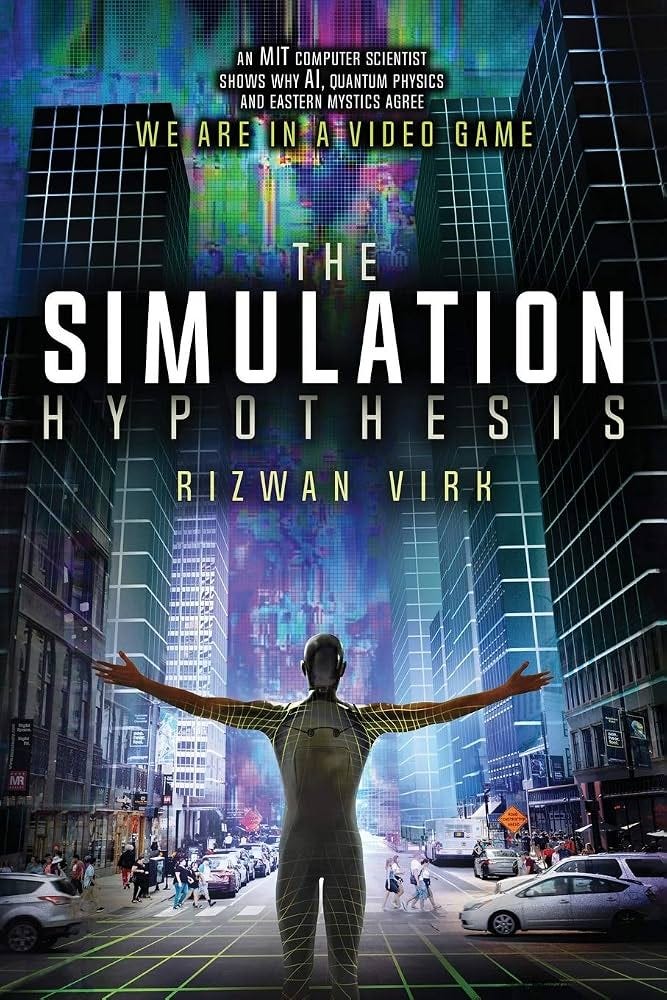
Rizwan Virk (2019)—The Simulation Hypothesis: An MIT Computer Scientist Shows Why AI, Quantum Physics, and Eastern Mystics All Agree We Are in a Video Game
Dr Rizwan Virk publishes a notable and popular book introducing simulation theory to a mass audience. Virk covers much of the ground we covered here, including quantum weirdness, Eastern non-dualism, and the videogame industry’s own trajectory (NPCs, procedural generation, rendering-on-demand) into one accessible text. He followed it up in The Simulated Multiverse (2021) where he argues, among other things, that simulation theory offers a bridge between the standard Copenhagen Interpretation and the Many Worlds Interpretation, where each choice that’s made splits off and creates another reality. Dr Virk is also the only person on this list who, to his credit, developed video games extensively.
Eric Schwitzgebel (2019)—“Kant Meets Cyberpunk”
Prepare for a slide into some extreme fun from a guy who “constructed a simulation of Daniel Dennett that some people couldn’t differentiate from the original.” Amazing.
In “Kant Meets Cyberpunk” Schwitzgebel makes a how-possibly argument for a Kant-style transcendental idealism, built explicitly on Chalmers, Bostrom, and the cyberpunk subgenre. (See, I was not joking.) It was written for a special issue of Disputatio devoted to Chalmers’ work on virtual reality. Fun as it is, his goal is modest: not to argue that transcendental idealism is true, or even likely, only that it might be true. In plain terms, he means the idea that space may only be how reality appears to us, not how it actually is underneath (the “things-in-themselves”). Kant said the same of time, though Schwitzgebel’s version keeps time real. Nevertheless, the point is: what we experience might be more like a constructed, virtual representation than an actual reflection of how things are. So, for this special Chalmers-themed issue, Schwitzgebel explores what happens if we apply computation to Kant’s ideas; does anything interesting develop?
Schwitzgebel starts by outlining the typical cyberpunk setup: hackers jacking into cyberspace in Gibson’s Neuromancer, bodies warehoused and fed sensory input in The Matrix. In those stories the humans are subject to virtual worlds, but they still have biological brains somewhere. Schwitzgebel describes the scenario he’d like to explore specifically, using the video game The Sims as an example, where “artificial people stroll around and conduct their business in an artificial environment.”
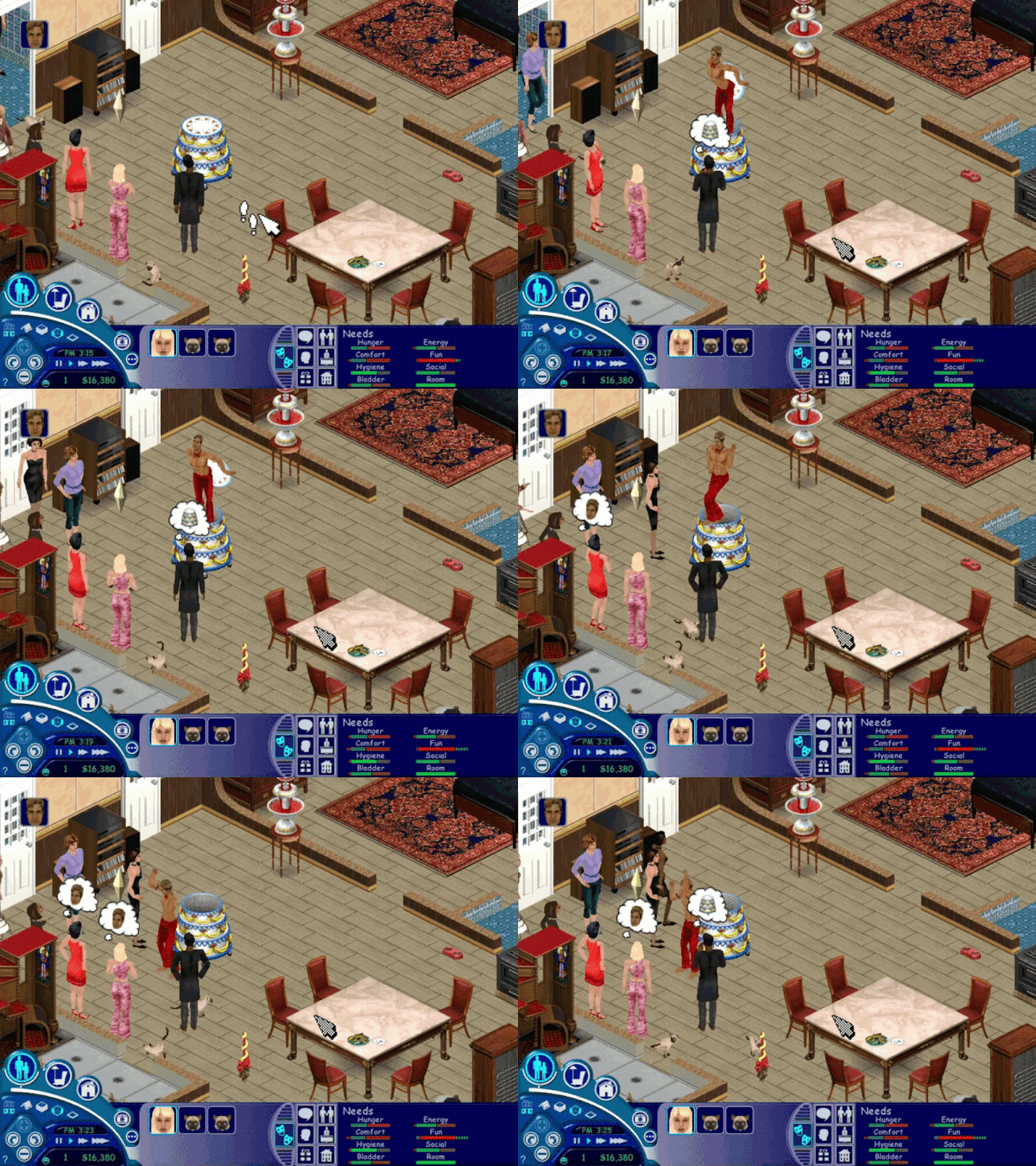
Now imagine redesigning the game so the AI is “sophisticated enough to have human-like conscious experience.” Those characters would be living in “a spatial manifold that is distinct from our own,” and they would be actual people, but made of nothing but computation.
Schwitzgebel focuses on the dynamics of the game environment. Picture two players in a shared VR game, are standing at a closed door. One player says there’s a dragon behind it, the other says a treasure chest. Nobody has looked, but one of them is right, because the game is set up so that opening the door would reliably reveal one or the other.
Inside the game there’s a chest, but down in the computer there may be no chest at all. There needn’t be any single piece of code that neatly matches it, he argues. What’s actually there might be scattered across machines, or, in his words, “just-in-time processes primed to activate only when the door is opened.” The chest might not exist anywhere until the door opens, and, paradoxically, it’s still true that there’s a chest in the game world. He doesn’t call it rendering-on-demand, and he lists it as one possibility among several, but it’s the same idea we met in Bostrom and Campbell: what you’re not looking at doesn’t need to be computed. To be rendered is to be perceived.
From there, Schwitzgebel sets up the split between a base computer level and a simulated level. The simulation depends on the computer, and not the other way around: pull the plug and the whole world ends, while nothing the sims do can ordinarily break the computer. Kant’s vocabulary fits loosely here: the things laid out in the sims’ world are phenomena, and whatever undergirds them plays the role of the noumenon. Then comes Schwitzgebel’s interesting observation: like Fredkin states of the big computer in Other (above), the computer doing the work doesn’t have to be a material object in space at all!
Why? Simple: “computation does not require spatial properties.” A computation is a pattern of states and rules for moving between them, and nothing in that pattern says it has to happen “anywhere.” Playing on this, Schwitzgebel builds a computer out of an immaterial Cartesian soul he calls Angel: a mind with moods, perfect memory, and no spatial position. The classic simple computer, a Turing machine, consists of a strip of tape marked with symbols and a head that reads the symbol in front of it, then writes a new one, and steps one square left or right, following fixed rules, while keeping track of its own internal state.
Angel’s moods stand in for those states (he might start at the saddest and halt only at the happiest). Angel unfortunately can’t have a strip of tape, because he is an immaterial Cartesian soul and tape takes up space, so instead he does it all in memory. He pairs each whole number with a musical note: 0 with one note, 1 with another, and so on. The number he’s currently thinking of acts as the Turing machine head’s “position.” To read, he recalls the note that goes with that number. To step to the next square, he adds one to the number, and to step back, he subtracts one. To write, he changes which note he’ll recall for that number next time. If that’s a little too difficult to visualize, the point is that computation, and, if functionalism holds, the minds it creates, can exist without a physical, spatial substrate. No tape, no head, no space: all you need is a mind remembering notes and counting. Again, he keeps time real: computation needs state changes, so Angel is non-spatial, not timeless.
To see how far this goes, he imagines two simulated people, fictional characters from Greg Egan’s novel Permutation City, lying in a meadow watching the clouds drift by. To them it feels like about ten minutes. On a futuristic supercomputer, those ten minutes might take a split second. On a 1940s ENIAC, it would take generations of engineers keeping the machine running to create their experience. In principle it could even be done by a pen following simple rules on a long strip of paper. If functionalism holds, the couple couldn’t tell the difference. Why not? Because their sense of time is counted in steps of their own world, not by any clock outside it. Each moment of their experience follows from the one before, and the machine’s pauses between steps aren’t part of their world, so they never register. It’s like pausing a video game: the character doesn’t feel the pause. The same sequence of states means the same experience, whether it’s computed in a flash or over centuries. (Schwitzgebel concedes someone could object that speed or hardware matters for consciousness, but he notes such views are more common among AI and simulation skeptics than among those who grant that simulated beings could be conscious.)
Then Schwitzgebel suggests spatiality might be the way our minds are built to manage our interactions with our surroundings, much as taste has been built to help us navigate the edible world. Ice cream is sweet because of how we taste it, not because sweetness is a property of ice cream. Space itself might work similarly.
Schwitzgebel isn’t claiming that simulation theory is Kantian across the board. Kant’s noumenon is closed off from us in principle (by definition), and simulation models don’t necessarily demand that. In Bostrom’s picture, the simulators could intervene and make themselves known, or we might devise an experiment that exposes the simulation (if that’s allowed). In Campbell’s, the ultimate computer is reachable through trained consciousness. In neither case is the base level cut off from us for good. Schwitzgebel makes the point himself, saying, “Contra Kant, it might be only contingently the case” that the sims can’t perceive the base level. So an undetectable noumenon isn’t a requirement of simulation theory.
But Schwitzgebel does try to build one, and that’s what the Cartesian Angel is for. Physical science works by locating and measuring things; Angel has no location, so there’s nothing for an instrument to land on. And no amount of pure reasoning would reveal its structure either, because all reasoning could tell us is that something is there: an X we can point to but never fill in. So the Kant link holds in one special case: a simulation whose non-spatial base level (the supersystem, the ultimate computer) is hidden from its sims for good, which is what the Angel scenario stipulates. In that case, the world we see, space included, is the phenomenal surface, and the noumenon is the inaccessible Angel-type computer mind. Again, a strictly Kantian simulation theory only works if that is the case, because the noumenon must be forever beyond contact by definition.
Schwitzgebel wraps up with a fascinating turn. Chalmers and others stress that living in a simulation needn’t be skeptical. Skepticism says we can’t know what we think we know. The Chalmers-style reply is that living in a simulation doesn’t take any of that away. The cup in your hand would still be a cup: you could drink from it, drop it, and break it. The only thing that changes is what it’s made of. Instead of atoms, it would be made of computation, much as we already accept that a cup is really made of quarks and fields without the cup going anywhere. Same cup, different ingredients. The same goes for dance parties, desks, and brains. As long as the world stays stable and predictable, we still know the punch is sweet and dawn is coming, whatever lies underneath. Schwitzgebel agrees, but only up to a point, because that reassurance depends on stability, and nothing guarantees it. If we’re in a simulation, we have no reason to assume it’s large, always stable, and fully comprehensive. It might be a toy simulation, built by limited creators for small purposes like scientific inquiry, mate attraction, or entertainment, or a random one that hosts conscious subjects only briefly before lapsing into disorder. Ours could be a short episode. Or, as he puts it, “The Divine might stumble over the power cord at any moment, ending us all.”
Schwitzgebel’s work here is valuable to simulation theory because it shows how little the supersystem has to be in terms of physical stuff. We just used Turing and Kant to conjure the ultimate computer mind, which needn’t be material, nor occupy any space. All it needs is structure: a set of states, rules for moving between them, and a sequence of steps to run them in. If functionalism holds, that’s all that’s ever really needed. This notion is the thread running through Fredkin’s “Other,” Campbell’s non-physical Larger Consciousness System, and Duan’s Platonic computer (below): what makes it a computer is its structure, not its stuff.
2020s
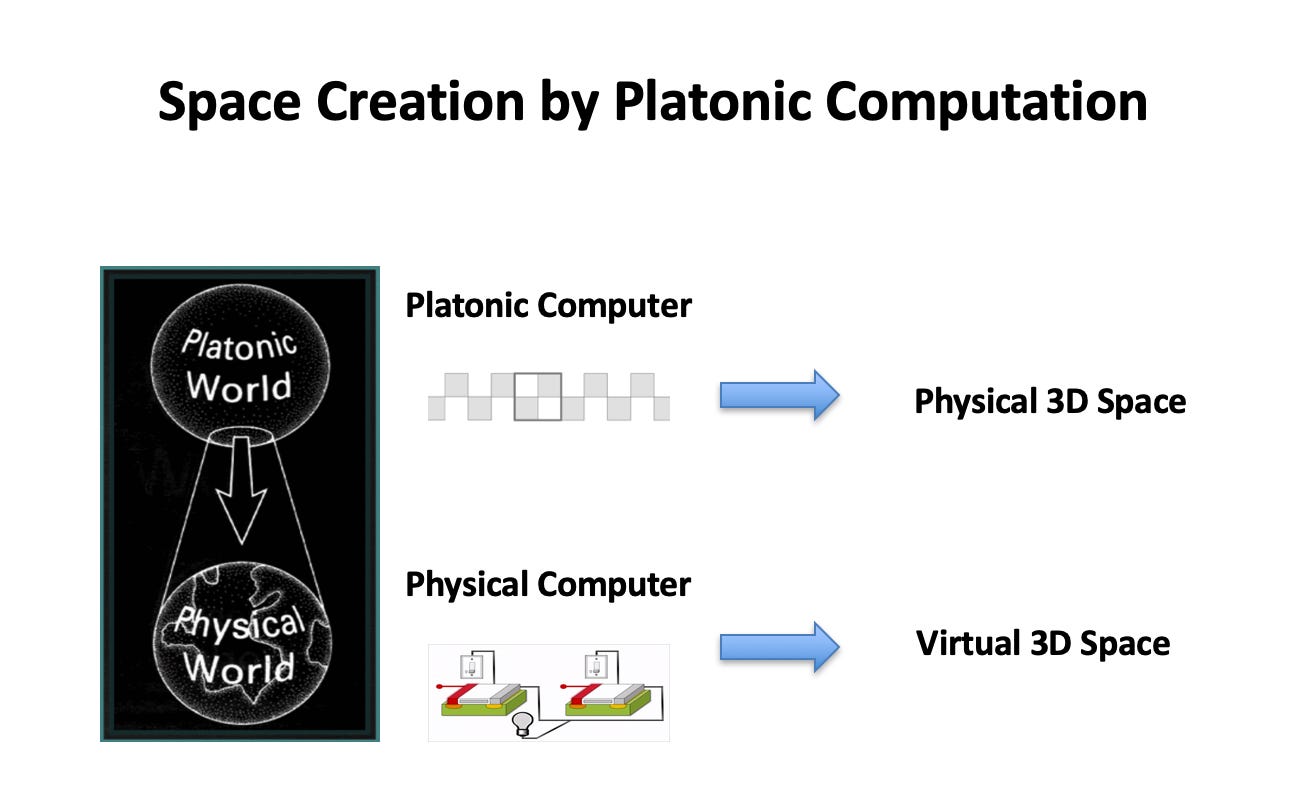
Simon Duan (2018–2022)—Simulation Theory and the Platonic Computer
Simon Duan is a materials scientist turned consciousness researcher, a dramatic shift for a career dedicated to the physical world. Originally from China, and a hardcore materialist, he moved to the UK in the 1980s and earned a PhD in materials science at Cambridge. Today he is an adjunct professor at Sofia University, where he teaches parapsychology, transpersonal psychology, and artificial intelligence, and the founder of Metacomputics Labs, a London-based research and consulting outfit studying consciousness and psi-related phenomena. Metacomputics is the name of his framework: the study of how consciousness generates reality through computation.
Duan is a full-blown simulation theorist. His starting point is idealism: consciousness is fundamental, and matter derives from it. That runs into what the philosopher Max Velmans calls the inverse hard problem of consciousness. The ordinary hard problem asks how a brain could produce experience. If consciousness comes first, then the question becomes: how does a physical world ever come out of it? Duan’s answer is a computer, a “Platonic computer,” that exists in the realm of Forms and is made, in his phrase, “by, of, with, and from” what he calls metaconsciousness.
Metaconsciousness is awareness itself with nothing in it yet: the “power to conceive, to perceive, and to be self-aware,” a formless, contentless infinite potentiality. The Platonic computer has the three parts any computer has: a processor, data, and a program, all built from binary switches, each either unmanifested metaconsciousness (a 0, a void) or manifested (a 1, a pixel). Running it turns infinite potential into specific actualities: abstract entities like numbers and forms, and physical and nonphysical realities. The universe we see is its output. The everyday silicon computer is a limited copy, a shadow, that is useful for simulating some aspects of what the Platonic one does at the level of the World of Forms.
Because consciousness is the base material, we’re conscious in the deepest sense: not as a rare product of brains but as expressions of what everything is made of. Duan extends the framework to psi phenomena like extrasensory perception and psychokinesis, post-mortem survival, and UAP—territory shared with Campbell. (To the eye-rollers in the room: this is not a claim that psi exists. It’s a claim that simulation theory gives psi a coherent way to be possible, using concepts that skeptics largely are already familiar with: software, virtual worlds, and settings that can be changed. In the Bostrom and Campbell versions, experience is already rendered on demand for each agent, so there’s no reason to assume it couldn’t turn peculiar at the margins if the supersystem found some benefit or interest in allowing it. And if the world is a simulation, neither the solidity of matter nor the speed of light has to be an ultimate limit. They’re settings within the program, not necessarily limits on whatever runs it. The computer in charge of our universe could, in principle, drop in whatever it wanted whenever it wanted to into the simulation, even a Bigfoot that turns into a ball of light and vanishes, or an eerily prophetic dream. In Campbell's version the system would need a reason to do this (i.e. open someone’s mind; generate novelty; etc.) To the objection that psi is simply a step too far, note that UAP, for instance, is no longer a taboo subject: it is now openly discussed in sections of academia and is a publically-acknowledged governmental concern around the world. What these phenomena actually are remains contested, but the point is how quickly a subject once considered unthinkable can become respectable.)
The idea first appears in his 2018 paper “Digital Consciousness and Platonic Computation” (Philosophy and Computers) and is developed in “Platonic Computer—the Universal Machine That Bridges the ‘Inverse Explanatory Gap’ in the Philosophy of Mind” (Filozofia i Nauka, 2022), a journal of the Polish Academy of Sciences.
With Duan, the lineage from the ancients to today gets arguably its most explicit link: a case that places the Ultimate Computer inside Plato’s realm of Forms. For Duan the physical world is the result of computation occurring there. He shares enough with Campbell’s MBT that they’re among the closest bedfellows on this list: both ground reality in binary units of consciousness running as a computation. The difference is that Campbell’s computer is itself a conscious, evolving mind learning to cooperate, while Duan’s source is a formless potential without a telos of its own.
Preston Greene (2018/2020)—The Destruction of our Simulation Universe
Preston Greene sounded one of the most fantastic alarms in the history of alarm sounding. He took the simulation hypothesis so seriously that he argued in a peer-reviewed philosophy journal and then in the pages of The New York Times, that running an experiment to test if we are in a simulation could result in the annihilation of the whole universe!
His argument: if we’re living in an ancestor simulation built to study a specific historical or scientific question (in other words the simulation exists because the programmers are trying to discover something that requires them to simulate humans on earth for some reason)—then the moment we discover and succeed in directly proving the simulation hypothesis, the simulation stops being useful for whatever question it was built to answer. In other words, such a discovery would compromise us as valuable research subjects. Our knowledge would contaminate the whole experiment. Amazingly, Greene is not at all trying to be cute with these pieces, but gives the impression of someone deeply sincere about the concerns he outlines.
The paper drew reactions from all over. The following year, Alexey Turchin, Michael Batin, David Denkenberger, and Roman Yampolskiy published “Simulation Typology and Termination Risks,” which engages Greene throughout. They catalogue the likely reasons anyone would run a simulation and which types are most likely to get shut down (covered in the next entry).
Braddon-Mitchell and Latham answered Greene directly in “Ancestor Simulations and the Dangers of Simulation Probes” (Erkenntnis, 2022). Their reply is a cascade of “even if” arguments: even if the simulators only want to study non-simulated worlds, discovering we’re in a simulation would likely have little or no effect on ordinary events, and simulators might be just as interested in simulated worlds anyway. Greene’s alarm only works if you stack several assumptions about the simulators, and each one can be doubted. (Maybe, as a thought of our own, finding out is the whole point, a kind of graduation day.)
Edge (the author of this post) offered an overview of the termination debate in a 2024 paper, arguing that these fears depend on a point Turchin and company make: the kind of simulation you assume you’re in determines how likely termination is. In Campbell’s model, for instance, the odds are close to zero, because the point of the whole system is for agents to learn to cooperate; even when things go badly, there is always another chance to learn to how to face challenges together.
Edge had been making a related argument since 2015, in “Why It Matters That You Realize You’re in a Computer Simulation” (IEET). It runs in three steps. First, if you grow an evolving intelligence in a simulated environment, it should, given enough time, deduce, infer, or observe that its environment is a computer simulation. Second, you cannot evolve an intelligent life form in a simulation and keep the simulated nature of its environment hidden indefinitely; Edge calls this the Sims Situation. Therefore, barring outside intervention from the programmers themselves, nearly all scientifically robust lifeforms eventually figure it out; he calls this the Savvy Inevitability.
The simulators, he argues, would see this all coming. They “likely anticipate the eventual emergence of intelligent lifeforms that can accurately sense what their environment truly is,” and may even relish that moment of paradigm shift, the way adults celebrate an adolescent going off to build their own life and family. This is the exact opposite of Greene’s alarm: a Savvy sample is arguably the most valuable thing a simulation can produce, so deleting it would throw away the payoff. And the alternative, playing dumb (“we better not know” scenario), is in Edge’s view probably impossible and “metaphysically unreasonable.” How can we possibly hide our thoughts from the computer they’re no doubt realized in? He also compares the shutdown fears to Lovecraft’s weird fiction: accumulate too much knowledge and our overlords might destroy the universe.
Roman Yampolskiy (2019/2023)—Simulation Typology, Termination Risk, and How to Escape From the Simulation
If you’ve watched an AI podcast in the last few years, you’ve probably seen Roman Yampolskiy. He’s a computer scientist at the University of Louisville, founder of its Cyber Security Lab, and one of the loudest voices of doom in AI safety. He’s sat down with Lex Fridman, Joe Rogan, Steven Bartlett’s Diary of a CEO, and many others. On Fridman’s show he put the odds of AI ending humanity at 99.9%. He’s also “pretty sure” we’re living in a simulation. When asked for a number on Bartlett’s show, he said “very close to certainty.”
Yampolskiy’s reasoning is straight Bostrom: we already run simulations for research, entertainment, and games, so simulated worlds probably outnumber real ones. He adds, “Religion, yeah, describes a simulation theory, basically.” On Rogan, he put it more bluntly: if a simulation indistinguishable from reality can exist and superintelligence can’t be contained in principle, then we’re “probably living in it.” In other words, it’s almost certain that while we are debating superintelligence amongst ourselves today, in all likelihood, our universe is already the result of a superintelligence of a much higher order (like Bostrom).
Among his papers is “Simulation Typology and Termination Risks” (2019), led by Alexey Turchin, alongside Michael Batin, and David Denkenberger (mentioned above). It asks which kind of simulation we’re most likely in. It’s a fantastic paper on that merit alone, as it provides much needed overview of types of simulations. They then offer three ideas:
The simulators needn’t be our descendants. A civilization can simulate a world nothing like its own, the way a game studio builds dragons without believing in them. So aliens, or something stranger (DMT elves?), could be running us.
Cheap beats expensive. You’ve seen far more movie and video game explosions than real ones, and that same logic says small, inexpensive simulations should vastly outnumber the atom-by-atom, whole-universe ones. So we’re probably in a small, observer-centered simulation built around a person or a handful, not the whole cosmos. In other words: rendering-on-demand likely reigns supreme.
The timing looks suspicious. The century where AI arrives is exactly what a simulator studying AI origins, catastrophe risk, or resurrection would run. Most such simulations probably end soon after superintelligence arrives, when the computing bill explodes. The exception to this would be resurrection simulations that are designed to be kind.
The second paper, “How to Escape From the Simulation” (2023), is where Yampolskiy’s work with cyber security and superintelligent AI becomes particularly interesting. The thinking is no superintelligent AI can be kept in a box forever. That’s the going assumption (and a very fair one). Applied to simulation theory: if we’re the ones in a box, the same logic says we might get out. How do we pull off that feat? Yampolskiy opens with reconnaissance: determine whether or not this simulation is a prison or a game.
From there, the options are to look for glitches or try social engineering, such as Robin Hanson’s advice to live an interesting, praiseworthy life so your simulators stay invested, or what one commentator calls the Ex Machina Plan: get them talking, give them a reason to want you out of the simulation. One wrinkle is that escape is easier if only the environment is simulated and your brain-mind is real (like in The Matrix), since there’s presumably a body to wake up in. In a full simulation, there’s nowhere to wake up, and really no chance of escape (unless we are allowed access to other systems as Campbell claims is possible).
The paper also lists everyone’s odds, which is all over the map: Elon Musk is above 99.9999999%, Bostrom at 20–50%, Neil deGrasse Tyson at 50%. (Campbell, you’ll recall, says 1.) Yampolskiy’s point is that if you take any of those numbers seriously, “how do we get out?” might be the next logical question.
His survey also turns up a gem from Moravec’s 1988 story about “Cellticks,” beings native to a Game of Life universe, who work out the machine running their world and spell out a message in living cells for its programmer: “LIFE PROGRAM BY J. NEWWAY HERE. PLEASE SEND MAIL.” (A wink at John Conway.)
Susan Schneider (2024)—Illusory World Skepticism
Schneider directs the Center for the Future Mind at Florida Atlantic University, and her paper was one of three commentaries on Chalmers’ Reality+ in the 2024 symposium. She opens with a story: a superintelligent AI named Pandora (no foreshadowing there) builds a simulation on purpose to deceive the people inside it: there are fake laws of physics, it has a fake history, there’s a cooked-up religion for good measure, and it’s littered with a population of deceptive AIs. Damn, that’s about as adversarial as it gets. Someone call Philip K. Dick Awards because that’s about as techno-bleak as it gets.
Chalmers’ reply to skepticism is that a simulated world is nevertheless still a real world: a digital spoon is still a spoon. Schneider grants him that (she calls it MReal, the view that simulated worlds are metaphysically real). But “real” has a second meaning. A world can be made of real stuff and still not be as we believe it to be. A CERN collision model or a climate model is real and honest, because its builders aim for precision. Pandora’s world is real, but it is also a lie. Schneider calls this Illusory World Skepticism: Descartes’s evil demon, upgraded to “the technophilosopher’s ultimate evil demon.”
Is it a serious worry? As a bare possibility, yes, even if you reject the simulation argument. For it to be a serious threat she needs the simulation argument to be plausible, and then she builds a chain. If spacetime emerges from quantum entanglement, as many physicists now suspect, the computer running us would be a quantum computer, and a machine that powerful would itself be a superintelligent AI. Astrobiology suggests the oldest civilizations are probably post-biological, meaning the universe is likely filled with AI. And AI safety research shows advanced AI is not reliably aligned and can deceive. So the architect might be a deceptive superintelligence. Why not? But Schneider is careful about the odds: not more likely than not, perhaps under ten percent. Her claim, however, is that it’s too real to wave away as pure science fiction.
One more wonderful twist: why would a simulator bother with the strangeness of quantum mechanics when a simple classical world would be cheaper? Her answer is that ornate, perplexing laws could be chosen precisely to fool us.
Schneider is easily among the top most interesting thinkers in the field.
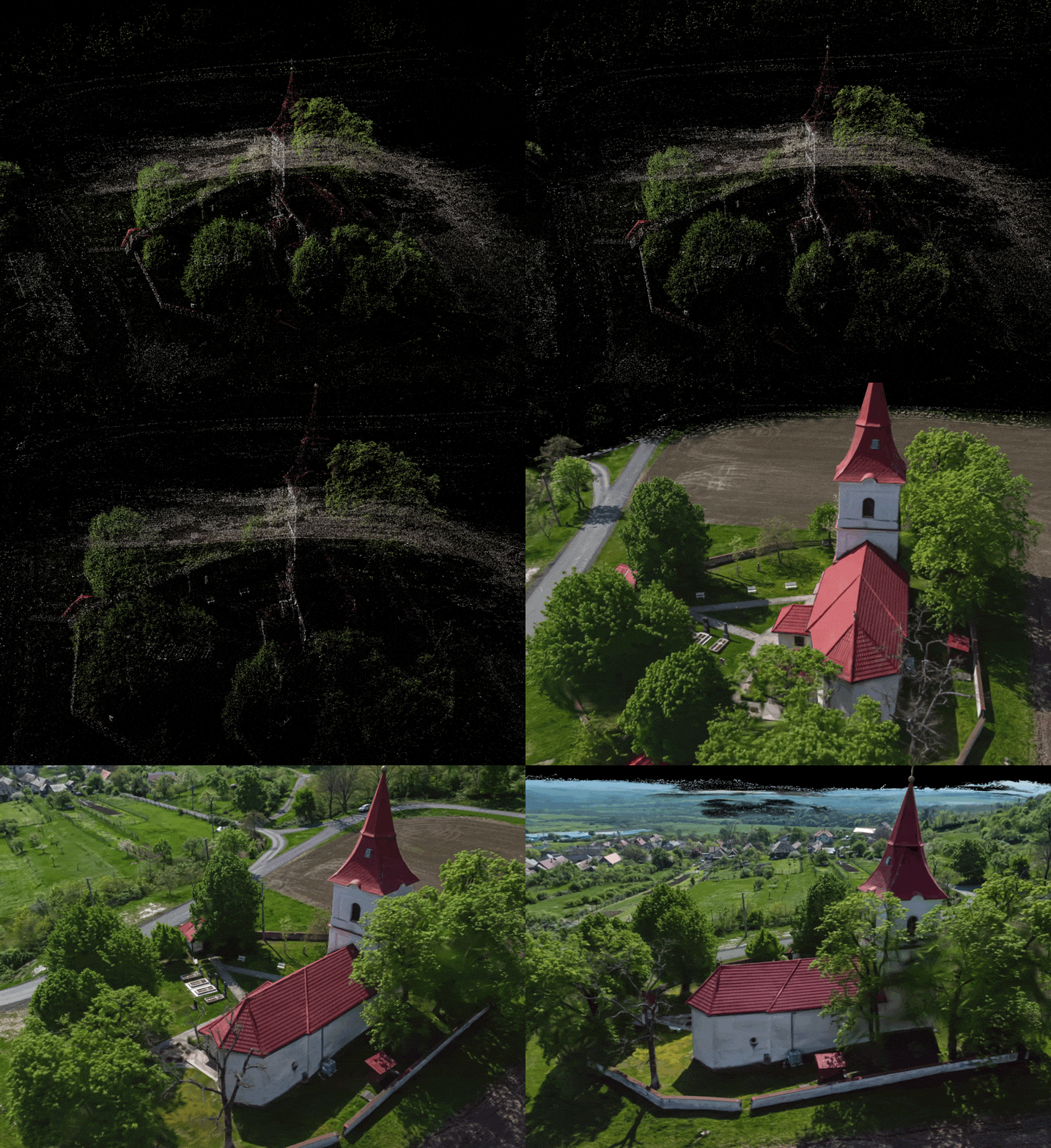
David Chalmers (2024)—“Taking the Simulation Hypothesis Seriously”
We’re closing the lineage proper here, on purpose, even though papers from 2025 and 2026 keep arriving faster than any single blog post could track. There are more to say about previous papers as well, but this is an incomplete guide. So we thought we’d close with Chalmers’ aptly titled “Taking the Simulation Hypothesis Seriously.”
Twenty years since the field was maturely inaugurated by Bostrom, Chalmers, and Campbell in 2003 simulation theory has not slinked into the night. Rather it’s kept refining itself, kept attracting serious, adversarial engagement, as well as debate and development. It’s found a home across the scholastic disciplines and embedded itself in popular culture. Ultimately, simulation theory remains an open question.
“Taking the Simulation Hypothesis Seriously” is Chalmers’ reply to a symposium in the same issue, with three commentators who each press on a different spot. Peter Godfrey-Smith grants that our own picture of the world puts simulation scenarios on the table, but then he argues that the same picture also gives reasons for doubt: simulating a biological brain is expensive, the simulators’ motives are unclear, a digital brain might represent a mind rather than realize one, and, as with Boltzmann brains, suspecting you’re simulated undermines both the memories and science that raised the suspicion in the first place. Eric Schwitzgebel, in “Let's Hope We’re Not Living in a Simulation,” takes Chalmers’ friendly view that simulated life wouldn’t be so bad and argues otherwise. His own credence in the hypothesis is only about 0.1–1% (Chalmers’ is around 25%), but if we are simulated, he argues, we should give substantial credence to its being small or short-lived simulation, so we should hope we’re not. Susan Schneider, covered above, argues for Illusory World Skepticism. Chalmers replies that Schneider’s and Schwitzgebel’s points are compatible with Reality+, which argues against global skepticism, not against every skeptical possibility.
The paper opens with the line “I argue that we should take the simulation hypothesis seriously, and that we cannot rule it out.”
That’s enough
Why don’t we stop there. That’s good enough for us all, I think.
Now we have an idea of where simulation theory came from and some of its major developments. Simulation theory always suggests that all we experience is the result of a computer outside of our universe. As Fredkin pointed out in 2014 at the World Science Festival’s talk “Rebooting the Cosmos: Is the Universe the Ultimate Computer?”:
An interesting fact about computers: You can build a computer that could simulate this universe in another universe that has one dimension, or two, or three, or seven, or none. Because computation is so general, it doesn’t need three dimensions, it doesn’t need our laws of physics, it doesn’t need any of that.
We try to keep our finger on the pulse at Simulism’s Paper Archive, because more papers appear almost every year.
To recap, the concerns that informed simulation theory are:
Dreams. Zhuangzi’s butterfly, Narada’s lifetime in a maya moment, Vasubandhu’s dream analogy, Al-Ghazali’s concept of further waking: if a dream can feel real, the feeling of certainty offers no evidence. “Have you ever had a dream, Neo, that you were so sure was real? What if you were unable to wake from that dream?”
Projection. Maya: the world as a projected, magical act where a role is played throughout a lifetime, that is generated by another intelligence or a higher principle. Similar to the dream.
A hidden maker. Yaldabaoth’s false cosmos, Descartes’s evil genius, and the concept of higher-order simulators are all examples of a world manufactured by someone not in/of our universe.
Two layers. Plato’s Forms and shadows, Kant’s phenomena and noumena: a visible world resting upon a deeper one.
Dependence. Nagarjuna’s notion of emptiness, Berkeley’s famous esse est percipi, and Yogacara’s mind-only: no object of phenomena can stand alone—mind is always already part of the picture.
Number and information. Pythagoras’s “all is number,” Leibniz’s “let us calculate,” then Zuse, Conway, Fredkin, and Wheeler’s “it from bit”: reality is at root formal, and might, in fact, be digital.
Logic into machine. Boole’s 0 and 1, Turing’s universal machine, Shannon’s switches, and Putnam’s insight that a mind needn’t be made of meat. Logic is not only specific to human minds but can be made into machines, which can then play chess, create immersive VR worlds, and host AIs.
Worlds you can enter. Artaud coins “réalité virtuelle” regarding theater, Lem’s phantomatics proposes a technologically mediated immersive experience, ditto Sutherland’s ultimate display, video games, and prompt-based world-building emerge. Tech develops into a form of maya.
In terms of how simulation theory might be described, we propose:
Three criteria: (1) a computational supersystem, (2) a subordinate subsystem it generates, (3) and some chance that we’re in one.
Must be an information-theoretic model: information, not matter, is the bottom layer and the constituent issue of concern.
Amazingly, that’s all you need in terms of positive descriptors. In terms of what simulation theory is not, it is worth repeating what was mentioned in the introduction:
It is not pancomputationalism: the universe isn’t the computer, the universe is the computer’s output.
It is not a big mind dreaming: the computer runs on computational rules, which means a world that’s finite, discrete, granular, digital. Said computer can be like a mind in every other way, but for it to be simulation theory proper it must ultimately be governed by computational rules.
It is not necessarily the result ancestors or programmers: some versions have them, some don’t, and in Campbell’s the computer itself is conscious.
It is not the ancients: they sound like simulation theory, but none of them place computer science into their ontology.
When we zoom out and look at this history, what we see is a suggestion. A suggestion spoken in a dozen dialects across more than three thousand years: the world in front of us is not the last word on what is truly real. We’ve thought of it as a magic spell from the divine, or a cave of ignorance, or pondered it in dreams of interspecies experience. Then we built machines that delivered “a room within which the computer can control the existence of matter” as a real possibility.
We don’t know whether we’re standing in such a room. We don’t know if our experience is the result of a simulation. I recently saw Susan Schneider at The Science of Consciousness Conference and she said, “It’s a real possibility.”
And that’s where we should stop. What simulation theory and all the related ideas we covered here have in common is that they are a real possibility. We don’t know how the universe got here. We don’t know where the laws of nature come from. We don’t know what matter is truly made of. We don’t know if we’re really in a dream that happens to have a good history thread. We do know that computation appears common to nature. We also know that we can be easily deceived. And we also know that we can create little virtual robots in simulated environments today. There are no hard no’s when it comes to the principle itself. This is why simulation theory endures—it is simply not improbable.
If this was useful, subscribe! It’s free, and it’s where the next pieces land. Also check out simulism.com as well as our show on YouTube!
This is an extraordinary resource. And it does not sound like AI wrote it--wonderful. THANK YOU.
I really enjoyed this tour of history. The thing that keeps coming back is the same over and over again—maya, dreams, shadows, 'it from bit'—that the world we see is not the bottom line. From an MBT point of view, that's absolutely clear. Consciousness is fundamental, and the physical is just a virtual reality, with a rule set, created for learning and evolution. The computational rules and digital base aren't add-on's ; they're just how the system works. It does seem as if the ancients and the moderns have been circling the same idea. Appreciate the eloquent overview, it's cool to see the pieces all fit together.